
The 2026 Office Move: Why Triangle Businesses Are Relocating Right Now
The conversation around office space has shifted dramatically. For years, headlines were dominated by return-to-office mandates and the question of whether the office was dead. As we move through 2026, the dust has settled, and a clearer, more strategic picture has emerged. Businesses in the Triangle—from Raleigh and Cary to Durham and Chapel Hill—aren’t just moving; they’re upgrading. They are executing intentional relocations designed to attract talent, optimize operations, and secure a competitive edge.
This guide cuts through the noise. We’ll look at the hard data driving the 2026 commercial moving market, what it means for your business, and how to execute a flawless relocation.
The “Great Compliance”: How RTO is Driving Commercial Moving Demand
The debate over remote work has evolved into a structured reality. In early 2025, a significant portion of the workforce threatened to quit over return-to-office mandates. By 2026, the landscape has flipped. A national survey found that only 7% of workers say they’d quit over an RTO policy today, a phenomenon researchers are calling “The Great Compliance” .
However, this doesn’t mean a full return to the pre-2019 office. Gallup data shows that 52% of remote-capable employees are in hybrid arrangements, while only about 21-25% are fully on-site . For Triangle businesses, this hybrid reality is the primary driver of commercial moves. Companies are no longer forcing employees back to old, uninspiring desks. Instead, they are relocating to spaces designed to make the commute worthwhile—spaces built for collaboration, focus, and flexibility.
Beyond Downsizing: The "Flight to Quality" in Raleigh, Cary, and Durham
If 2025 was about “rightsizing,” 2026 is about “upsizing” the quality of space. Commercial real estate analysts call it a “flight to quality,” and in the Triangle, it’s in full effect. According to Cushman & Wakefield’s 2026 US Outlook, demand for high-quality Class A and prime office space is tightening fast, while older, secondary buildings continue to struggle . Construction of new office space is at its lowest rate since 2013, meaning the best spaces are becoming a scarce commodity.
CBRE projects that leasing activity will surpass 2019 levels in 2026, driven largely by large tenants returning to the market to secure this prime space before it’s gone . This is the trend we are seeing firsthand: businesses in Raleigh moving from dated suburban office parks to vibrant new hubs in North Hills or Downtown; Cary companies consolidating two floors of underutilized space into one efficient, high-end layout; Durham firms leaving generic buildings for creative spaces in the American Tobacco Campus that reflect their brand culture. The goal isn’t just to have an office; it’s to have a strategic asset.
The AI Footprint: How Technology is Reshaping Office Space Needs
A less obvious but powerful trend influencing office moves in 2026 is artificial intelligence. As AI tools automate routine administrative tasks, the composition of the workforce is changing. Markets Group estimates that AI-driven labor adjustments have eliminated between 50,000 and potentially millions of white-collar positions over the past 18 months . This doesn’t mean companies are shrinking, but it does mean they are reallocating talent.
Fewer entry-level administrative roles mean fewer rows of cubicles. Instead, the demand is growing for collaborative, creative, and technology-enabled spaces where human judgment and complex problem-solving—skills AI can’t replicate—take place. Companies are moving to create “AI footprints”: spaces optimized for the high-value work that requires people to be together, while reducing square footage dedicated to solitary, heads-down tasks that can be done remotely. This recalibration is a major factor in the 2026 move towards higher-quality, better-designed office environments.
A Tale of Three Tiers: Which Offices Are Moving and Why
The 2026 moving market isn’t uniform. Your reason for relocating often depends on your company’s size and industry.
Large Corporations (Fortune 500): These firms are driving the five-day mandates and leading the charge into premium Class A space. They are making long-term bets on their headquarters and primary hubs, demanding the best locations to signal stability and attract top-tier talent .
Mid-Sized Companies: This group is navigating the most interesting path. They face the push and pull between employee expectations for flexibility and leadership’s desire for collaboration, often with fewer resources than enterprise counterparts. Their moves are typically strategic consolidations, aiming to balance collaborative space with flexible, bookable workspaces .
Small Businesses & Startups: With 67% of companies under 500 employees remaining fully flexible on remote work , their moves are often driven by growth or the need for a magnetic culture hub . A smaller, well-located, and beautifully designed space can be a powerful tool for recruiting and retaining a tight-knit team.
Strategic Planning for Your 2026 Office Relocation
A commercial move is a complex operation, but with the right data and partner, it can be a seamless transition.
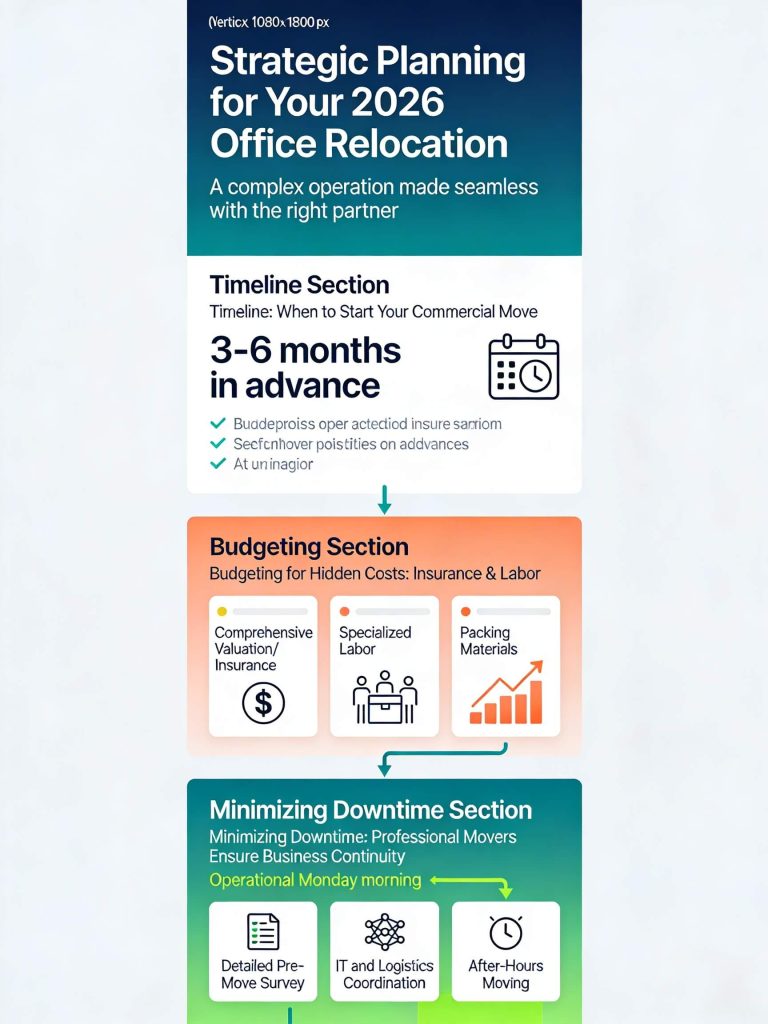
Timeline: When to Start Your Commercial Move
The window for securing premium space is narrowing. With prime inventory tightening, businesses need to act decisively. CBRE’s outlook explicitly warns of growing scarcity of prime space by year-end . For a standard office move, we recommend beginning the planning process at least 3-6 months in advance. This allows time for site selection, lease negotiation, design and construction of the new space, and scheduling the physical move during off-peak hours to minimize business disruption. For larger, more complex relocations, a longer lead time is essential.Budgeting for Hidden Costs: Insurance & Labor
The biggest challenge facing the moving industry in 2026 is rising costs, particularly for labor, vehicles, and especially insurance . When budgeting for your move, don’t just look at the square footage. Factor in:Comprehensive Valuation/Insurance: Ensure your high-value commercial items—servers, specialized equipment, executive furniture—are fully protected.
Specialized Labor: Moving IT infrastructure or decommissioning a old office requires skilled labor beyond standard packing and loading.
Packing Materials: High-quality materials for electronics and fragile items are a non-negotiable cost for a damage-free move.
Minimizing Downtime: How Professional Movers Ensure Business Continuity
A professional commercial move is an exercise in project management. The goal is to be operational in your new space by Monday morning. This requires:Detailed Pre-Move Survey: A walk-through to catalog every item and identify any challenges (e.g., disassembling modular furniture, moving bulky items through tight spaces).
IT and Logistics Coordination: Working with your IT team to properly disconnect, pack, transport, and reconnect servers and computers.
After-Hours Moving: Scheduling the heavy lifting for evenings or weekends to ensure zero impact on your business day.
Why Ken's Pack & Move is the Triangle's Partner for Complex Commercial Moves
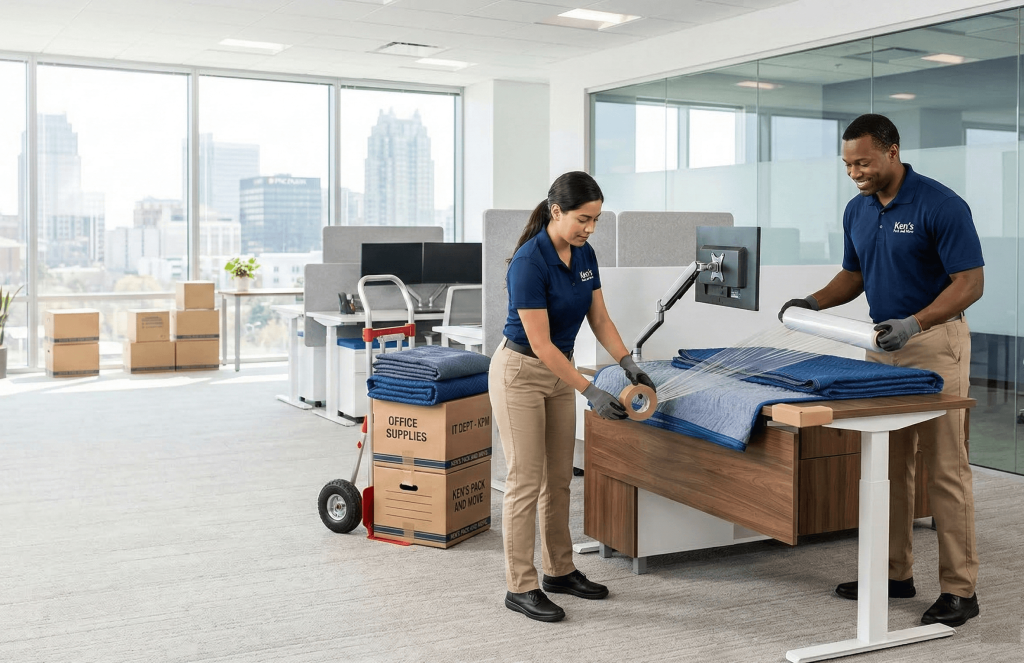
Triangle businesses trust Ken’s Pack & Move because we treat a commercial relocation with the precision it demands. We understand that you’re not just moving boxes; you’re moving your company’s operations. We bring the same dependability and punctuality we’re known for in residential moves to every commercial project, confirmed with real-time updates 24 hours prior. Our teams execute detailed protocols, from carefully shrink-wrapping and padding modular furniture to expertly handling sensitive electronics. We arrive equipped with the right manpower, dollies, and moving blankets to get the job done quickly and carefully, so you can focus on your business, not the move. As one of the leading local movers in the Triangle, we know the nuances of navigating office complexes, loading docks, and city centers from Raleigh to Durham.
Do you offer weekend or after-hours commercial moving services?
Yes. We understand that business doesn’t stop during the week. We offer flexible scheduling, including evenings and weekends, to ensure your move has zero impact on your daily operations.
How far in advance should we book movers for a corporate relocation?
We recommend booking at least 4-6 weeks in advance, though larger, more complex moves may require more lead time. This ensures we can reserve the right size crew and equipment for your specific window.
Do you provide decommissioning services for old office equipment?
Yes. We can help with the responsible decommissioning and disposal of outdated furniture, electronics, and other office assets as part of your move. The need for expert decommissioning services continues to grow as businesses digitize
Can you move sensitive IT equipment and servers?
Absolutely. We have specialized protocols and packing materials for moving sensitive technology. We can coordinate with your IT team to ensure a secure and seamless transition.
What insurance coverage do you provide for high-value commercial items?
We offer comprehensive valuation options. Please contact us to discuss the specific value of your commercial goods so we can recommend the appropriate coverage for a damage-free move.
Sources:
JK Moving Services. (2026). Office moving and relocation: A look into 2026 trends .
Business Wire. (2026). JK Moving Provides 2026 Outlook for Commercial and Residential Moving, Citing Rising Costs and AI as Factors that will Impact Industry .
JK Moving Services. (2026). 2026 moving industry outlook: Rising costs, AI, and shifting demand .