

Moving With Kids: A Parent's Checklist for a Safer, Easier Move
From explaining the move and packing children's rooms to keeping little ones safe on moving day, here's a practical plan for helping your family feel prepared before, during, and after relocation.
By Ken's Pack & Move | Family Moving Tips
Quick Answer: How Do You Make Moving With Kids Easier?
Moving with kids is easier when parents communicate early, maintain familiar routines, involve children in age-appropriate decisions, prepare a separate essentials bag, and arrange safe supervision on moving day. Pack children's everyday belongings late, unpack their sleeping space early, and give them time to adjust emotionally.
For families relocating around Raleigh, Cary, Durham, or nearby Triangle communities, planning school transitions and travel logistics before moving day can prevent additional stress.
Most important: Your moving checklist should account for two separate priorities: transporting household belongings efficiently and helping children feel safe, informed, and supported.
Moving to a new home can be exciting for adults, but children may experience the same transition very differently. A parent might see a better neighborhood, shorter commute, or more living space. A child might see an unfamiliar bedroom, a different school, and the possibility of leaving friends behind.
That doesn't mean moving has to become an overwhelming experience. With the right preparation, parents can reduce avoidable disruptions, create opportunities for children to participate, and make moving day more manageable for everyone.
This guide covers more than packing boxes. It explains how to prepare babies, toddlers, school-age children, and teenagers; how to organize a family moving timeline; what belongs in a first-night bag; how to handle practical safety concerns; and how to settle into a new home throughout North Carolina's Triangle region.
Why Can Moving Be Stressful for Children?
Moving can be stressful for children because it changes familiar surroundings, daily routines, relationships, and expectations. Children often have less control over the decision to move than adults, making uncertainty an important part of their experience.
A child's response depends on age, temperament, previous experiences, family circumstances, and the size of the transition. Moving a few streets away may feel very different from relocating across North Carolina or into another state.
Loss of Familiarity
Children may miss their bedroom, favorite neighborhood places, playgrounds, pets they used to visit, or comforting daily patterns.
Social Changes
Switching schools, losing frequent contact with nearby friends, and joining unfamiliar activities can create uncertainty.
Reduced Control
Children rarely choose the moving date, destination, or major household decisions, so small choices can become especially meaningful.
Common reactions can include excitement, sadness, frustration, repeated questions, temporary clinginess, or worry about the new home. These reactions are not universal, and they do not automatically indicate a serious problem.
The Child Mind Institute's guidance on moving with children emphasizes giving children appropriate opportunities for control, discussing anticipated challenges, and preserving familiar routines.
How Should You Prepare Kids for Moving at Different Ages?
Children need different levels of explanation, participation, and reassurance depending on their development. A toddler may need concrete demonstrations of what moving means, while a teenager may be most concerned about friends, school activities, and personal independence.
| Age Group | Primary Concern | Helpful Parent Strategy |
|---|---|---|
| Babies | Disrupted feeding, sleeping, and caregiving routines | Maintain familiar care patterns and prepare a complete baby essentials kit. |
| Toddlers (1–3) | Unfamiliar changes and separation from favorite objects | Use simple explanations, visual demonstrations, and comfort items. |
| Preschoolers (3–5) | Confusion about what will change or stay the same | Read moving-themed books, play pretend moving games, and show pictures. |
| School-age kids (6–12) | Friends, school, activities, and belonging | Discuss the new school, plan goodbyes, and involve them in room planning. |
| Teenagers (13–17) | Social connections, independence, and disrupted plans | Share accurate information, listen seriously, and offer meaningful choices. |
Moving With a Baby
For families with infants, the biggest challenge is usually maintaining care routines while the adults handle logistics. Prepare feeding supplies, diapers, wipes, extra clothing, medications, and appropriate sleep equipment separately from household boxes.
If possible, have a trusted adult supervise the baby away from the busiest loading area. Once you arrive, prioritize a safe sleep environment and essential caregiving supplies before arranging decorative furniture.
Follow current infant safe-sleep recommendations. A moving-day nap is not a reason to substitute an unsuitable sleeping surface for an approved sleep space.
Moving With Toddlers and Preschoolers
Young children learn best through concrete, repeated explanations. Instead of saying, "We're relocating next month," say, "Our clothes, toys, and beds will go to a different house where we will live together."
Show photos of the new home when available. Let children choose the stickers for their boxes, place a favorite stuffed animal in their travel bag, and help with lightweight, safe items.
Avoid introducing several unrelated major transitions at once when reasonably possible. Starting toilet training, changing childcare, and moving into a new home during the same short period may make an already busy transition harder.
Moving With Elementary-Age Children
Children in elementary school may ask practical questions: Where will I go to school? Can my friends visit? Will I still play soccer? Will my bedroom look the same?
Answer what you know, distinguish confirmed plans from possibilities, and create opportunities for your child to help with packing, labeling, and choosing their room arrangement.
Moving With Teenagers
Teenagers may experience a move as a loss of independence, identity, friendships, or important school opportunities. Avoid minimizing those concerns simply because the relocation makes sense for the household.
Give teenagers advance notice when possible, include them in conversations about scheduling, explore appropriate extracurricular options, and support continued contact with existing friends.
Offer meaningful choices, such as room organization or which personal belongings should travel in the family vehicle, while being clear about decisions that cannot change.
Moving With Kids Checklist: What Should Parents Do and When?
A family moving timeline separates major decisions into manageable stages. The following eight-week schedule is a planning framework, not a requirement. Families with less notice can combine steps and prioritize immediate safety, essential supplies, school arrangements, and transportation.
Eight to Six Weeks Before Moving
- Explain the move using age-appropriate language.
- Discuss what will change and what will remain familiar.
- Research schools, childcare, and neighborhood services.
- Begin comparing moving options and requesting quotes.
- Create a family calendar with key deadlines.
- Start sorting outgrown clothing and unused toys.
- Identify any accessibility or additional support needs.
Five to Three Weeks Before Moving
- Confirm the moving date and service arrangements.
- Contact the current and prospective schools.
- Request necessary educational or health records.
- Plan child supervision for moving day.
- Begin packing nonessential household items.
- Help children prepare for goodbyes.
- Photograph sentimental spaces when appropriate.
Two Weeks to One Week Before Moving
- Prepare an essentials bag for each child.
- Pack rarely used toys, games, and books.
- Confirm child-care arrangements and travel plans.
- Check prescriptions and routine medical supplies.
- Review the new property's access and safety needs.
- Schedule utility transfers or service activation.
- Explain the moving-day schedule to children.
Moving Day and First Night
- Keep children away from loading routes and tools.
- Carry important documents and medications personally.
- Maintain snacks, hydration, and rest opportunities.
- Confirm safe transport and child restraints.
- Inspect the new home for immediate hazards.
- Set up safe sleeping arrangements.
- Make time for a familiar family activity.
For additional advice about organizing furniture, boxes, and belongings, explore the Ken's Pack & Move moving tips library. Your family plan should complement your household inventory rather than replace it.
How Do You Pack a Child's Room Without Creating Extra Stress?
The simplest approach is to pack children's belongings in stages, preserve access to their most-used comfort items, and make it easy to identify what must be unpacked first.
Start With Items Children Rarely Use
Pack seasonal clothing, extra bedding, decorative items, collectibles, and infrequently used toys first. These are less likely to interrupt ordinary routines.
As moving day approaches, pack books and games that are not daily favorites. Leave practical clothing, toiletries, essential school supplies, and important comfort objects readily available.
Let Children Help With Safe Packing Tasks
Appropriate jobs may include sorting soft toys, placing books in a small box, choosing box-label colors, or checking whether items belong in a keep, donate, or recycle category.
Adults should handle sharp tools, breakable objects, heavy boxes, furniture, and packing materials that present age-related hazards.
Use Clear, Consistent Labels
Every child's box should include the destination room, a short contents description, and an unpacking priority.
Example Children's Room Box Labels
- BEDROOM – FIRST NIGHT: Pajamas, bedding, nightlight, bedtime books.
- BEDROOM – SCHOOL: School supplies, backpack accessories, homework materials.
- BEDROOM – TOYS: Building blocks, dolls, puzzles, age-appropriate games.
- BEDROOM – CLOTHING: Everyday clothing and seasonal items.
- BEDROOM – DECOR: Wall decorations, photo frames, nonessential accessories.
What Should Never Go Into an Inaccessible Moving Box?
Keep prescription medications, important documents, necessary feeding supplies, emergency contacts, critical medical equipment, and essential comfort items with the responsible adult.
Young children may also need a familiar blanket or stuffed animal throughout the move. Check that any comfort item is appropriate for the child's age and safe to use in the intended setting.
How Can You Keep Children Safe on Moving Day?
Moving day introduces temporary hazards such as open doors, moving trucks, stacked boxes, unsecured furniture, packing tools, and adults carrying heavy loads. Children should have a clear supervision plan that operates separately from the moving crew's work.
1. Arrange Dedicated Child Supervision
When possible, have a trusted caregiver supervise young children at another safe location during loading and unloading. This may be a relative's home, a familiar childcare arrangement, or another appropriate environment.
If children must remain at the property, designate a responsible adult who is not simultaneously carrying furniture or managing the truck. Establish an appropriate supervised area away from the movers' path.
2. Control Access to Trucks and Loading Routes
Do not allow children to play on vehicle ramps, inside moving trucks, beneath furniture being moved, or near unsecured stacks of belongings. Keep walkways clear of toys, cords, and loose packing supplies.
3. Keep Tools and Potentially Hazardous Materials Secure
Utility knives, scissors, cleaning chemicals, batteries, cords, small hardware, and plastic packing materials should be kept inaccessible to young children.
4. Use Proper Vehicle Safety Restraints
Children should travel in appropriate passenger vehicles using age- and size-appropriate restraints in accordance with applicable law and manufacturer instructions. Never allow children to ride in a moving truck's cargo compartment.
5. Childproof the New Home Before Free Play
Inspect stairways, windows, exterior doors, exposed outlets, cleaning products, accessible tools, and furniture that could tip. Secure heavy furniture and televisions where necessary, and check smoke and carbon monoxide alarm arrangements as applicable.
6. Create a Family Reunification Plan
For school-age children, review who they should contact if separated from their caregiver and where the family should meet. Adults should carry emergency contact information, especially when family members travel in separate vehicles.
What Should Be in a Moving-Day Essentials Bag for Kids?
A moving-day essentials bag contains the items a child will need during travel, on moving day, and through the first night or two before the household is fully unpacked. Keep it with your family rather than inside an inaccessible moving box.
| Category | What to Pack | Why It Matters |
|---|---|---|
| Clothing | Changes of clothes, pajamas, underwear, socks, weather-appropriate layers | Prevents urgent searches through packed clothing |
| Personal care | Toothbrush, toothpaste, wipes, diapers when needed, hygiene products | Supports familiar bedtime and morning routines |
| Food and hydration | Water, age-appropriate snacks, feeding supplies, necessary dietary items | Helps families manage long travel or unloading periods |
| Health essentials | Medications, required medical supplies, emergency contacts | Keeps time-sensitive needs accessible |
| Comfort | Favorite age-appropriate toy, books, familiar bedding as appropriate | Provides continuity in unfamiliar surroundings |
| Entertainment | Coloring materials, puzzles, downloaded content, headphones for older kids | Offers safe activities during downtime |
| School items | Backpack, enrollment information, required documents | Reduces disruption if classes begin soon |
| Sleep | Safe sleep equipment, nightlight, appropriate bedtime items | Helps establish a usable sleeping area immediately |
For long-distance moves, account for travel delays and prepare additional supplies. For infants or children with medical needs, the contents and quantities should reflect their individual care plans.
Should Each Child Have Their Own Bag?
Separate bags can make organization easier, especially for families with children of different ages. Parents can carry the youngest children's supplies, while older children may manage selected personal items.
Important medications, identification, and safety-critical belongings should remain under appropriate adult control.
Moving With Kids Infographic: Your Family Moving Checklist
Use this illustrated checklist as a quick planning reference while preparing your household. It works best alongside the detailed timeline, child-safety precautions, and first-night checklist explained above.
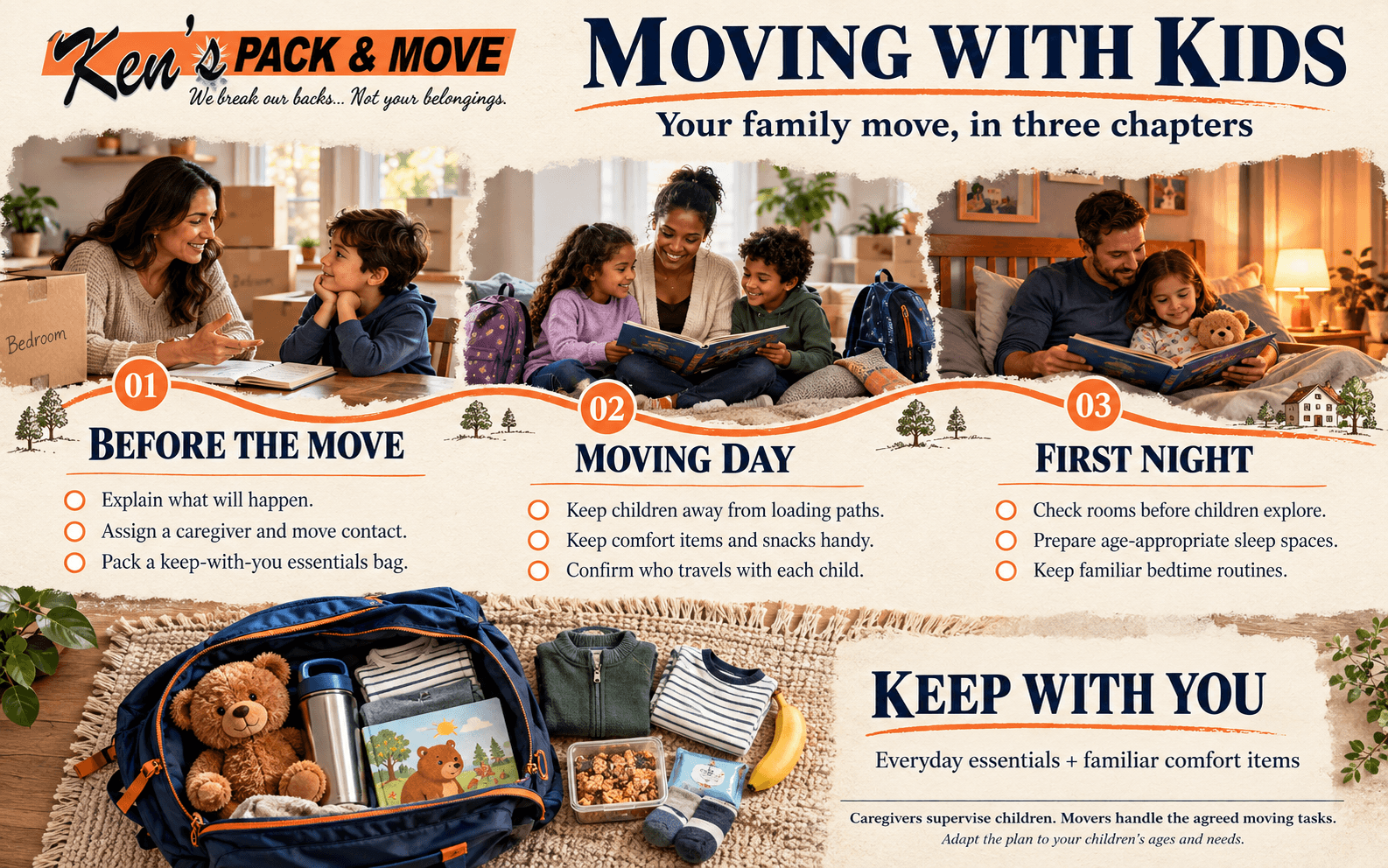
Share the checklist with caregivers or relatives who will help on moving day. Make sure everyone understands the same schedule, supervision arrangements, and priority belongings.
How Do You Prepare Children for a New School or Neighborhood?
School changes can be among the most important parts of a family relocation, particularly for children who are closely connected to teachers, classmates, sports teams, and established friendships.
Contact Schools Before the Move
Confirm the appropriate district or school assignment for the new address, registration requirements, enrollment timing, transportation options, and any records needed for the transfer.
Do not assume that two homes within the same city are assigned to the same school. District and attendance boundaries may change, and policies differ among school systems.
Prepare Academic and Support Records
Ask the current school how educational records will be transferred. When relevant, discuss special education services, accessibility needs, language support, medication administration, and ongoing learning accommodations with the receiving school.
Parents should follow school procedures for safely sharing sensitive records.
Explore the Neighborhood Together
If you can visit before moving, show children the route to school, local parks, libraries, and nearby everyday destinations. If a visit is impractical, photographs, maps, and conversations about specific places can provide useful context.
Make Room for Goodbyes
Children may benefit from exchanging contact details with friends, taking photographs of favorite places, attending a farewell activity, or preparing a memory collection.
Don't force an elaborate goodbye event on a child who would prefer a quieter experience. Let their preferences guide the approach where possible.
Plan Ways to Build New Connections
Once settled, consider school clubs, sports, community events, library activities, or other age-appropriate groups. Avoid overloading the family's first weeks with activities; children may need time for rest and adjustment.
How Can Parents Help Children Adjust to a New Home?
Helping children adjust after moving involves rebuilding predictability while allowing room for unfamiliar experiences and mixed emotions. A child may enjoy the new bedroom while still missing an old friend or neighborhood.
Set Up Their Sleeping Space Early
Prioritize a clean, safe, usable bedroom or sleep area. Familiar bedding, age-appropriate comfort items, and recognizable arrangements can make the first nights feel less unfamiliar.
Keep safety ahead of appearance: secure furniture, check window hazards, and confirm that sleep spaces are suitable for the child's age.
Rebuild Familiar Routines
Try to preserve normal meals, bedtime rituals, family reading time, and other practical routines, even when the household is not fully unpacked.
The Centers for Disease Control and Prevention explains that consistent, predictable routines can help young children understand expectations and feel secure.
CDC child development guidance also identifies predictable caregiving, warmth, and supportive family interactions as important parenting practices.
Invite Honest Conversations
Ask open-ended questions such as, "What's been the hardest part of the new house?" or "Is there something you'd like us to do together this weekend?"
Some children are ready to talk immediately. Others communicate through play, behavior, writing, or quiet one-on-one moments.
Stay Connected to Old Friends
For children who have moved away from friends, parent-supervised calls, letters, or planned visits when practical can help maintain those relationships.
At the same time, encourage opportunities for new friendships without suggesting that old ones must be replaced.
Watch for Persistent Difficulties
Temporary upset can occur during major changes, but ongoing sleep disruption, pronounced withdrawal, persistent school difficulties, or distress that significantly affects daily functioning warrants closer attention.
If you're concerned, talk with your child's pediatrician or an appropriately qualified mental health professional. Moving advice is not a substitute for individualized clinical assessment.
A Simple First-Week Family Routine
- Day 1: Establish safe sleeping arrangements, meals, and essential supplies.
- Days 2–3: Organize children's everyday belongings and explore the immediate home environment.
- Days 3–5: Confirm school or childcare arrangements and introduce familiar activities.
- Days 5–7: Visit an appropriate neighborhood destination and check in about each child's feelings.
This is an example, not a required adjustment schedule. Prioritize your child's needs and the family's circumstances.
What Should Families Know About Moving With Kids in Raleigh, Cary, and the Triangle?
Families relocating within the Raleigh-Durham-Chapel Hill region should account for practical differences in commuting patterns, school assignments, neighborhood access, and moving-day logistics.
Ken's Pack & Move serves communities across the Triangle, including Raleigh, Cary, Durham, Apex, Morrisville, Garner, Holly Springs, Knightdale, Wake Forest, and Chapel Hill.
Raleigh Family Moves
Verify school assignments and plan around workday traffic, apartment access, parking, and local moving restrictions where applicable.
Cary and Apex Moves
For moves involving houses, townhomes, or apartment communities, check HOA rules, loading access, and family transportation arrangements ahead of time.
Durham and Chapel Hill Moves
Families relocating for employment, education, or other reasons should verify school and childcare transitions before finalizing their moving timeline.
Long-Distance Family Moves
Plan overnight stops, child restraints, medication access, meals, and travel breaks. Keep critical items with the family throughout transport.
Should Families Move During the School Year or Summer?
There is no universally best time to relocate with children. A summer move may provide more time before the next school term, but it can also mean changing established vacation or childcare arrangements.
A school-year move may be necessary for employment, housing, or family circumstances.
Consider academic calendars, extracurricular commitments, household availability, weather, and moving-service scheduling. When the date is outside your control, concentrate on giving children accurate information and helping them prepare.
What About North Carolina Weather?
Triangle-area moves can involve hot, humid conditions, thunderstorms, or other weather disruptions. Prepare water, appropriate clothing, a sheltered waiting place, and a contingency plan for child supervision.
Keep children away from wet loading surfaces, slippery entryways, and areas where movers are transferring heavy belongings.
Can Hiring Professional Movers Make Moving With Kids Easier?
Hiring professional movers can reduce the number of physical moving tasks parents must perform themselves. That may allow caregivers to concentrate more of their attention on children, travel arrangements, essential supplies, and settling into the new home.
Professional moving help does not replace family planning or child supervision. It primarily addresses the transportation and handling of belongings, while the family remains responsible for children's care and personal needs.
Tasks Families Can Discuss With Their Moving Company
- Packing and preparation of household belongings.
- Protection and loading of large furniture.
- Handling of properly packed boxes and fragile household items.
- Furniture disassembly and reassembly where included.
- Unloading and placement of belongings in designated rooms.
- Arrival timing, property access, and the sequence of loading.
- Additional packing or unpacking assistance where available.
Before booking, request a written estimate and clarify which services, supplies, travel charges, and scheduling arrangements are included. The right approach depends on your move size, distance, available help, and budget.
What Mistakes Should Parents Avoid When Moving With Kids?
Many family moving problems arise from overlooked routines and unclear responsibilities rather than the actual distance traveled.
Waiting Too Long to Explain
Giving children no meaningful preparation can increase uncertainty. Communicate once plans are reliable, using details appropriate for their age.
Packing Comfort Items Too Early
Keep essential toys, bedtime belongings, and daily necessities accessible until they are no longer needed.
Assuming Movers Can Watch Children
Assign a dedicated caregiver. Moving crews must focus on handling furniture, equipment, and household goods safely.
Overloading the First Day
Prioritize safety, sleeping spaces, meals, and essentials. Decorating every room immediately is rarely necessary.
Ignoring School Administration
Check enrollment deadlines, records, transportation arrangements, and the receiving school's requirements in advance.
Expecting Instant Adjustment
Allow children to miss familiar people and places even when the family is happy with the new home.
Frequently Asked Questions About Moving With Kids
1. How do you make moving less stressful for kids?
To make moving less stressful for kids, explain the relocation in age-appropriate language, preserve familiar routines, and include children in manageable decisions. Give them time to ask questions and express concerns. Prepare comfort items and essentials separately from household boxes, arrange safe moving-day supervision, and establish a familiar sleeping routine at the new home. Children's reactions differ, so remain flexible rather than expecting every child to adjust on the same schedule.
2. When should you tell children you are moving?
Tell children about a move once the plan is sufficiently certain and there is enough time to prepare them. The appropriate timing depends on their age, understanding, and the circumstances. Older children may need more advance notice to manage school and friendship transitions. Younger children benefit from simple explanations repeated as moving day approaches. Avoid presenting uncertain details as promises, and give children opportunities to ask questions.
3. What is the best age for a child to move?
There is no universally best age for moving. Babies, toddlers, school-age children, and teenagers face different challenges, and the impact depends on factors such as family support, changes in school or childcare, and individual temperament. Rather than choosing a moving date based solely on age, parents should consider practical family needs and create developmentally appropriate preparation, reassurance, and continuity.
4. Should children help pack when moving?
Yes, children can help pack when the tasks are safe and appropriate for their age. Younger children might sort soft toys or choose box labels, while older children can organize books and personal belongings. Adults should handle sharp packing tools, heavy boxes, breakable items, and furniture. Participation can give children a sense of involvement, but it should not become pressure or an expectation that they perform unsafe moving labor.
5. What should kids keep with them on moving day?
Children should have access to age-appropriate snacks, water, changes of clothes, personal-care supplies, entertainment, and suitable comfort items. Parents should separately manage medications, important documents, emergency contacts, and any necessary medical or infant-care supplies. Pack enough for travel and the first night, accounting for possible delays. Keep these items in the family vehicle or under caregiver control rather than buried in the moving truck.
6. Is it better to move during summer or the school year?
Summer moving can allow time for children to become familiar with their new surroundings before a new school term. However, it may not be practical for every family and does not guarantee an easier emotional transition. A school-year move can also be managed with adequate school coordination, advance communication, and routine planning. Choose a date by considering housing, work, school calendars, childcare, and the child's individual circumstances.
7. How do you handle moving with a toddler?
When moving with a toddler, use short, simple explanations and demonstrate what will happen using pictures or familiar objects. Keep feeding, naps, and bedtime routines as consistent as reasonably possible. Save favorite toys and comfort items for last, and arrange dedicated supervision during loading and unloading. At the new home, childproof immediate hazards before allowing exploration and prioritize safe sleep and daily care supplies.
8. How can I help my child adjust to a new school?
Help your child adjust to a new school by completing enrollment requirements, learning about the school environment, and discussing what the first days may look like. When possible, arrange a school visit or orientation. Encourage participation in appropriate activities without overwhelming the child's schedule. Maintain contact with old friends and communicate with school staff if your child needs learning, medical, accessibility, or emotional support.
9. Should children be present when movers arrive?
Children do not need to be present during loading or unloading. For young children, supervision in another safe location may be the simplest arrangement. If they remain at home, a designated adult should keep them away from loading paths, moving equipment, unsecured furniture, and vehicles. A moving crew should not be expected to provide childcare. Explain the day's plan to children so they understand where they will be and who will care for them.
10. How long does it take kids to adjust after moving?
There is no fixed adjustment period for children after moving. Some quickly enjoy their new home, while others need more time to feel comfortable with changed routines, friendships, or schools. Parents can help by listening, maintaining familiar activities, and providing opportunities to build connections. If emotional or behavioral difficulties persist, become severe, or interfere with daily functioning, consult a pediatrician or qualified mental health professional.
11. Can professional movers help families with children?
Professional movers can assist with packing, transporting, and arranging household belongings, depending on the booked services. This can reduce the amount of heavy lifting and logistical work handled by parents. Families should still arrange appropriate child supervision, manage medications and personal documents, and coordinate children's travel. Ken's Pack & Move offers moving and packing assistance across Raleigh, Cary, Durham, and surrounding Triangle communities; confirm specific services when requesting an estimate.
12. What should a family unpack first after moving?
Families should first establish a safe sleeping area, locate essential toiletries and clothing, prepare food and hydration supplies, and address immediate hazards in the new home. For children, prioritize familiar bedding, age-appropriate comfort items, and school necessities. Full decoration and nonessential unpacking can follow later. The goal is to make the home safe and functional while preserving familiar daily activities.
Final Thoughts: A Successful Family Move Starts With Preparation
Moving with kids requires more than transporting boxes between addresses. It involves preparing children for change, preserving what makes them feel secure, addressing school and social transitions, and creating a safe plan for moving day.
Families do not need a perfectly organized relocation to help children adjust. Clear communication, reliable supervision, accessible essentials, and patience can make a meaningful difference.
If you're planning a move in Raleigh, Cary, Durham, or another Triangle community, start with a realistic family checklist and coordinate the physical moving tasks early. That leaves more room to focus on the people making the transition with you.
Sources and Further Reading
This article combines household moving-planning guidance with publicly available child development and parenting resources. The sources below support general recommendations on communication, routine, and adjustment; they do not establish that a particular moving schedule guarantees specific outcomes.
- Child Mind Institute. Advice for Moving With Children.
- Centers for Disease Control and Prevention. Tips for Relying on Routines and Rules.
- Centers for Disease Control and Prevention. Healthy Habits: Child Development.
- Seattle Children's. Kids Thrive on Structure and Routines.
- Ken's Pack & Move. Moving Tips and Local Guides.