
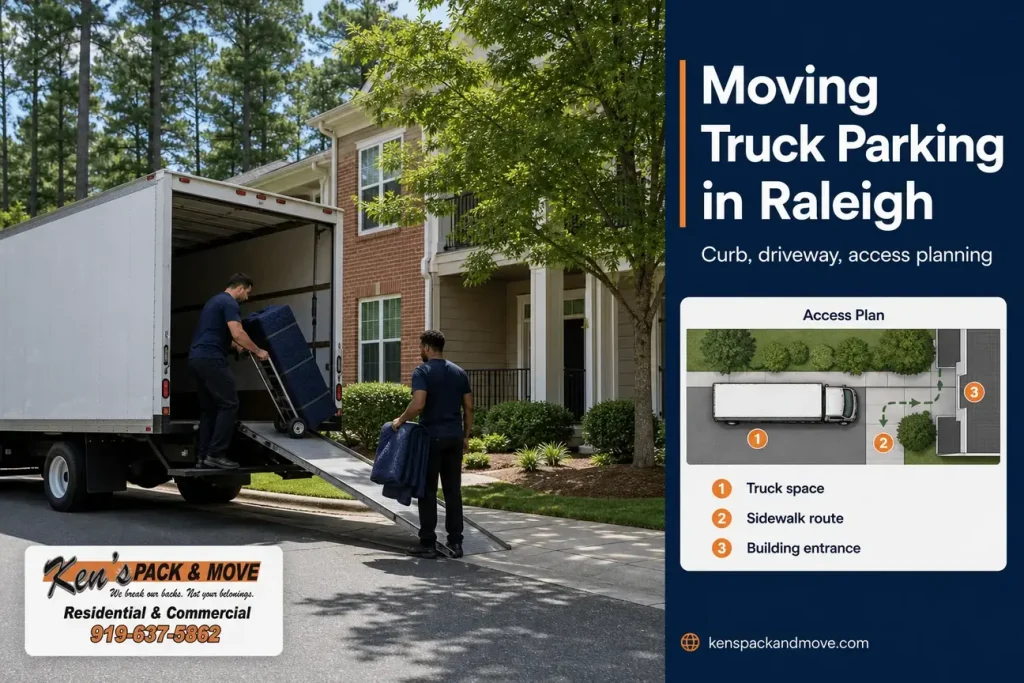
Moving Truck Parking Raleigh: What to Reserve
Planning moving truck parking Raleigh access means answering two questions before the crew arrives: is the truck location legally available, and does the property or building allow loading there? A private driveway, apartment loading area, or HOA-controlled street may need written approval from the owner, manager, or association. Public curb space, metered parking, sidewalk use, cones, ramps, or furniture staging may involve City of Raleigh right-of-way or parking requirements. Do not assume the closest curb is available just because it is open when you drive by. Confirm the space, the path from truck to door, and any building rules before moving day.
[ARTICLE_IMAGE_FEATURED]
Quick Answer
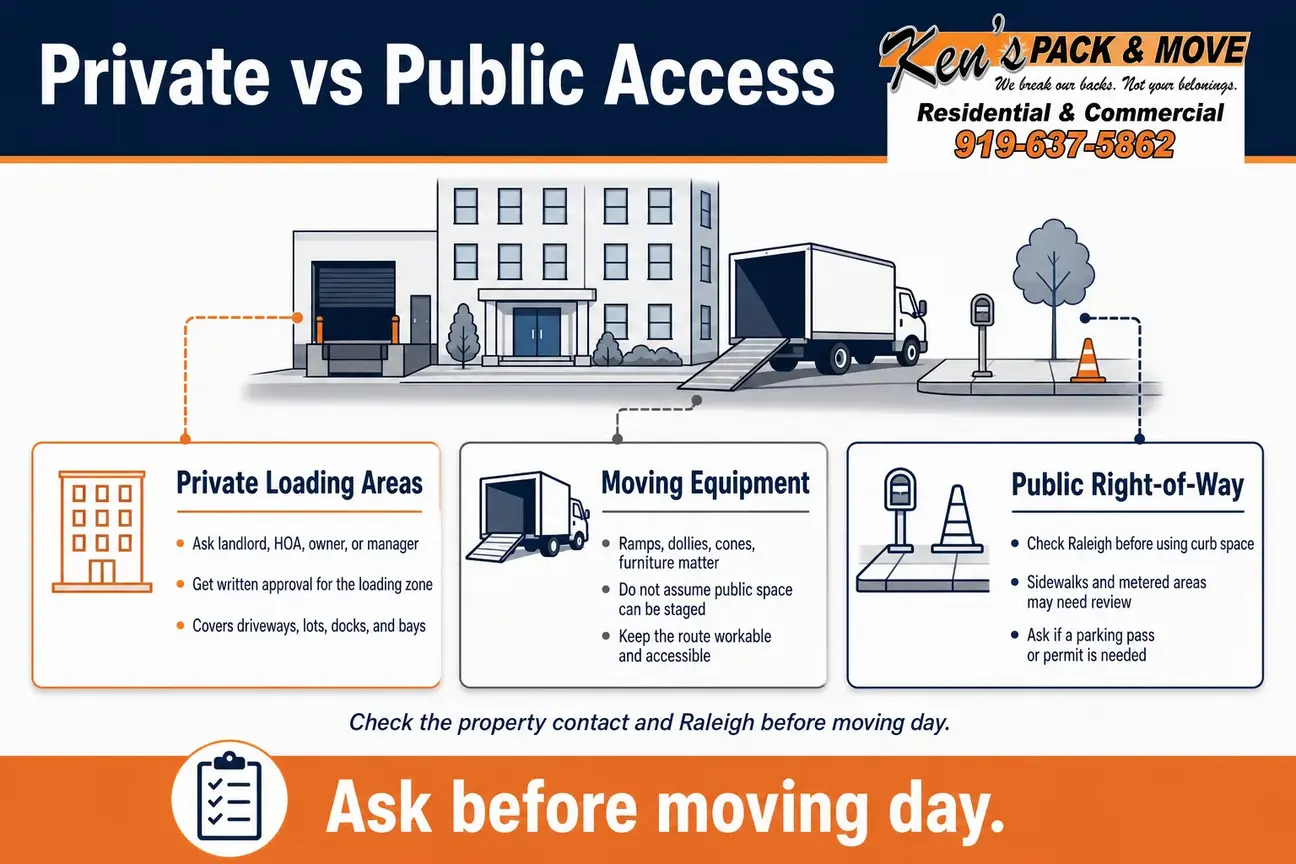
Reserve private loading areas through the landlord, apartment office, condo manager, HOA, or property owner. For public curb space, sidewalks, metered areas, or other public right-of-way, check Raleigh requirements before placing the truck, cones, ramps, dollies, or furniture there. The City of Raleigh Right-of-Way Services page says anyone wishing to occupy the right-of-way must obtain a permit, and it directs parking-pass requests for moving vans to Raleigh Parking.
If your moving van parking plan depends on a public curb, ask whether a Raleigh parking permit or parking pass is needed before moving day. A private moving day loading zone still needs written approval from the person or group that controls the property. Share parking limits, access restrictions, stairs, elevators, and dates when you request a moving quote.
What to reserve before moving day
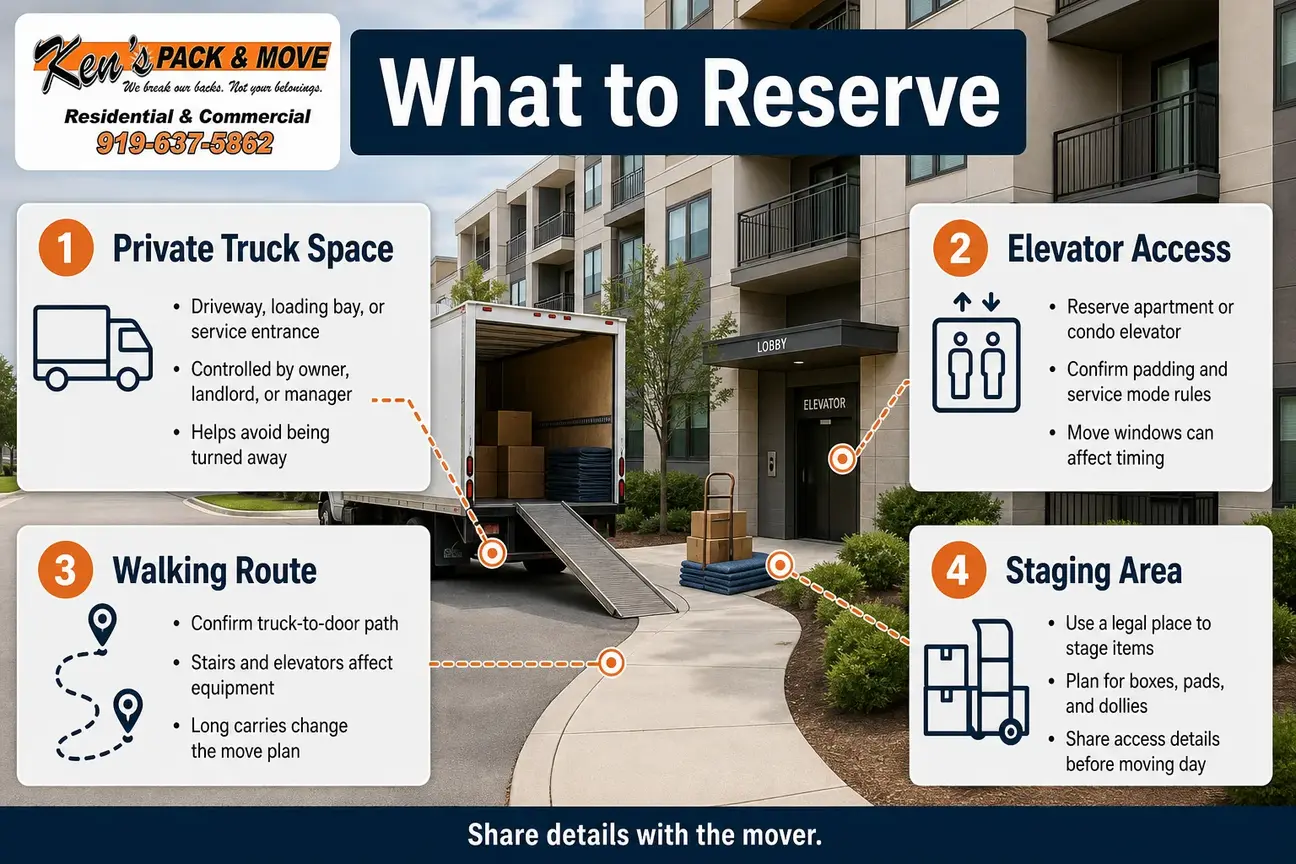
A good parking plan starts with the space itself, but it does not stop there. The crew also needs a workable route from the truck to the home, a legal place to stage items, and enough information to plan equipment and timing. These access details cover most Raleigh house, townhouse, condo, and apartment moves.
| What to reserve or confirm | Who usually controls it | Why it matters |
|---|---|---|
| Private driveway, loading bay, or service entrance | Owner, landlord, apartment office, or building manager | Prevents the truck from being turned away from the closest legal loading point. |
| Apartment elevator or freight elevator | Apartment or condo management | Move windows, padding, service mode, and elevator access can affect the whole schedule. |
| Loading dock or designated loading area | Building management, HOA, or property manager | Some properties restrict truck size, dock use, ramp placement, or hours. |
| Public curb, metered space, or street space | City rules and posted restrictions | Open curb space may still have time limits, signs, meters, or right-of-way concerns. |
| Sidewalk or pedestrian route | City rules if public; property manager if private | Ramps, dollies, and staged items can create access or approval issues. |
| HOA guest parking, shared lane, or private road | HOA, townhome association, or private property owner | Private rules may be stricter than street signs, especially near fire lanes or gates. |
| Backup legal parking location | Customer, building manager, or city guidance | Construction, blocked spaces, or another vehicle can force a longer carry. |
For a Raleigh move, the practical goal is simple: have one approved loading point at pickup, one approved loading point at delivery, and a backup if the first option is blocked. If the legal truck location is not close to the entrance, tell your mover early. Long carries, elevators, stairs, narrow halls, and parking limits can affect the move plan.
Also think about the pedestrian path before the truck arrives. A moving truck sidewalk issue can appear when the truck is legally parked but the ramp, dolly route, or staging area affects people walking past the property. That is why the route from truck to door belongs in the same plan as the parking space.
How moving truck parking Raleigh rules differ from building rules
City rules and building rules are separate. A landlord can approve a private loading dock without deciding whether a public curb space needs city approval. Raleigh can regulate public right-of-way without knowing whether your apartment manager requires an elevator reservation or certificate of insurance. You may need to check both.
Think of the move in layers. First, identify where the truck will sit. Second, identify who controls that space. Third, identify whether anything will extend beyond the truck: lift gate, ramp, hand trucks, furniture pads, boxes, cones, or a temporary staging area. Fourth, confirm the walking route from the truck to the door. A parking space that looks fine for a passenger car may not work for a moving truck, especially near a corner, garage entrance, fire lane, tight alley, or busy downtown curb.
For movers in Raleigh, the access details are more than a convenience. They help the crew decide how to approach the job, what equipment may be useful, and whether the legal loading area creates a longer carry. Raleigh neighborhoods vary: some homes have wide driveways, while downtown apartments may depend on a loading dock, metered spaces, or management-approved move windows.
A simple way to avoid confusion is to ask, “Who can say yes to this exact space?” If the answer is an apartment office, get the approval in writing. If the answer is the City of Raleigh, contact the city before moving day. If the answer is an HOA, ask for the written rule. If nobody can clearly say yes, choose another legal location and tell the moving company what changed.
The same approach works for a moving day loading zone and for any moving truck sidewalk route. The parking space, the loading point, and the pedestrian path may be controlled by different rules, so do not treat one approval as approval for everything.
When moving van parking may call for a Raleigh parking permit
A moving van parking plan may involve a Raleigh parking permit or parking pass when you are trying to reserve public parking areas, metered spaces, or curb space for a moving vehicle. Raleigh’s guidance does not create a single universal “moving truck permit” for every residential move, so the right question is not “Does every move need a permit?” The better question is “Will my truck, equipment, or staging area occupy public right-of-way or public parking?”
The City of Raleigh says that any person wishing to install an object in, or occupy, the right-of-way must obtain a permit. That can matter when a truck, ramp, cone setup, furniture staging area, or pedestrian detour affects a public street, sidewalk, or other public property. Raleigh also states that requests for parking passes for construction vehicles, moving vans, or other vehicles can be obtained by Raleigh Parking directly.
When you contact the city about moving van parking, be specific. Give the address, date, expected vehicle type, the exact curb or parking area, and whether a meter, sidewalk, alley, lane, or pedestrian route could be affected. If the truck will need more than an ordinary parking space, explain that. If you expect to use cones, ramps, a lift gate, or a short staging area, mention that too.
A Raleigh parking permit or pass should not be treated as a guarantee that the space will be clear when the truck arrives. Another vehicle, construction activity, street work, a special event, or enforcement issue can still interfere with access. Build a backup plan, and share it with your mover.
For downtown apartments, older neighborhoods, and streets near busy corridors, moving van parking can be the detail that decides whether the carry is short or long. If a Raleigh parking permit is part of the plan, keep the approval information available and still check the posted signs at the curb.
Ken’s Pack & Move should not be assumed to obtain Raleigh permits or parking passes for a customer. If public right-of-way or public curb space is part of the plan, the customer should confirm the city requirements directly and share the approval details when requesting the move.
How to set up a moving day loading zone on private property
A moving day loading zone on private property is usually handled through the person or organization that controls that property. That may be a landlord, apartment manager, condo association, HOA, building engineer, security desk, or property owner. This is practical planning, not a claim that every private space has the same legal requirement.
For a house, the simplest private loading area is often the driveway. Before moving day, check whether the driveway can handle the truck’s approach, whether trees or low wires limit clearance, and whether the truck can park without blocking a sidewalk, street, mailbox, hydrant, or neighbor’s access. If the driveway is steep, narrow, curved, or shared, tell the mover before the quote is finalized.
For apartments and condos, the moving day loading zone may be a dock, garage bay, service entrance, or marked curb area on private property. Ask management whether it must be reserved, whether a staff member must unlock it, and whether the truck has to fit under a garage clearance. If the property requires a certificate of insurance, get the required wording and delivery method in writing.
A private moving day loading zone should be more than a verbal “park over there.” Ask whether the area is reserved only for your move window, whether delivery trucks use the same space, and whether maintenance or trash pickup could block it. If the property cannot hold the space, identify the next legal option.
Townhome and HOA communities need a little extra attention. Some streets are public; others are private or association-controlled. Guest parking may be limited, fire-lane rules may be enforced by the property, and gates or access roads may restrict a larger truck. Ask the HOA or property manager where a moving truck can legally stop and whether the crew can use carts, dollies, or ramps on shared walkways.
If you are hiring local movers, send photos of the approved loading area if you can. Include the curb, driveway, dock, garage entrance, stairs, elevator, and the route from truck to door. Photos do not replace written permission, but they help the moving company understand the access before the crew arrives.
Apartment and condo parking questions to put in writing
Apartment moves in Raleigh often have more rules than single-family homes because the truck shares space with residents, management, deliveries, trash pickup, visitors, elevators, and security. Before you reserve a crew, ask your building for the move rules in writing. A quick phone answer is helpful, but written rules are easier to share with the mover and easier to review on moving day.
Ask management to confirm the move-in or move-out window, the elevator reservation, and whether the elevator must be padded or placed in service mode. Ask whether the loading dock or loading zone must be reserved separately. Ask whether the truck has a size limit or whether a garage has a height limit. Ask whether carts, dollies, ramps, cones, or furniture staging are allowed in halls, sidewalks, lobbies, or docks.
Certificate of insurance requirements can also affect timing. Some apartment or condo buildings ask for a COI before they allow a move. If that applies, ask for the exact certificate holder name, address, coverage wording, delivery email, and deadline. Then share that information when requesting your quote.
Your building may use one term for the loading dock and another term for the curb area, so be precise. Ask whether moving van parking is allowed at the front entrance, service entrance, garage, or dock. Then ask whether the approved spot also counts as the moving day loading zone for boxes, carts, and furniture.
For more Raleigh-specific apartment planning, Ken’s Pack & Move has a guide to apartment movers in Raleigh that covers stairs, elevators, and tight spaces. Your building’s written rules still control the exact move window, loading area, and elevator access.
A practical apartment checklist includes:
- Move date, move window, and any quiet-hour restrictions.
- Elevator reservation, padding requirements, and service-mode instructions.
- Loading dock, loading bay, or curb access approval.
- Truck-size, garage-height, gate, and turning restrictions.
- COI wording and deadline, if the building requires one.
- Rules for carts, dollies, ramps, cones, and temporary staging.
- Floor, wall, door, and elevator protection requirements.
- Security, concierge, key fob, or loading-door procedures.
- Backup plan if another vehicle occupies the loading area.
What to know before using a moving truck sidewalk route
A moving truck sidewalk issue can happen even when the truck itself is parked legally. The sidewalk may become part of the move route, or it may be affected by ramps, dollies, furniture, boxes, cones, or short-term staging. If the sidewalk is public, Raleigh right-of-way guidance matters. If it is private property, the building or HOA rules may control it.
The City of Raleigh’s sidewalk occupancy guidance says a sidewalk can be temporarily occupied so work can occur, that sidewalks should remain accessible when possible, and that the occupancy must be approved before the work area is set up. For a move, that means you should not plan to block a public sidewalk with furniture, boxes, a ramp, or equipment unless the setup has been approved where approval is required.
A good moving truck sidewalk plan keeps pedestrians moving whenever possible. Do not create a blind corner with stacked boxes. Do not leave a dolly, ramp, or furniture pad in the pedestrian path. Do not use the sidewalk as an unplanned holding area because the elevator is not ready. If the legal parking space forces a longer carry, tell the crew ahead of time so they can plan the work safely and efficiently.
If temporary sidewalk use is necessary, ask the city whether the proposed setup needs approval, a pedestrian detour, a traffic-control plan, or a related parking application. Use the exact address and describe the full setup. “A truck will be nearby” is less useful than “a moving truck may use this curb space, and the ramp or dolly route may affect this sidewalk for this move window.”
For private apartments or HOA walkways, a moving truck sidewalk question may belong to property management instead of the city. Ask whether dollies are allowed, whether floor or walkway protection is required, and whether furniture can pause briefly along the route. If management says no staging is allowed, plan the loading sequence around that rule.
Homeowners, townhouses, and HOA access planning
For homeowners, the first choice is usually the driveway or a legal curb space near the house. Still, Raleigh streets can be narrow, hilly, busy, or lined with parked cars. A truck that fits on one block may not fit well on another. Look for overhead branches, low wires, steep driveway angles, tight turns, cul-de-sacs, mailboxes, hydrants, and nearby intersections.
Do not block a fire lane or marked no-parking area to shorten the carry. Do not assume a shared driveway, private lane, or neighbor’s curb is available without permission. If the truck must stop farther away, tell the mover. A long carry from the truck to the front door changes the work, especially with heavy furniture, large appliances, tight stairs, or fragile items.
Townhouse communities can be tricky because the street may look public but function like shared private access. Ask the HOA or property manager whether moving trucks are allowed on the street, where they can stop, whether guest spaces can be reserved, and whether a gate code or access fob is needed. If the move starts or ends in a community with private roads, send those rules with your quote request.
For senior or downsizing moves, access planning can be especially important. Families may need to coordinate with a facility, apartment community, or HOA, and the best truck location may not be obvious. Share mobility, elevator, hallway, and loading-area details when asking for help, but avoid assuming that a private property will allow a truck until the manager confirms it.
What to tell the mover when requesting a quote
Your quote request should include more than the number of rooms. Parking, stairs, elevators, and access restrictions can affect the move plan. Ken’s Pack & Move accepts free quote requests, but a form submission is a request, not a confirmed reservation. Date, crew, scope, and price should be confirmed directly before moving day.
When you request a free moving quote, include both addresses, preferred dates and times, home size and property type, and a basic inventory. Add the parking details: public street, private lot, driveway, garage, loading dock, alley, metered space, or reserved building area. State whether a Raleigh parking permit, parking pass, building reservation, or HOA approval has already been requested or received.
Include the route from truck to door. Is there a long carry? Are there stairs, elevators, narrow halls, gates, ramps, grass, gravel, or steep slopes? Are there fragile, oversized, heavy, or high-value items that need extra planning? Do you need full or partial packing, loading and unloading, furniture disassembly and reassembly, or debris removal after the move?
If your access plan includes moving van parking on a public street, say whether the space is metered, signed, timed, or near a bus stop, hydrant, driveway, crosswalk, or construction area. If the route creates a moving truck sidewalk concern, describe whether the sidewalk is public or private and whether the building has approved the route.
For North Carolina household-goods moves, the North Carolina Utilities Commission Moving 101 guide says that if you request it, a mover is required to give you a free written estimate on a Commission-approved form, with stated exceptions for requests made less than five business days before the move or shipments below the 500-pound threshold. The same guide says most movers will not provide a written estimate unless they see the items to be moved. Ask for access conditions, estimate details, and valuation choices in writing.
Ken’s Pack & Move is certificated by the North Carolina Utilities Commission for household-goods moves within North Carolina under certificate C-2551. The NCUC list of certificated movers is one way consumers can check a mover’s North Carolina household-goods certificate. That licensing point does not decide Raleigh parking or building rules, but it is a useful moving-company check before hiring.
Labor-only help when the rental truck is already booked
DIY movers often reserve the rental truck first and think about loading access later. If that is your situation, slow down long enough to confirm where the rental truck can legally sit at both addresses. A rental agreement does not override city rules, apartment policies, HOA limits, or posted parking restrictions.
Confirm the rental truck’s height, length, and return requirements with the rental provider. Then compare those dimensions with the driveway, parking lot, garage clearance, loading dock, or curb you plan to use. If the truck cannot fit near the entrance, decide whether the crew will load or unload from a legal alternate location. Do not wait until the truck is already idling in a restricted space.
Rental trucks can make moving van parking feel like a do-it-yourself detail, but the same access rules still matter. If the truck will sit on public curb space, ask about city requirements. If it will sit on private property, ask the property owner, apartment office, or HOA where it can legally stop.
If you only need loading and unloading help, share the same access details with labor-only movers. Labor-only help still depends on a legal, workable truck location. A crew can plan around a long carry or elevator when they know about it in advance, but surprise parking problems can slow the job and may require a different setup.
For short-notice situations, such as a lease change, closing delay, or canceled helpers, call 919-637-5862 to check availability. Same-day or last-minute help depends on whether a crew is available, the inventory, the access, and whether the destination is ready. Do not wait to mention parking, permits, stairs, elevators, or building move windows.
Common Raleigh access problems that slow a move
Most truck-access problems are preventable. The trouble usually starts when the approved space is not actually available, the truck is too tall for the garage, the elevator was not reserved, or the public sidewalk plan was never checked. A few minutes of planning can reduce confusion, but it needs to happen before moving day.
A missing Raleigh parking permit or an unclear pass request can also create confusion when the truck needs a public curb or metered space. The same is true when a moving truck sidewalk route was assumed but never checked with the city, building, or HOA.
Watch for these common issues:
- Open curb space that is not usable. A curb may have time limits, meter rules, construction restrictions, residential parking rules, loading signs, bus zones, hydrants, driveway cuts, or corner visibility issues.
- Apartment loading areas already occupied. Delivery trucks, trash pickup, other residents, or maintenance crews may use the same space. Ask the building how reservations are enforced.
- Garage clearance problems. A truck may not fit under a garage entrance even if the loading bay is technically reserved.
- Sidewalk staging. Boxes and furniture placed on a sidewalk can create a moving truck sidewalk concern if pedestrians cannot pass or if approval was needed.
- Long carries from a legal space. The closest legal space may still be far from the door, especially downtown or in dense apartment areas.
- Elevator conflicts. A reserved loading area helps less if the elevator is unavailable, unpadded, or not in service mode.
- Unshared gate or access codes. A crew cannot use a private road, garage, elevator, or loading dock if the access process is missing.
Take photos of the parking signs, loading zone, driveway approach, elevator entrance, and walking route. If you received a building email or city confirmation, keep it handy on moving day. If anything changes, tell the mover as soon as possible.
A practical timeline for parking and access
There is no single timeline that works for every Raleigh move, but the earlier you check access, the easier it is to fix problems. End-of-month lease turnover, summer heat, university move-in periods, storms, and busy downtown blocks can all make truck access less forgiving.
If a moving day loading zone requires building approval, start that request before the schedule fills up. If a Raleigh parking permit or pass may be needed, give yourself time to ask the city what information is required for your specific setup.
| When to check | What to do | What to share |
|---|---|---|
| As soon as your move date is likely | Ask the building, HOA, landlord, or property owner about move rules. | Move window, loading area, elevator rules, COI needs, and truck-size limits. |
| Before requesting a quote | Identify the truck location at pickup and delivery. | Street, driveway, dock, garage, alley, long carry, stairs, elevators, and access restrictions. |
| Before move week | Check whether public curb, meters, sidewalk, or right-of-way issues need city guidance. | Address, vehicle type, requested space, sidewalk impact, and expected setup. |
| A few days before the move | Reconfirm building reservations and review signs near the curb. | Any changed move window, access code, parking pass, or backup location. |
| Moving morning | Keep approvals, codes, and building contacts available. | Tell the crew about blocked spaces, construction, elevator issues, or revised access. |
If you are still deciding when to book the crew, this guide on how early to book movers can help you think through timing. Parking and elevator questions should be part of that scheduling conversation, not a last-minute add-on.
Moving day loading zone checklist
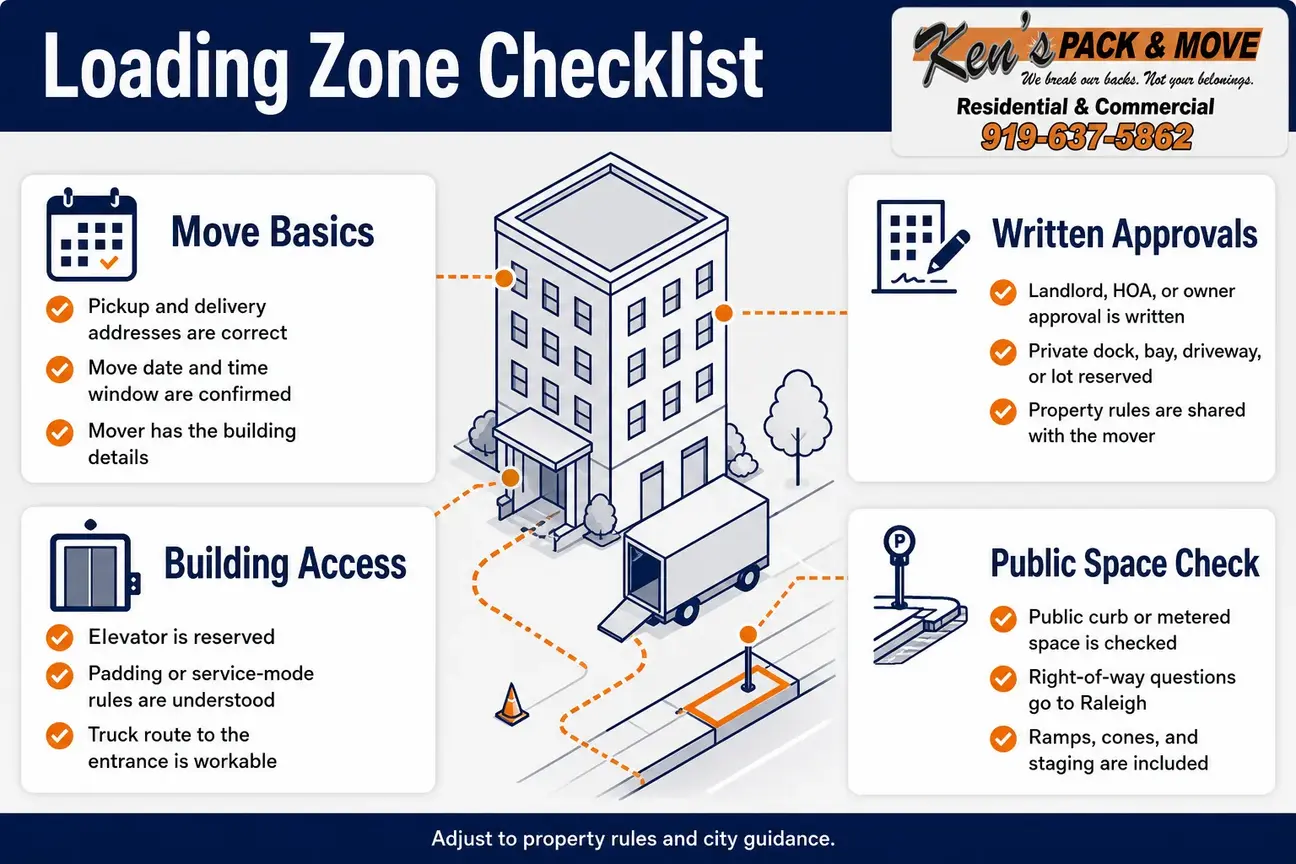
Use this checklist once you have your date, addresses, and building details. It is designed for Raleigh renters, homeowners, DIY movers, and families coordinating a parent’s move. Adjust it to your property rules and any city guidance you receive.
- Pickup address and delivery address are correct.
- Move date and preferred time window are confirmed with the mover.
- Building, landlord, HOA, or property-owner approval is in writing where needed.
- Elevator is reserved, and padding or service-mode rules are understood.
- Private loading dock, loading bay, driveway, or parking lot space is reserved where applicable.
- Public curb, metered space, or right-of-way question has been checked with Raleigh if the setup may affect public property.
- Moving van parking location is legal, practical, and reachable for the truck.
- Moving day loading zone is clear of other vehicles, deliveries, trash pickup, or maintenance activity as much as the property can control.
- Raleigh parking permit or parking-pass details are saved where applicable.
- Moving truck sidewalk route has been checked if ramps, dollies, or staging may affect pedestrians.
- Truck height, length, gate access, garage clearance, and turning limits have been considered.
- Sidewalk and pedestrian route are planned, especially if a ramp, dolly, or short staging area may be used.
- Stairs, elevators, narrow hallways, long carries, and fragile or oversized items have been shared with the mover.
- Gate codes, garage codes, elevator procedures, and building contact information are available.
- Backup legal parking location is identified if the first location is blocked.
- Written estimate, scope, valuation choice, and move details have been reviewed before moving day.
Final planning notes for a smoother Raleigh move
The safest approach is to treat parking as part of the move plan, not as a detail to solve when the truck arrives. The approved location affects the route, the equipment, the carry distance, the elevator schedule, and the way the crew protects the property. It also affects your building relationship, especially in apartments, condos, and HOA communities.
If you are comparing options, avoid choosing a mover based only on a quick verbal answer. Ask how access conditions should be shared, whether the estimate can reflect stairs, elevators, long carries, and parking restrictions, and what details should be confirmed before moving day. For in-state household-goods moves, use NCUC guidance to understand written estimates and mover certification.
For moving truck parking Raleigh planning, the key is clarity: one approved truck location, one approved route to the door, one plan for pedestrians, and one backup if the space is blocked. For help with a local move, get a moving quote from Ken’s Pack & Move and include both addresses, dates, property type, stairs, elevators, parking, access restrictions, large or fragile items, and whether you need packing, labor-only help, or debris removal.
Moving rules, building policies and prices change. Confirm scope, date, price and coverage with the mover in writing before moving day.
Frequently Asked Questions
Does every moving truck in Raleigh need a permit?
Not necessarily. The need depends on the proposed location and setup. If the truck, equipment, cones, ramp, furniture, or staging area will occupy public right-of-way, public curb space, metered parking, or a sidewalk, check Raleigh requirements before moving day.
Can a moving truck park in front of my Raleigh home?
Only if the space is legally available and the setup does not violate posted signs, time limits, access rules, or right-of-way requirements. If the preferred location is a private driveway, shared lane, or HOA-controlled area, get permission from the person or organization that controls it.
What should apartment renters reserve before moving day?
Ask management to confirm the move window, elevator reservation, loading dock or loading zone, truck-size limits, garage clearance, COI requirements, security procedures, and protection rules for floors, walls, doors, and elevators. Get the building rules in writing.
Can a moving truck block a Raleigh sidewalk?
Do not assume it can. If a public sidewalk will be occupied or affected by the truck, ramp, dollies, boxes, furniture, or staging, confirm city requirements first. If it is a private sidewalk or walkway, ask the building or property manager for the rules.
Who is responsible for reserving parking or building access?
The customer should confirm building permissions, HOA rules, private-property access, and public-space requirements before moving day. Do not assume the mover can obtain a city parking pass or right-of-way approval unless that has been clearly confirmed in writing.
What if the reserved loading space is blocked on moving day?
Use the backup legal parking location you identified ahead of time and contact the building manager, HOA, or city parking contact if applicable. Tell the crew right away because a longer carry, changed entrance, or delayed elevator access can affect the move plan.
What parking details should I include when requesting a moving quote?
Include both addresses, preferred dates, property type, truck location, parking limits, permit or pass status, stairs, elevators, long carries, gate or garage restrictions, fragile or oversized items, and whether you need packing, loading, unloading, furniture help, or debris removal.