

How to Check a Moving Company in North Carolina: check moving company NC Guide
If you need to check moving company NC records before a local move, start with official verification, not just reviews. For regulated intrastate household-goods transportation in North Carolina, ask the mover for its North Carolina Utilities Commission C-number, confirm it in the official carrier list, and review the estimate, valuation choice, inventory, and bill of lading before you pay or sign.
Quick Answer: A North Carolina household mover should be able to give you its exact company name and NCUC C-number for a regulated in-state household-goods move. Use the NCUC list of certificated movers to confirm the name and certificate number, then request the written estimate, read the bill of lading, and make sure valuation is selected before the move begins. Do not sign blank paperwork or rely on a verbal promise that is not reflected in the documents.
That matters for Triangle households dealing with a closing delay, a lease turnover, a parent’s downsizing move, or a rental-truck loading job. A mover can look polished online and still leave you with unanswered questions. The practical way to check a company is to match the official record with the documents you receive for your specific move.
NC mover certificate: what it tells you
An NC mover certificate is the starting point for checking a mover when the company is transporting household goods within North Carolina. The North Carolina Utilities Commission regulates intrastate household-goods transportation, and the NCUC’s consumer guidance tells customers to use legal movers and check the Commission’s information before hiring. The NCUC Moving 101 guide is the key consumer resource for this process.
In plain English, a C-number is the identifier connected to a mover’s North Carolina certificate for regulated household-goods moves within the state. When you ask a mover for its moving company license information in North Carolina, the practical item you are usually looking for is that C-number and the company name tied to it.
If an ad mentions licensing but does not give a C-number, ask the mover to translate that claim into the actual North Carolina certificate number. A clear answer should give you a company name and C-number you can compare with the official record.
A C-number is important, but it is not a magic all-purpose credential. It does not prove that a company performs every service it advertises. It does not prove interstate authority, international moving authority, office-moving coverage, vehicle shipping, storage, or specialty handling. It is a document check for a particular type of move: household goods transported within North Carolina.
Ken’s Pack & Move is certificated by the North Carolina Utilities Commission for North Carolina household-goods moves under C-2551. That statement is limited to the in-state household-goods certificate. It should not be read as an interstate authority claim or as a promise that every moving-related request is available.
Keep the certificate number next to the written estimate while you compare companies. That makes it easier to see whether the documents describe the same mover and the same job.
If your move is a local household move in Cary or elsewhere in the Triangle, this official record check is one of the cleanest ways to separate a legitimate inquiry from guesswork. For a broader reputation checklist beyond official paperwork, you can also read this companion guide on how to find a trustworthy moving company.
How to verify a mover in the official record
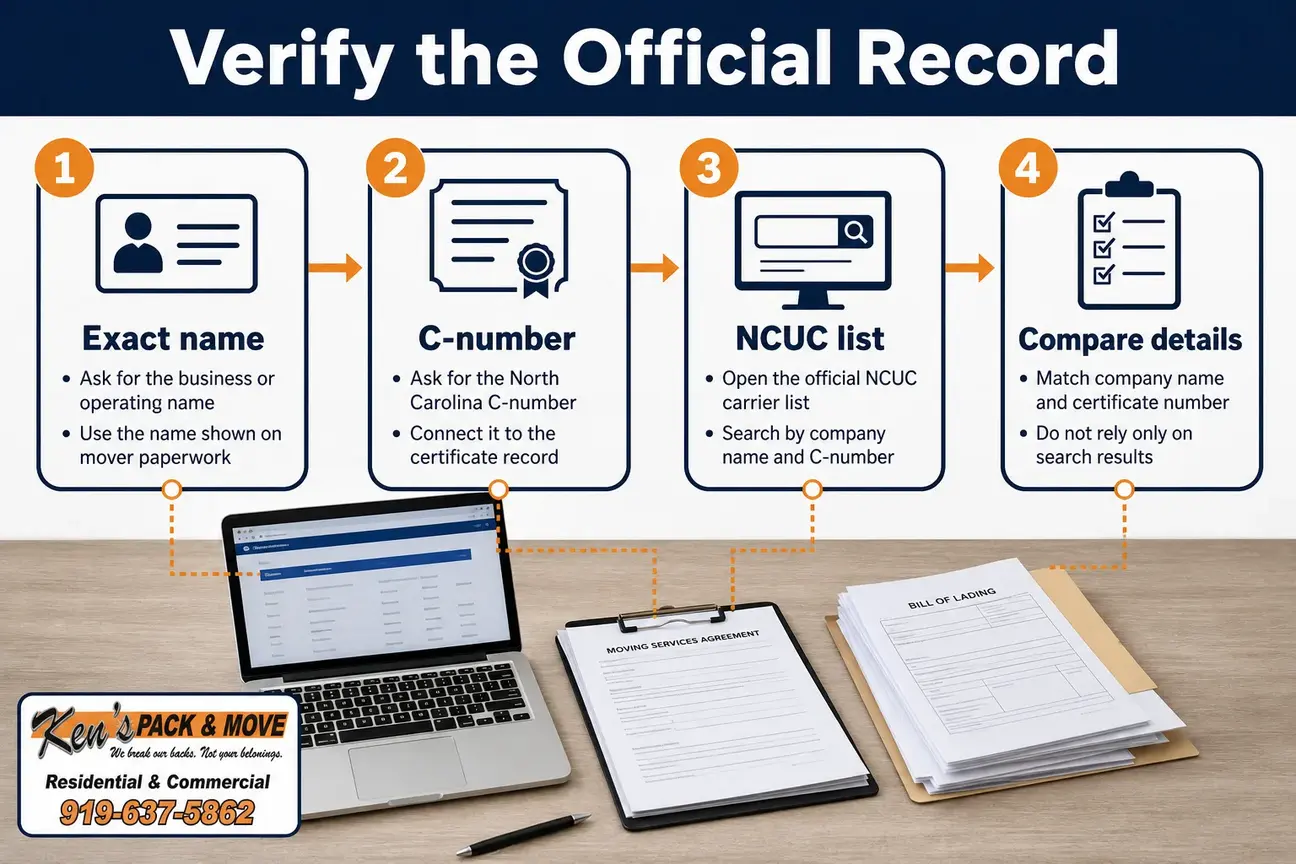
To verify a mover, do not stop at a search result, directory profile, social-media page, or quote email. Those can help you start a conversation, but they are not the same as checking the official NCUC record for an in-state household-goods carrier. A simple document trail gives you a better basis for deciding whether to request service, pay a deposit, or sign.
Use this process before you accept a quote for a covered household move:
- Ask the mover for the exact business or operating name used on its paperwork.
- Ask for the North Carolina Utilities Commission C-number.
- Open the official NCUC carrier list and search for the name and C-number.
- Compare the company name, certificate number, and contact information against the estimate or contract documents.
- Ask the mover to explain any mismatch before you move forward.
- Save or download a copy of the record you checked.
- If the company cannot provide a C-number or the information does not match, contact the appropriate regulator before signing.
This is the core of how to check a mover for an in-state household move. You are not trying to become a transportation lawyer. You are making sure the company asking for your money is the same company that appears in the official record and on the documents for your move.
This habit is useful when names shift between an advertisement, a phone call, a payment link, and a contract. A slightly different trade name is not automatically a problem, but it is something to clarify before move day. The name on the estimate and bill of lading should make sense when compared with the official certificate record.
For a Cary apartment move or a Raleigh house move where the mover is transporting the shipment, get the name and C-number in writing, then compare them with the documents you are asked to sign. If the job is labor-only loading or unloading and the mover is not transporting the shipment, the NCUC household-goods certificate check may not govern that labor-only service in the same way. You should still confirm company identity, scope, payment terms, and responsibility in writing.
The same verification routine also helps if you are coordinating the move from a distance for a parent, roommate, or adult child. Share the company name, C-number, written estimate, and bill of lading with everyone who is making decisions before money changes hands.
Use check moving company NC documents before you sign
The phrase check moving company NC should mean more than a quick online search. The real protection comes from document review: certificate, estimate, inventory, valuation selection, bill of lading, payment terms, and claims instructions. If one of those pieces is missing, slow down and ask questions.
Start by confirming that the job is actually a household-goods move within North Carolina. NCUC household-goods rules are not a blanket rule for every transportation or labor service. They should not be stretched to cover interstate, international, government, or office moves. If your move crosses state lines, you need to review the appropriate federal guidance instead of assuming the same North Carolina certificate answers every question.
For an in-state household move, ask for the written paperwork before the crew is loading your belongings. If the details are not ready until the last minute, you may feel pressure to sign quickly. That is exactly when mistakes get missed: wrong addresses, missing packing services, unclear stairs or elevator access, or a valuation choice that is not marked where you can see it.
A practical document check gives you time to compare the quote to your actual move. If your building has a freight elevator reservation, a long walk from the parking area, a narrow stairwell, or a strict move-in window, those details should be discussed before moving day. They can affect the scope, time, crew planning, and paperwork.
What a written estimate should include
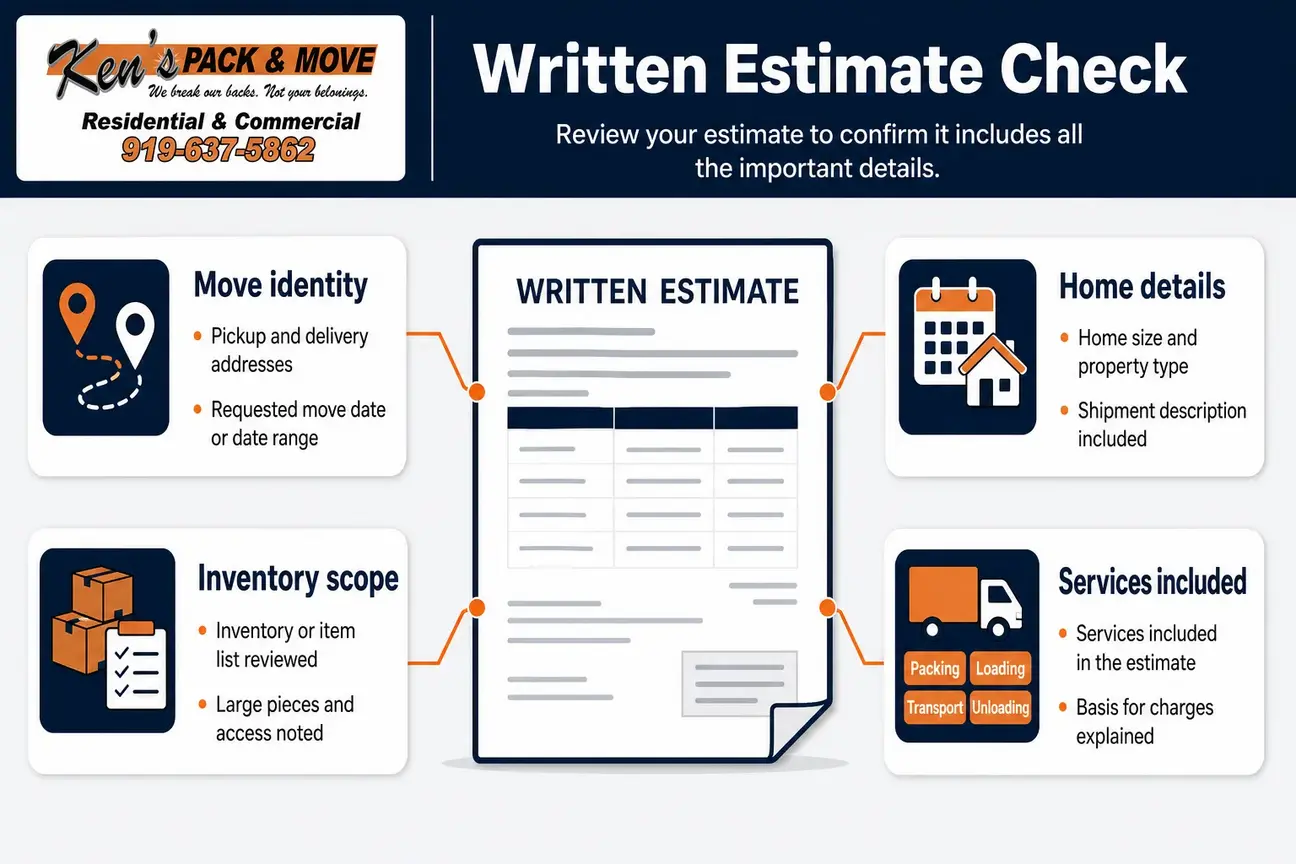
A written estimate is one of the most important documents to request. The NCUC says that if a customer requests it, a mover is required to provide a free written estimate on a Commission-approved form. The estimate should identify the move being estimated, the services included, and the basis for the charges.
For a household move, the estimate should not be a vague total with no explanation. The goal is not to memorize tariff language; it is to understand what the mover believes the job involves.
Before you accept a written estimate, review whether it reflects:
- Pickup and delivery addresses.
- Requested move date or date range.
- Home size, property type, and shipment description.
- Inventory or a clear summary of the items being moved.
- Distance and whether the move is local or longer-distance within North Carolina.
- Stairs, elevators, long carries, parking limitations, and building access.
- Packing services, unpacking services, or customer-packed boxes.
- Large, heavy, fragile, or high-value items.
- Whether loading, unloading, furniture disassembly, or reassembly is included.
- Any known conditions that could change the estimate.
- Valuation selection or where that selection will be made.
The certificate gets attention, but the estimate is where your actual job starts to take shape. A certificated mover still needs accurate information to quote the work. If you leave out a third-floor walk-up, a difficult parking situation, or a room of packed boxes, the written estimate may not reflect the real job.
The NCUC Maximum Rate Tariff provides the framework and required forms for covered intrastate household-goods services. The NCUC Maximum Rate Tariff is a technical document, but the customer-facing takeaway is simple: your paperwork should identify the services, terms, and rating basis instead of leaving you to guess.
Do not rely on verbal changes. If you add packing, change the delivery address, add a stop, discover a tight elevator window, or remove a large item from the move, ask for the paperwork to be updated. The safest version of a quote is the one that matches the job the crew will actually perform.
A written estimate is also where a moving company license question becomes practical. The certificate tells you who the mover is; the estimate tells you what the mover believes your move includes.
What to review before signing the contract
A moving company license check tells you whether the company appears in the official certificate record. Contract review tells you whether the documents for your move match what you were told. Both steps matter.
Before signing, read the estimate, bill of lading, inventory, and any terms provided by the mover. If the paperwork is incomplete, blank, or inconsistent, ask for a completed version before you sign. Do not sign first and hope the details get filled in later.
A valid certificate does not fix a vague scope, an unmarked valuation choice, or a missing access note. Treat the official record check and the contract review as separate safety steps.
| Document item | What to check | Why it matters |
|---|---|---|
| Company identity | Name, address, phone number, and C-number | Helps connect the paperwork to the official record |
| Move details | Pickup, delivery, date, and access notes | Confirms the job being agreed to |
| Scope | Loading, unloading, packing, furniture work, or debris removal | Prevents confusion over included services |
| Inventory | Room-by-room items, boxes, and special pieces | Creates a reference point for delivery and claims |
| Estimate basis | How the charges are calculated and what could change them | Helps you understand what you are accepting |
| Valuation | Which option is selected and where it is recorded | Affects how loss or damage claims are handled |
| Payment terms | What is due, when, and by what method | Reduces pressure and surprise on moving day |
| Claims instructions | How to report a problem and what records to keep | Gives you a process if something goes wrong |
The review should be calm and practical. You are not accusing the mover of anything by reading the terms. You are confirming that the written record matches the phone call, walk-through, photos, or quote request.
For local moving services in the Triangle, the biggest paperwork mistakes often come from access and scope. Examples include elevator reservations, apartment loading zones, HOA move-in windows, packed versus unpacked items, and whether the customer needs full or partial packing. Get those items into the quote discussion early.
Why the bill of lading matters
The bill of lading is not just a receipt. It is the written contract for the move. It should set out the company, shipment, terms, and responsibilities, and you should keep a complete copy until the move and any claim issues are resolved.
NC DOJ’s moving guidance tells consumers to take inventory, ask about a written inventory, and keep important move documents. It also points North Carolina consumers to the Public Staff for in-state moving concerns.
When reviewing the bill of lading, compare it with the estimate. Does it show the same company name? Does it show the same move addresses? Does it reference the same services? Does it match the valuation choice? Are payment terms written down?
If a verbal promise matters, it belongs in the paperwork. That includes extra packing help, a second stop, a fragile item note, a timing restriction from a building manager, or a plan for a long carry from the parking area. Verbal agreements are easy to misunderstand on a busy moving day, especially when elevators, weather, traffic, and lease deadlines are all competing for attention.
A bill of lading can also reveal moving company red flags before the truck is loaded. Watch for a company name that does not match the estimate, a missing C-number, blank sections, or services that are suddenly described differently than they were during the quote conversation.
Also avoid signing blank forms. A blank or partly completed document puts you in a weak position because the final terms may not reflect the conversation you had. Ask for completed documents, read them, and keep copies.
How valuation works for a North Carolina household move
Valuation is a key part of the document review, but it is often misunderstood. It is not the same thing as a homeowner’s or renter’s insurance policy. It is the mover’s liability framework for loss or damage under the applicable moving documents.
The NCUC materials explain that customers must select their valuation level before the move begins, and that selection cannot be changed once the move starts. That is why valuation should be discussed before loading begins, not after a problem happens.
For a North Carolina household move, ask the mover to explain the available valuation options shown in the NCUC materials, including basic value protection and full value protection. NCUC materials identify basic value protection as $0.60 per pound per article. That detail helps you understand the option, but it does not tell you what any individual company includes unless the written paperwork says so.
Do not assume that a company includes a particular valuation level unless the written paperwork says so. Ken’s Pack & Move does not use this article to claim that any specific valuation option is automatically included. Customers should select and confirm coverage in writing before moving day.
Valuation questions are especially important for owner-packed boxes, electronics, antiques, fragile items, collectibles, and anything unusually valuable. Ask how those items should be packed, described, and documented. If an item needs special treatment that has not been discussed, bring it up before the quote is finalized.
Valuation review is another reason the official certificate check is only one part of the process. The certificate helps you identify the mover, while the valuation selection helps you understand the paperwork that applies to your shipment.
Moving company red flags to investigate
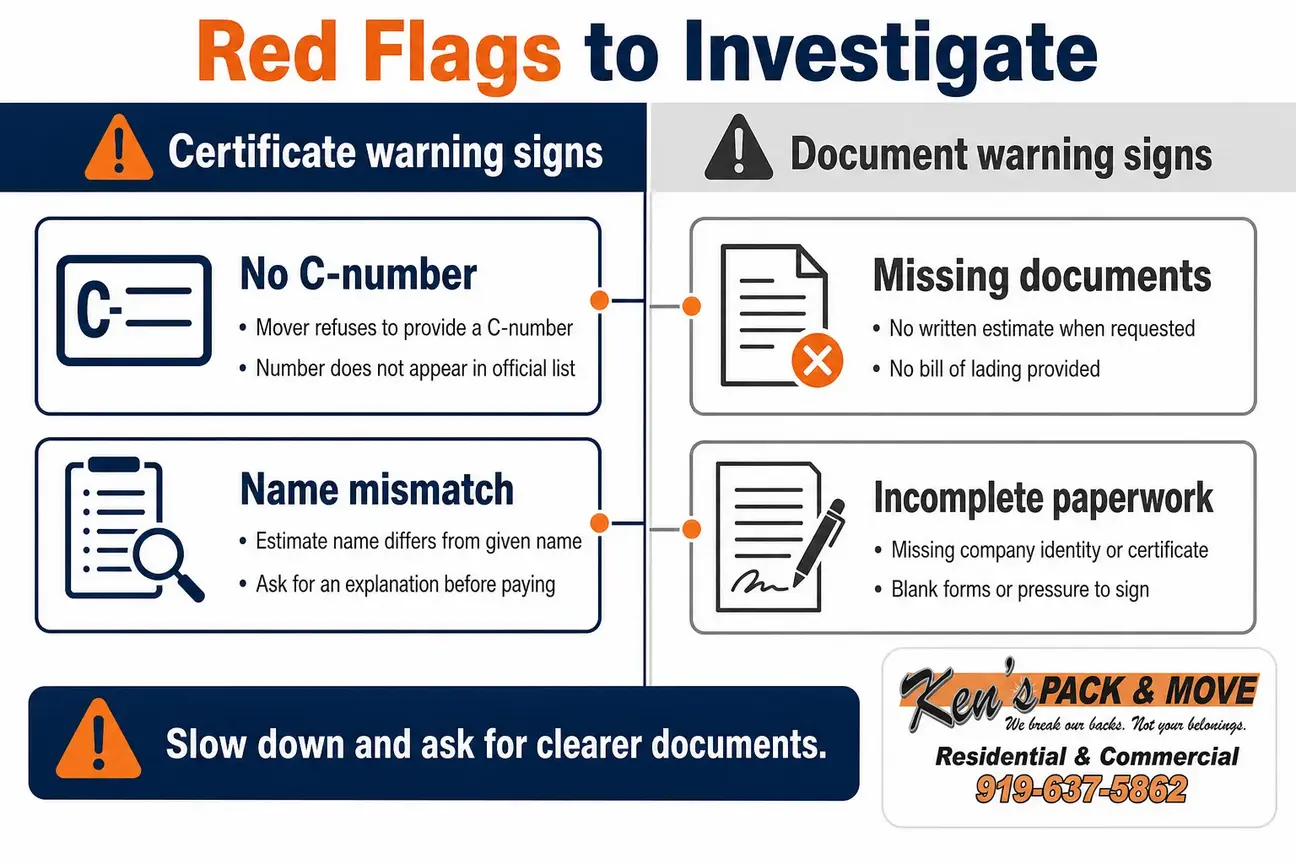
Some moving company red flags are official verification problems. Others are practical warning signs that should make you slow down and ask for clearer documents. Either way, do not let urgency push you into signing incomplete paperwork.
Certificate-related warning signs include a mover refusing to provide a C-number, giving a number that does not appear in the official list, or using a company name on the estimate that does not match the name you were given. A mismatch may have an explanation, but it should be explained before you pay.
Document-related warning signs include no written estimate when requested, no bill of lading, missing company identity, missing certificate number, blank forms, vague scope, or an unexplained change between the quote and the paperwork. These are the places where a rushed move can become confusing fast.
Payment-related moving company red flags include pressure to pay before you receive written documents, demands that are not reflected in the contract, or a final payment request that does not match the written terms without a documented explanation. The issue is not the existence of a deposit or payment schedule; the issue is whether the obligation is clear and tied to the paperwork.
Scope-change warning signs include verbal add-ons that never appear on the estimate, a change in the company performing the work, or pressure to sign a revised document without time to read it. If the job changes, the documents should change too.
Other moving company red flags are communication problems. Be careful if the mover avoids direct questions about certificate information, cannot explain valuation, will not describe what is included, or keeps moving important details into a phone call without updating the written record.
General scam-awareness resources can also help you recognize pressure tactics. The FMCSA Protect Your Move red flags page is aimed at interstate moving concerns, but many of its practical warning signs are useful reminders to ask questions and avoid rushed decisions.
Questions to ask before you verify a mover and pay
When you are trying to verify a mover, good questions save time. Ask them before paying a deposit, signing a bill of lading, or reserving a move date based only on a phone conversation.
- What is the company’s exact legal or operating name?
- What is the North Carolina Utilities Commission C-number?
- Does that C-number appear in the official NCUC carrier list?
- Is this quote for a household-goods move within North Carolina?
- What services are included in the written estimate?
- What services or items are excluded?
- Is the estimate based on the applicable move details, shipment size, access, and scope?
- What information could change the estimate?
- How are stairs, elevators, long carries, parking limits, and building rules handled?
- Who supplies packing materials, and who packs fragile items?
- Will there be a written inventory?
- What valuation options are available?
- Which valuation option is selected, and where is it written?
- When will the bill of lading and completed documents be provided?
- What payment is due, when is it due, and what document describes it?
- What is the claims process?
- If the company cannot perform the job, who contacts you and what happens next?
- Is the job being performed by the certificated mover named in the documents?
These questions are not meant to make the move harder. They help everyone get on the same page. A clear estimate and contract help the customer, the office team, and the crew understand the job before the truck arrives.
If a company cannot answer basic questions, treat that as a reason to slow down. The most useful verification step is often the simplest one: ask for the certificate number, ask where it appears in the record, and ask where the same company name appears on the documents you sign.
What Triangle households should have ready for a quote
A strong quote starts with accurate information. If you are moving from a Cary apartment, a Raleigh townhouse, or a nearby Triangle home, gather the details a mover needs before you request service.
Have both addresses ready, along with preferred dates, property size and type, stairs, elevators, parking limits, loading zones, long carries, and access restrictions. Share the approximate volume of items, large or heavy pieces, fragile or high-value items, and whether you need full or partial packing.
If you are renting a truck and only need loading and unloading, say that up front. Labor-only work has a different scope than a full local move, and the crew still needs to know stairs, parking, heavy pieces, and timing. If that is your situation, this guide to labor-only movers may help you think through the details. Remember that the NCUC household-goods certificate verification described above is specifically for regulated intrastate household-goods transportation, not every standalone loading job where the mover is not transporting the shipment.
If you need help quickly because a lease changed, a closing moved, or helpers canceled, be direct about timing. Same-day and short-notice help depends on crew availability, inventory, access, and a ready destination. You can review last-minute moving help, but no form submission should be treated as a confirmed booking until the company confirms date, crew, scope, and price directly.
When you are ready, you can request a free moving quote or call 919-637-5862. Include both addresses, preferred dates, home size, stairs, elevators, parking, large or fragile items, and whether you need packing, labor-only help, local moving, or debris removal as part of the move.
For customers comparing options near the Cary office, the Cary moving company page is a useful place to see local service context. The office is in Cary, and customers are served at their addresses.
Moving company license check vs review research
A moving company license check answers a narrower question than review research. It asks whether the mover appears to have the appropriate North Carolina certificate for an intrastate household-goods move. Reviews, referrals, and reputation research can be useful, but they do not replace the official record.
Think of it as two layers. First, confirm the company and C-number. Second, review the estimate, bill of lading, valuation, inventory, and payment terms for your specific job. Third, if you want broader confidence, look at communication, responsiveness, and whether the mover answers your questions clearly.
The official record is especially important when you are under pressure. End-of-month lease turnover, summer heat, afternoon storms, and traffic around I-40 or I-440 can make Triangle moves feel rushed. That is when it is tempting to accept the first person who says yes. A short verification pause can prevent a much bigger headache.
Do not treat a logo, badge, directory listing, or social post as a substitute for the certificate list and written documents. If the mover is legitimate and the job is clear, providing the basic verification information should not be a mystery.
A careful licensing question should lead to a C-number and an official record, not just a slogan. If the company uses the phrase moving company license in conversation, ask exactly which North Carolina record it means and where you can verify it.
What if something goes wrong?
If a problem happens, start by documenting it. Take photographs, keep the inventory, save the estimate and bill of lading, preserve payment records, and keep emails or text messages. Then notify the mover promptly and ask what the claims process requires.
NC DOJ advises North Carolina consumers with moving problems to notify the company promptly and, if necessary, file a written complaint with the company no later than nine months after delivery. For North Carolina move concerns, NC DOJ also points consumers to the NCUC Public Staff, Transportation Rates Division.
Filing a complaint does not guarantee a specific result. It does, however, give you a documented path instead of a series of disconnected phone calls. The better your records are, the easier it is to explain what was agreed to, what happened, and what documents support your position.
For in-state household moves, keep your paperwork together until delivery is complete and any issue is resolved. That includes the written estimate, bill of lading, inventory, valuation selection, photographs, payment records, and messages about schedule or scope changes.
Final checklist before you choose a mover
Before you choose a mover, run one last practical check. Confirm the North Carolina certificate, compare the company name and C-number, request the written estimate, read the bill of lading, choose valuation in writing, and make sure the scope matches your actual move.
Watch for moving company red flags such as missing certificate information, blank documents, pressure to sign, unexplained payment requests, or verbal changes that never appear in the paperwork. If something feels off, pause and ask for clarification before moving day.
To verify a mover well, you do not need to overcomplicate the process. You need the official record, complete documents, clear valuation, and a written scope that matches the home, building, access, and inventory. That is the practical way to check moving company NC information before trusting a crew with your belongings.
Moving rules, building policies and prices change. Confirm scope, date, price and coverage with the mover in writing before moving day.
Frequently Asked Questions
Is a C-number the same as a moving company license in North Carolina?
For an intrastate household-goods move, the C-number is the key certificate identifier to check with the North Carolina Utilities Commission. People may casually call it a moving company license, but the practical step is to confirm the company name and C-number in the official NCUC carrier list.
Does an NC mover certificate mean the company can move me out of state?
No. An NC mover certificate applies to regulated household-goods moves within North Carolina. It should not be treated as proof of interstate authority, international moving authority, vehicle shipping, storage, or every service a company may advertise.
Does the NCUC certificate check apply to labor-only loading?
The NCUC household-goods certificate check applies to regulated intrastate household-goods transportation. If a crew is only loading or unloading a rental truck and is not transporting the shipment, confirm company identity, scope, payment terms, and responsibility in writing, but do not assume the same certificate check governs that standalone labor-only work.
Should I ask for a written estimate before booking?
Yes. For a North Carolina household move, request the written estimate before accepting service. Review the addresses, date, inventory, services, access conditions, packing responsibilities, rate basis, valuation selection, and any conditions that could change the estimate.
What paperwork should I keep after the move?
Keep the written estimate, bill of lading, inventory, valuation selection, payment records, photographs, and messages about scope or schedule changes. Hold onto them until delivery is complete and any claim or billing question is resolved.
What are the most serious moving company red flags?
Serious warning signs include refusal to provide a C-number, a certificate number that does not match the company, blank forms, no written estimate when requested, no bill of lading, unclear payment terms, or pressure to sign before documents are complete.
Can I rely on reviews instead of official verification?
No. Reviews may help you understand customer experiences, but they do not replace checking the official certificate record or reading the estimate, bill of lading, valuation selection, and payment terms for your own move.
What should I do if the mover’s documents use different company names?
Pause and ask for a written explanation before paying or signing. The company name, operating name, certificate information, estimate, and bill of lading should make sense together. If the mismatch cannot be explained, contact the appropriate regulator before moving forward.