
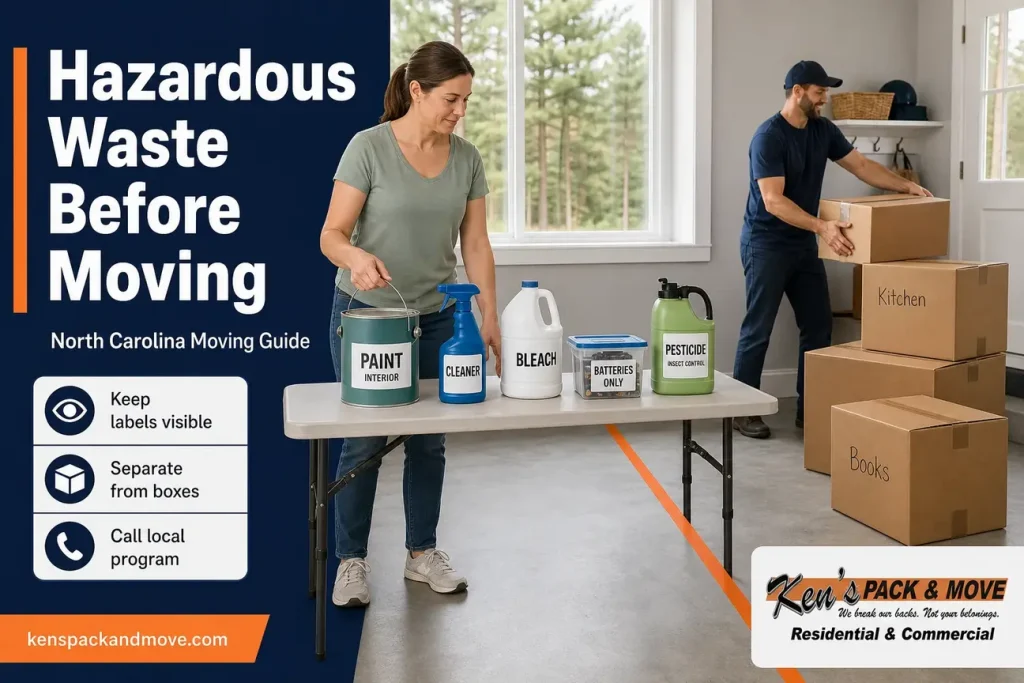
Hazardous Waste Before Moving in North Carolina: 4 Safe Steps
Quick Answer: If you are sorting hazardous waste before moving in Raleigh or elsewhere in the Triangle, identify paint, cleaners, pesticides, fuels, propane containers and batteries before packing begins. Keep products in original, labeled containers, separate them from regular moving boxes, and contact your local solid-waste or household hazardous-waste program for acceptance instructions. Disposal planning is separate from a mover’s restricted-items list, and Ken’s Pack & Move does not transport, accept or dispose of hazardous materials.
Moving day already has a lot of moving parts: parking, elevators, closing dates, lease keys, children, pets, summer heat and afternoon storms. The garage shelf with old paint, the shed with lawn chemicals and the drawer full of loose batteries are easy to overlook until the crew is almost on the way. That is when people are tempted to toss everything into one last box. For hazardous household products, slow down and make a separate plan.
This guide is for Raleigh-area renters and homeowners who need a practical, safe way to sort household products before a local or in-state move. It explains four steps: find questionable items early, keep labels and containers intact, contact the right local program, and keep restricted items out of the moving scope. For the separate question of what a mover will not carry, see Ken’s Pack & Move’s guide to items movers will not move.
Step 1: Find hazardous waste before moving before packing starts
Hazardous products do not belong in the same planning bucket as lamps, books, cookware or folded linens. The U.S. Environmental Protection Agency describes household hazardous waste as common household products that can be dangerous because they are toxic, corrosive, ignitable or reactive, and its examples include paints, cleaners, oils, batteries and pesticides. EPA also tells households to read labels for use, storage and disposal directions on its household hazardous waste guidance.
That matters before a move because packing changes the risk. A product that sat upright on a garage shelf can tip over in a box. A label that was readable on a can may be covered by tape. A loose battery can end up next to keys, tools or coins. A half-used pesticide bottle can be set beside a cleaning product because both were found under the sink.
There are also two different questions to answer. The first is disposal planning: can this item be reused, donated, recycled or accepted by a local household hazardous-waste program? The second is transportation planning: can this item go in a moving truck, or must it be handled separately? Those answers may come from different places, and a moving crew is not a household hazardous-waste facility.
If you are also deciding what the crew can pack, what you should carry yourself, and what needs special handling, Ken’s Pack & Move has a separate guide to what to pack yourself vs. what movers pack. Use that for packing scope, and use this article for disposal planning.
What counts as North Carolina hazardous waste at home?
The phrase North Carolina hazardous waste can sound like an industrial topic, but move preparation often starts with everyday products in a garage, laundry room, bathroom cabinet or shed. North Carolina DEQ identifies household hazardous waste examples such as cleansers, pesticides, furniture strippers, paints and paint thinners, and says those materials should be managed properly through a household hazardous-waste collection event or facility when disposal is necessary. The agency also directs residents to contact local solid-waste management officials for information in their area through its North Carolina household hazardous waste page.
For a move, treat the following as a starting list, not a complete inventory:
- Paint, paint thinner, stains, varnishes and related solvents.
- Drain cleaners, oven cleaners, strong bathroom cleaners and other chemical cleaners.
- Pesticides, herbicides, insect sprays and garden chemicals.
- Furniture strippers, adhesives and workshop chemicals.
- Automotive fluids, fuel containers, oil-based products and similar garage items.
- Propane cylinders, fuel cans and other pressurized or flammable containers.
- Pool and spa chemicals.
- Lithium batteries and other batteries, especially loose, damaged or rechargeable batteries.
Because acceptance rules can vary by county, product, container condition, quantity and collection schedule, do not assume that one Raleigh-area drop-off program takes every item on the list. North Carolina hazardous waste planning should start with your local solid-waste authority, not with a moving box.
Make a room-by-room sweep before the main packing push
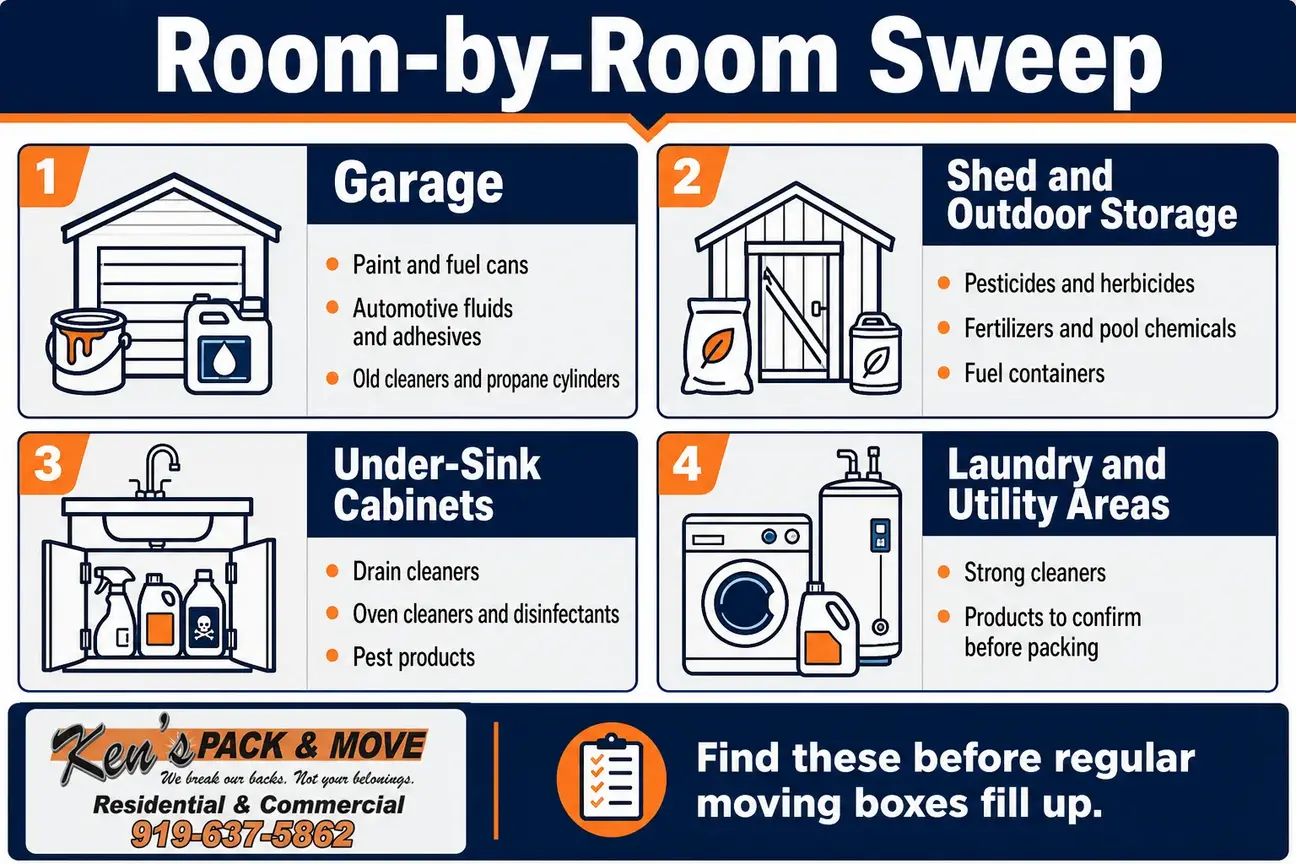
The best time to find hazardous products is before you start filling regular moving boxes. If you wait until the night before the truck arrives, you may have fewer safe options and more pressure to make a quick decision. A simple sweep lets you separate regular household goods from products that need a disposal or confirmation call.
Walk these areas first:
- Garage: paint, fuel cans, automotive fluids, adhesives, old cleaners, lawn equipment products and propane cylinders.
- Shed or outdoor storage: pesticides, herbicides, fertilizers, pool chemicals and fuel containers.
- Under-sink cabinets: drain cleaners, oven cleaners, disinfectants and pest products.
- Laundry and utility areas: strong cleaners, old detergents and specialty stain removers.
- Workshop: solvents, strippers, stains, glues and batteries for power tools.
- Home office or electronics drawer: loose lithium batteries, battery packs, damaged chargers and old devices.
- Basement, attic or parent’s storage area: mystery containers, old paint, unlabeled cans and long-forgotten chemicals.
As you sort, make five labels: “keep and use before moving,” “ask local HHW authority,” “possible donation or reuse,” “not for movers,” and “damaged container—needs instructions.” Do not make a “load last” pile for hazardous products. That turns a disposal question into a truck-loading problem.
If you are hiring help for packing, disclose restricted items before the crew arrives. Packing crews can help with ordinary household belongings when the scope is confirmed, but hazardous materials must be handled separately. For general packing support, see Ken’s Pack & Move’s packing services guide.
Step 2: Keep labels, containers and problem items separate
Once you identify questionable products, the next safe step is to preserve the information on the container. For household products that may be hazardous, labels are not clutter. They are instructions. EPA says to follow product-label directions for use and storage, read labels for disposal directions, keep hazardous products in their original containers and never remove labels. EPA also says not to store hazardous products in food containers.
That means you should not pour leftover solvent into a soda bottle, combine partial cleaners in one jug, or tape over the only readable label on a paint can. Even if you know what the product is today, the person at a collection facility, fire department or local solid-waste office may need the label to advise you.
Use a sturdy tray, bin or box only as secondary containment while you are waiting for instructions. Keep each product upright in its own original container. If a cap is loose, tighten it if you can do so safely. If a container is leaking, bulging, corroded, smoking, hot or giving off strong fumes, do not pack it, move it through the house casually or set it in a vehicle without guidance.
EPA notes that corroding containers need special handling and advises contacting a local hazardous-materials official or fire department for instructions. If there is immediate danger, fire, strong fumes or possible exposure, treat it as an emergency rather than a moving-day errand.
Moving paint safely without guessing the disposal rule
Moving paint safely starts with sorting, not loading. Paint, paint thinner and related products are exactly the kinds of items North Carolina residents should treat as household hazardous-waste planning questions. That does not mean every can has the same local option, and it does not mean the moving truck is the right place for it.
First, separate usable paint from old, dried, leaking or unknown paint. If a local program allows donation or reuse, follow that program’s instructions. If a can is not usable or you do not want it at the new home, contact the local household hazardous-waste program before taking it anywhere. Confirm whether the program accepts that type of paint, whether the original label is required, whether there are appointment rules, and whether there are quantity or packaging instructions.
Second, keep the can in its original labeled container. Do not mix leftover paints together to save space, and do not add solvent or other products. Moving paint safely also means keeping paint separate from cleaners, pesticides, fuels and batteries while you wait for disposal guidance.
Third, do not assume paint can go in ordinary trash or on a moving truck. The right answer may depend on the type of paint, local rules and the condition of the container. If you plan to ask any mover about paint, ask before moving day and get a clear answer. For Ken’s Pack & Move, do not include hazardous materials in the move scope; handle them through the proper local disposal or recycling channel.
For a practical paint inventory, note whether each container is labeled, sealed, rusty, leaking, dried out or still usable. That short list gives local officials better information and keeps paint out of last-minute packing decisions.
Battery disposal moving plan for lithium batteries
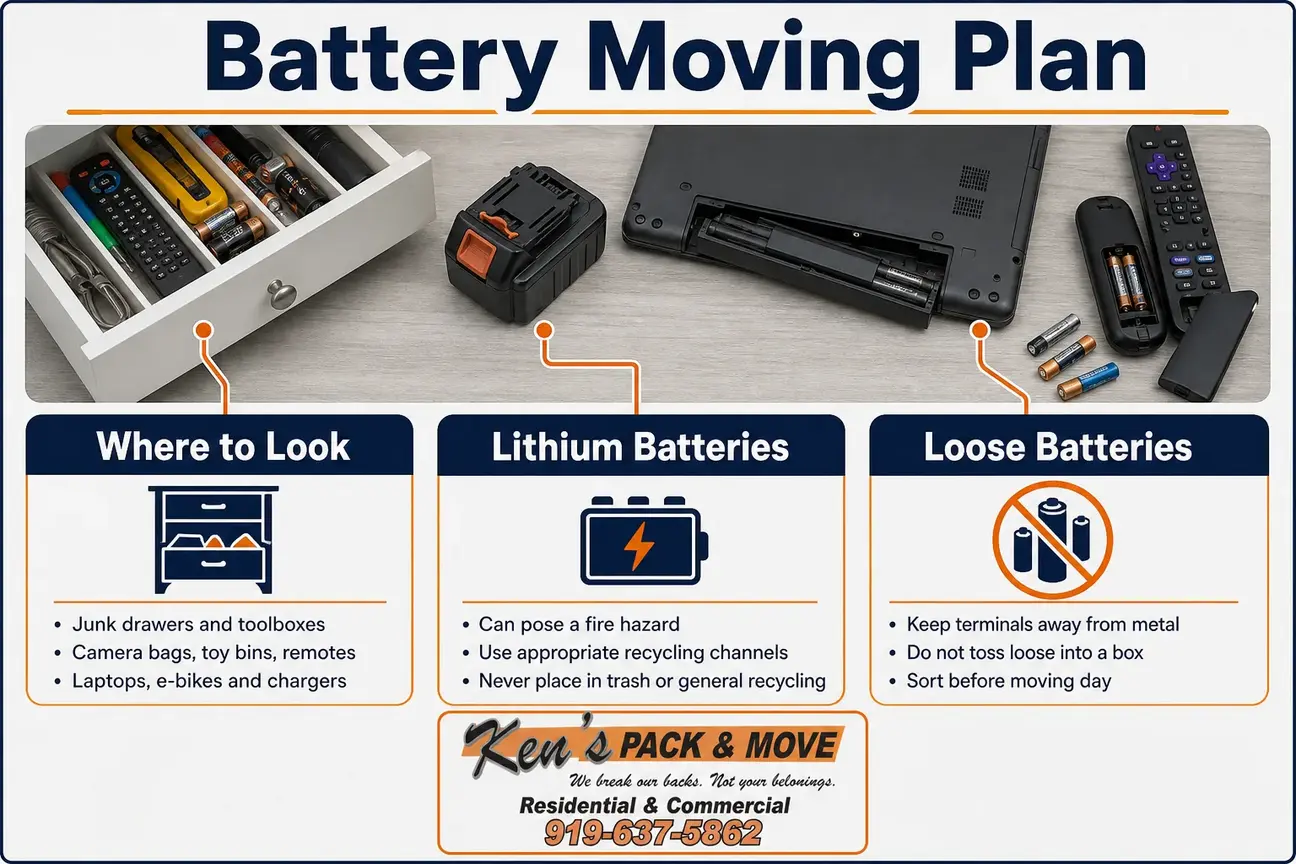
A battery disposal moving plan is easy to overlook because batteries are small. Loose batteries end up in junk drawers, toolboxes, camera bags, toy bins, remotes, laptops, e-bikes, cordless tools and backup chargers. Lithium batteries need particular attention.
PHMSA states that lithium batteries can pose a fire hazard, including when they are no longer useful in consumer products. PHMSA also says private individuals should use appropriate recycling channels and should never place household lithium batteries in the trash or general recycling due to safety concerns on its lithium battery safety page.
For normal, intact loose batteries, keep terminals from touching metal objects. Do not toss loose batteries into a coffee can with nails, keys or coins. Keep them separated, protect the terminals according to the receiving program’s instructions, and confirm whether the recycling or household hazardous-waste program accepts that battery type.
For swollen, leaking, hot, damaged, defective or recalled batteries, do not put them in ordinary recycling, a moving box, a general trash bag or a mixed electronics tote. Ask the local hazardous-waste authority or fire department what to do. Do not try to ship, tape, cool, puncture or disassemble a damaged battery based on a quick internet tip.
Devices with built-in batteries also need care. A laptop, power tool, scooter battery or rechargeable device may follow different local instructions than a loose battery. A practical battery disposal moving checklist separates loose batteries, battery-powered devices and damaged batteries into different questions for the receiving program.
Carry daily-use chargers, laptops, phones and essential devices yourself. If you are using labor-only movers to load a rental truck, do the same battery sort before helpers arrive. Loading help does not turn hazardous or questionable items into acceptable cargo.
Propane before moving: cylinders, grills and fuel cans
Propane before moving deserves its own check because people often remember the grill late in the process. A grill may be ordinary patio furniture, but a propane cylinder is not just another household item. Treat propane cylinders, gasoline cans and similar fuel containers as separate confirmation calls.
Do not place propane cylinders in moving boxes. Do not assume they can ride on a moving truck. Do not puncture, burn, empty, transfer or modify a cylinder to make disposal easier. Keep cylinders and fuel containers away from heat, flames and sparks while you ask for product-specific instructions.
When you contact your local solid-waste authority, household hazardous-waste program or fire department, ask direct questions: Do you accept the cylinder? Do you accept the residual contents? Does the valve condition matter? Is there a separate process for refillable cylinders, disposable cylinders, gasoline cans or mixed fuel? Do I need an appointment?
Propane before moving is especially important on short-notice jobs. If a closing date moves up or a helper cancels, it can be tempting to set the tank beside other garage items and deal with it later. Instead, mark it clearly as “not for movers” and keep it out of the household-goods inventory.
If the grill itself is moving, separate the grill question from the cylinder question. Wipe down ordinary patio items as needed, but keep the fuel container on the restricted-item list until the local authority or product instructions tell you what to do with it.
Step 3: Call the local program and confirm the mover’s restricted list
The third step is to ask the right people the right questions. A disposal program answers where an unwanted product can go. A mover answers what can be packed, loaded and transported as part of a household move. Those are related, but they are not the same.
For Raleigh-area moves, start with the local solid-waste or household hazardous-waste program that serves your current address. If you are moving from Raleigh to another North Carolina town, your current disposal question usually starts where the waste is located, not where your next home will be. If you are unsure, ask the local program how to proceed.
Use state resources to find the right local contact, then confirm the details directly. NC DEQ’s household hazardous-waste page points residents toward local-government facilities and collection events, but a listing does not prove that every site accepts every product on every day. Acceptance can depend on the material, container condition, local schedule and program rules.
What to have ready before you call
When you call or check the local website, have this information ready:
- Product name and type, using the label if available.
- Container size and condition.
- Whether the container is leaking, corroded, bulging or unlabeled.
- Whether the product is paint, thinner, pesticide, cleaner, fuel, propane, battery or unknown.
- Whether you are asking about the contents, the container, or both.
- Your city or county of residence.
- Your moving date, if timing affects your options.
Ask about accepted materials, collection dates, operating hours, appointment requirements, quantity limits and packaging instructions. If the product is damaged, ask whether you should bring it in at all or contact another official first. North Carolina hazardous waste planning works best when you confirm before you drive.
Use your notes from paint, battery and propane sorting when you call. Those categories help you explain the situation clearly without overhandling products or guessing what a facility can accept.
Disposal planning is not the same as a mover’s restricted list
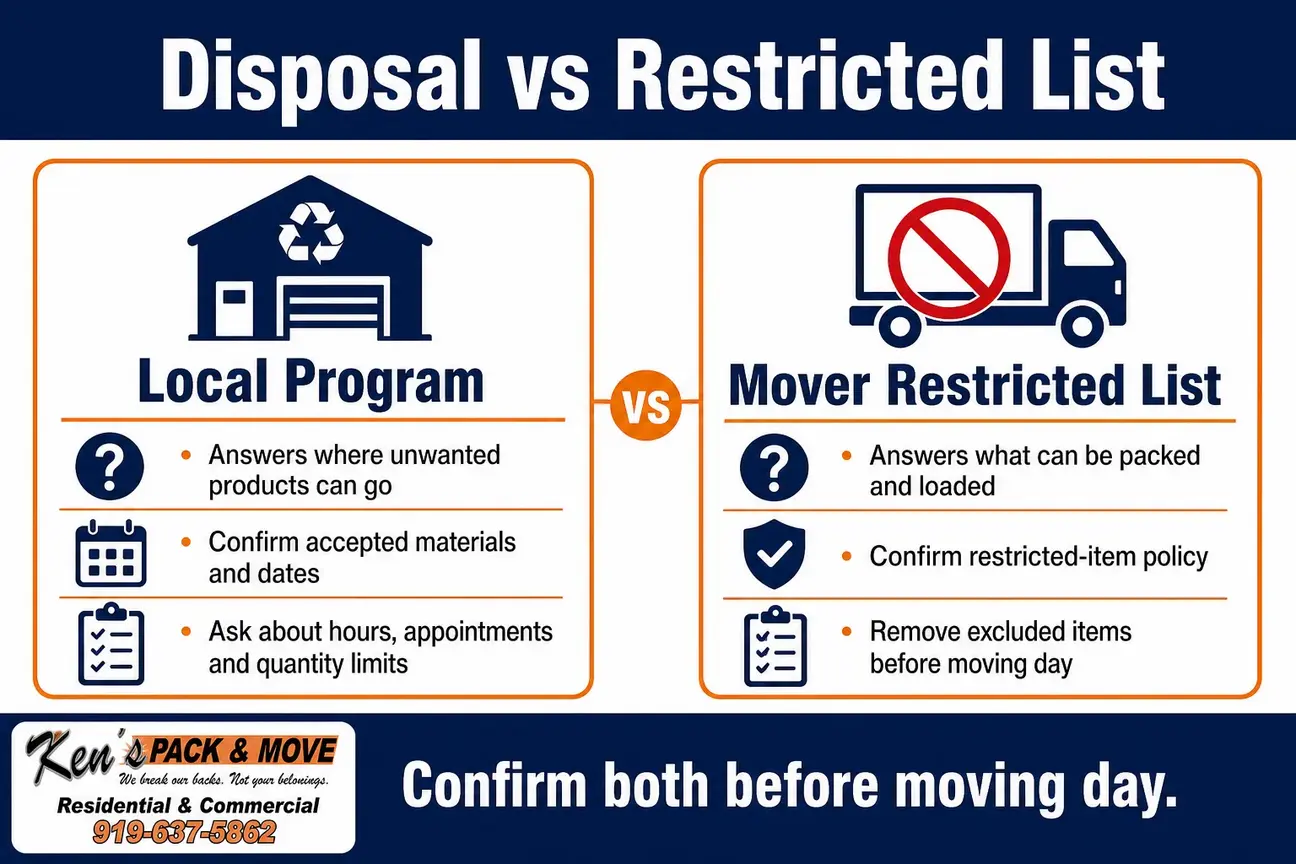
A mover’s restricted-items answer should stay separate from local disposal instructions. A product might be accepted by a household hazardous-waste program but still excluded from the moving truck, so both questions need clear answers before moving day.
| Question | Who should answer it? | What to confirm |
|---|---|---|
| Where can unwanted paint, chemicals or batteries be accepted? | Local solid-waste or household hazardous-waste authority | Accepted materials, dates, hours, appointments, quantity limits and packaging instructions |
| Can a specific item go on the moving truck? | The mover, before moving day | Restricted-item policy and what must be removed from the move scope |
| Can Ken’s Pack & Move accept hazardous waste for disposal? | Do not treat the mover as a disposal facility | Hazardous materials must be handled separately through the proper authority |
| What should happen to a leaking, corroded or actively reacting container? | Local hazardous-materials official, fire department or emergency services as appropriate | Whether it is safe to handle or transport and what steps to take next |
This distinction helps protect the move plan. The crew can focus on household goods that are within the confirmed scope, while you resolve hazardous products through the proper local channel. If you are planning local moving services in Raleigh, build this sorting step into the week before packing whenever possible.
Step 4: Keep restricted items out of the move-day scope
The final step is making sure your sorting work survives the pressure of moving day. Once boxes start stacking up and furniture is being wrapped, a small pile of questionable products can disappear into the flow unless it is clearly marked and kept apart.
Use this week-before checklist to keep the household-goods move clean and organized:
- Walk the garage, shed, cabinets, utility room and workshop before final packing.
- Pull aside paint, cleaners, pesticides, fuels, propane containers, pool chemicals and batteries.
- Keep products in original containers with labels visible.
- Do not transfer products into food, drink or unmarked containers.
- Do not combine leftovers or mix products to save space.
- Place questionable items in a separate, upright holding area away from boxes for the mover.
- List paint cans, stains and thinners by type and container condition.
- Separate loose batteries, battery-powered devices and damaged batteries.
- Mark propane cylinders and fuel containers clearly so they do not get loaded by mistake.
- Call or check the local solid-waste program before taking items to a facility or event.
- Ask about damaged, leaking, corroded or unlabeled containers before handling them.
- Tell the mover about excluded items so they are not included in packing or loading.
- Keep documents, medications, valuables, chargers and daily-use electronics with you.
If you need help with the household-goods side of the move, you can request a free moving quote. Have both addresses, preferred dates, home size and type, stairs, elevators, parking details, large or fragile items, and whether you need packing, labor-only loading or unloading, or debris removal. Keep hazardous materials out of the requested move scope and handle them separately.
What to do when the move is short-notice
Short-notice moves happen: a lease changes, a closing date shifts, a roommate plan falls apart, or another helper cancels. When that happens, the hazardous-product sweep should move closer to the top of the list, not the bottom.
Start with the garage, shed and under-sink cabinets because those are the places most likely to hold products that cannot be treated like normal boxes. Pull those items out before general packing begins. Mark them “not for movers” so they do not get wrapped, boxed or staged by mistake.
Then contact the appropriate local program as soon as possible. If the item is paint, describe the product and container. If the issue is a battery, explain whether it is loose, in a device, damaged or swollen. If the question is propane, ask specifically about the cylinder and any residual contents.
If you are checking availability with Ken’s Pack & Move for a short-notice move, call 919-637-5862. Same-day or last-minute help depends on whether a crew is available, the inventory, access, destination readiness and the confirmed scope. Hazardous materials are not part of that scope and should not be staged for loading.
How Raleigh-area households can keep the move organized
In Raleigh, end-of-month lease turnover, apartment move-in windows, parking limits and afternoon storms can tighten the schedule. Hazardous products add one more layer, but they are manageable if you separate them early.
Use colored tape, sticky notes or a written inventory to keep categories clear. For example, mark regular household goods for packing, carry-yourself items for your own vehicle, and hazardous-waste questions for local disposal guidance. Do not rely on memory once boxes begin stacking up.
If you are in an apartment or condo, keep hazardous products away from hallways, elevators and loading areas. Do not leave questionable containers in a shared trash room or on a loading dock. If a container leaks in a shared space, contact the appropriate property or local official for instructions rather than asking a moving crew to handle it.
For family downsizing moves, assign one person to the hazardous-product sweep. Adult children helping a parent move often find old paint, garden chemicals, batteries and cleaners in several rooms. A single written list helps prevent the same question from being asked twice and keeps the move team focused.
The safest plan for hazardous waste before moving is simple: find it early, keep it labeled, keep it separate, ask the right local authority, and keep it out of the moving-truck plan unless the item has been specifically cleared through the proper channel. Do not mix products, hide them in last-minute boxes or expect a mover to accept disposal responsibility.
Use EPA guidance for labels, original containers and damaged-container caution. Use North Carolina DEQ resources to find local household hazardous-waste contacts and confirm local rules. Use PHMSA guidance for lithium battery safety and recycling channels. Then keep the household-goods move focused on furniture, boxes, packing and access.
Moving rules, building policies and prices change. Confirm scope, date, price and coverage with the mover in writing before moving day.
Frequently Asked Questions
Can I put paint in a moving box?
Do not assume paint can go in a moving box or on a moving truck. Keep paint in its original, labeled container, separate it from regular household goods, and confirm disposal or transportation instructions before moving day.
Can I throw lithium batteries in the trash before moving?
No. Use an appropriate recycling or household hazardous-waste channel for lithium batteries. Keep loose batteries away from metal objects, and ask local officials what to do with damaged, swollen, leaking or recalled batteries.
Should cleaners and pesticides stay in their original containers?
Yes. Keep cleaners, pesticides and similar products in their original containers with labels attached. Do not combine leftovers, transfer products into food containers or cover the label with packing tape.
What should I do with a leaking or corroded container?
Do not place it in a moving box or transport it casually. Keep people and pets away, avoid heat or ignition sources, and contact the appropriate local hazardous-materials official, fire department or emergency service depending on the situation.
Can propane cylinders or gasoline cans go on the moving truck?
Do not assume they can. Ask the mover about restricted items and ask your local solid-waste, household hazardous-waste or fire authority for product-specific instructions. Ken’s Pack & Move should not be treated as a hazardous-material transporter or disposal site.
Where can Raleigh-area residents dispose of household hazardous waste?
Start with the local solid-waste or household hazardous-waste program that serves your address. Confirm accepted materials, operating dates and hours, appointment rules, quantity limits and packaging instructions before taking items to a facility or collection event.
Is hazardous-waste disposal the same as a mover’s prohibited-items list?
No. Disposal planning decides where unwanted products can be reused, recycled or accepted. A prohibited-items list decides what a moving crew will not pack or carry. Resolve both questions before moving day.