
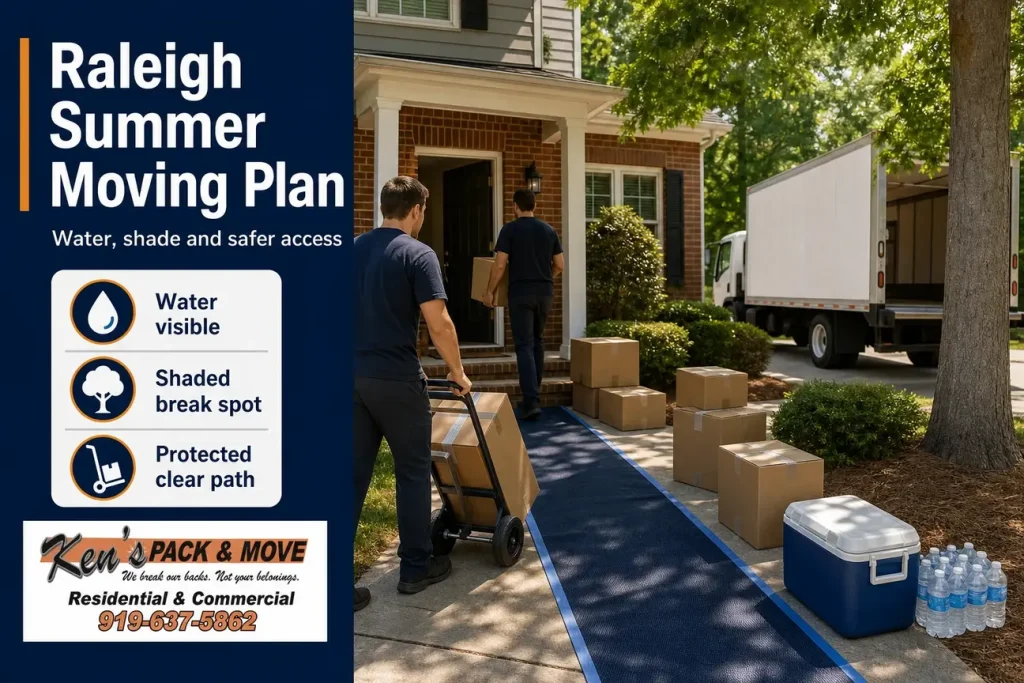
Moving in Raleigh heat: 7 Essential Safety Checks
Moving in Raleigh heat takes more than booking a truck and packing boxes. Raleigh’s humidity can make outdoor work feel hotter than the thermometer shows, so your moving-day plan should start with the heat index, water access, shaded or cooled breaks, and a clear decision point for rain, lightning, slick surfaces, or unsafe conditions. This guide focuses on practical choices for local household moves, apartment moves, DIY truck loading, and short-notice situations around Raleigh and the Triangle.
Quick Answer: Check the National Weather Service Raleigh forecast and heat index before the move and again on moving day. Plan water, shade or air conditioning, and a safe place for children, pets, medications, documents, valuables, chargers, and electronics. Confirm apartment rules, protect floors and entries, and discuss weather-related pauses or schedule changes with the mover before conditions become unsafe.
Safety check 1: Start heat index moving decisions with the Raleigh forecast
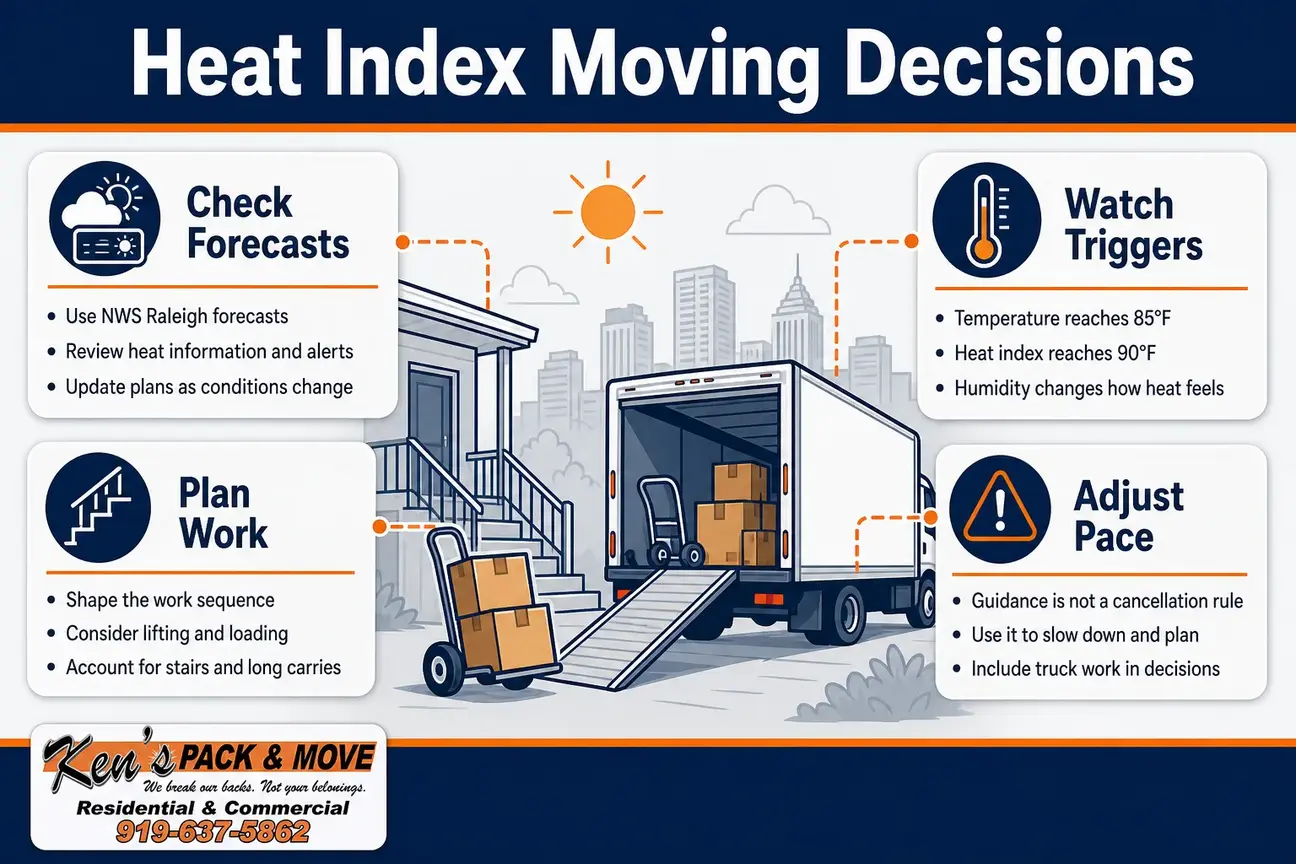
Heat index moving decisions matter because humidity changes how hot the air feels during lifting, loading, stairs, long carries, and truck work. For Raleigh summer moves, do not plan only around the posted temperature. Check current conditions, forecast updates, heat information, and weather alerts through National Weather Service Raleigh forecasts, heat guidance and weather alerts, then use that information to shape the work sequence.
National Weather Service Raleigh heat guidance says to take action to stay cool and safe when the temperature reaches 85°F or the heat index reaches 90°F. That is public safety guidance, not a universal mover cancellation rule. It is a prompt to slow down, plan water, make shade or air conditioning available, and talk through the day before boxes start moving.
Heat index moving planning is especially important for apartments, townhouses, and homes with long walks from parking to the front door. A short carry from a driveway feels different from a third-floor walk-up, an elevator that is not reserved, or a loading zone across a hot parking lot. The harder the access, the more important it is to discuss timing, breaks, and a safe route.
If a heat advisory or other alert is in effect, bring it up with the mover before work begins. Ask whether the forecast changes the sequence, how the crew will handle breaks, and whether a delay, shorter work period, or revised plan should be discussed. Heat index moving should be part of the first conversation, not a rushed decision after the truck is half loaded.
A good forecast check also helps you decide what needs to happen before the crew arrives. Finish packing, clear the route, label rooms, separate essentials, and confirm elevator access early. Those tasks reduce confusion when the day is hot, humid, or interrupted by storms.
Safety check 2: Hot weather moving starts with water, shade and workable access
Hot weather moving is easier to manage when water and shade are built into the layout of the home, not treated as an afterthought. Put water where household members can reach it without crossing the loading path. If you are offering water to the crew, set it in a safe, visible spot that does not block a door, stair landing, ramp, or hallway.
National Weather Service Raleigh heat guidance says outdoor workers should avoid overexertion, especially between 11 a.m. and 6 p.m., and take hourly breaks in shade or air conditioning. For a move, that means identifying the cooled room, garage shade, covered porch, lobby, or other safe rest spot before the first heavy item moves. The right spot depends on the property and the weather.
Good access helps the heat plan. Clear the path from the truck area to the door. Move porch planters, loose mats, toys, extension cords, and small furniture out of the route. If the truck cannot park close to the home or building entrance, the long carry may affect time, effort, and the way the crew sequences the load.
For DIY movers, renting a truck does not remove the need for a hot weather moving plan. Loading furniture into a rental truck still means lifting, walking, and working around a ramp or lift gate. If friends or family are helping, decide who is directing traffic, who is staying inside with children or pets, and who is watching the weather so the whole group is not improvising in the heat.
Hot weather moving also gets harder when boxes are unfinished, pathways are crowded, or the truck is parked far from the entrance. The more you can finish before the crew arrives, the more attention everyone can give to safe access, weather changes, and steady pacing.
Walk the route from the largest room to the truck area before loading starts. Look for narrow turns, loose rugs, low branches, wet grass, steep driveways, uneven sidewalks, and tight apartment corridors. A short walk-through helps the household and crew spot trouble before someone is carrying a dresser, mattress, or stacked boxes through that space.
Hot weather moving is also a timing conversation. If the building, HOA, lease, elevator window, or closing schedule limits when the move can happen, share that information early. The crew cannot plan around a restriction that has not been disclosed.
Safety check 3: Keep moving day hydration simple and visible
Moving day hydration should be simple, visible, and safe. Keep water in more than one place: one spot near the household’s essentials, one spot near a cooled break area, and one spot near the delivery address if you can stage it ahead. Do not place coolers, bottles, or cups where people are carrying boxes, backing down stairs, or turning furniture through a doorway.
NWS Raleigh’s heat guidance says, “Whether you feel thirsty or not, drink plenty of water,” especially while working or exercising outdoors. It is not necessary to turn moving day hydration into a medical formula. The practical point is to make water easy to reach, remind household members to drink before they feel worn down, and avoid saving all breaks for after the hard parts.
Watch for signs that work should stop and a person should move to a cooler place. NWS Raleigh identifies cramping, rapid pulse, heavy sweating, hot red skin, dizziness, confusion, nausea, and vomiting as warning signs that require immediate medical attention. This article is not diagnosing anyone. If warning signs appear, stop work, get the person away from heat when safe, and seek medical help.
If you are coordinating an older adult’s move or a move with children in the home, assign one person who is not carrying boxes to check on people. The person directing moving day hydration should also know where medications, keys, phones, chargers, and first-day supplies are. That keeps a hot, busy move from turning into a search for essentials.
For longer apartment hallways, stairs, or a delivery address without nearby parking, moving day hydration needs a destination plan too. Set aside water and a cooled break area at the new place before the first load arrives, especially if utilities, keys, elevator access, or building rules could slow unloading.
Moving day hydration should be planned for helpers as well as the household. If friends are loading a rental truck, make one person responsible for checking the forecast, opening the cooled break space, and reminding everyone to step out of the heat. A simple role assignment prevents the whole group from pushing through because nobody wants to be the first person to pause.
Safety check 4: Build summer moving safety around children, pets and older adults
Summer moving safety starts by keeping vulnerable people and pets out of the work zone. Children should not be standing in doorways, sitting on stair landings, or walking around open truck doors while furniture is being carried. If possible, arrange childcare, a supervised cooled room, or a trusted nearby location away from the loading path.
National Weather Service guidance says to check on people who may be more vulnerable to heat, including children and older adults. It also says never to leave infants, children, or pets in a parked vehicle, even with the windows cracked. On moving day, a vehicle can seem like a quick holding area, but it is not a safe substitute for supervision in a cooled location.
Pets need a plan before the door starts opening repeatedly. Keep them in a secure, cool area with water and supervision, or arrange for them to stay elsewhere during the busiest part of the move. Put a sign on the door to the pet room if that helps prevent someone from opening it by mistake. Make sure leashes, carriers, medications, and food travel with the household.
For senior or downsizing moves, summer moving safety also means protecting routine. Keep the resident’s medications, glasses, hearing aids, mobility aids, phone charger, destination address, and contact information in one reachable bag. If family members are helping, decide who stays with the person and who answers questions from the crew. For a broader planning view, Ken’s Pack & Move has a senior moving checklist that can help families organize the people side of the move.
Summer moving safety is easier when one adult is free to monitor the household instead of carrying every box. That person can answer the door, watch the weather, check on pets, keep children clear of the path, and make sure moving day hydration supplies are not accidentally loaded.
For a busy apartment or townhouse move, that same adult can also watch for doors that need to stay closed, pets that may bolt, children moving toward stairs, or visitors entering the work area. A moving crew may be focused on furniture, truck space, and safe carrying routes. The household should manage children, pets, personal medications, and family needs.
Safety check 5: Keep essentials, medicine and restricted items out of the loading stream
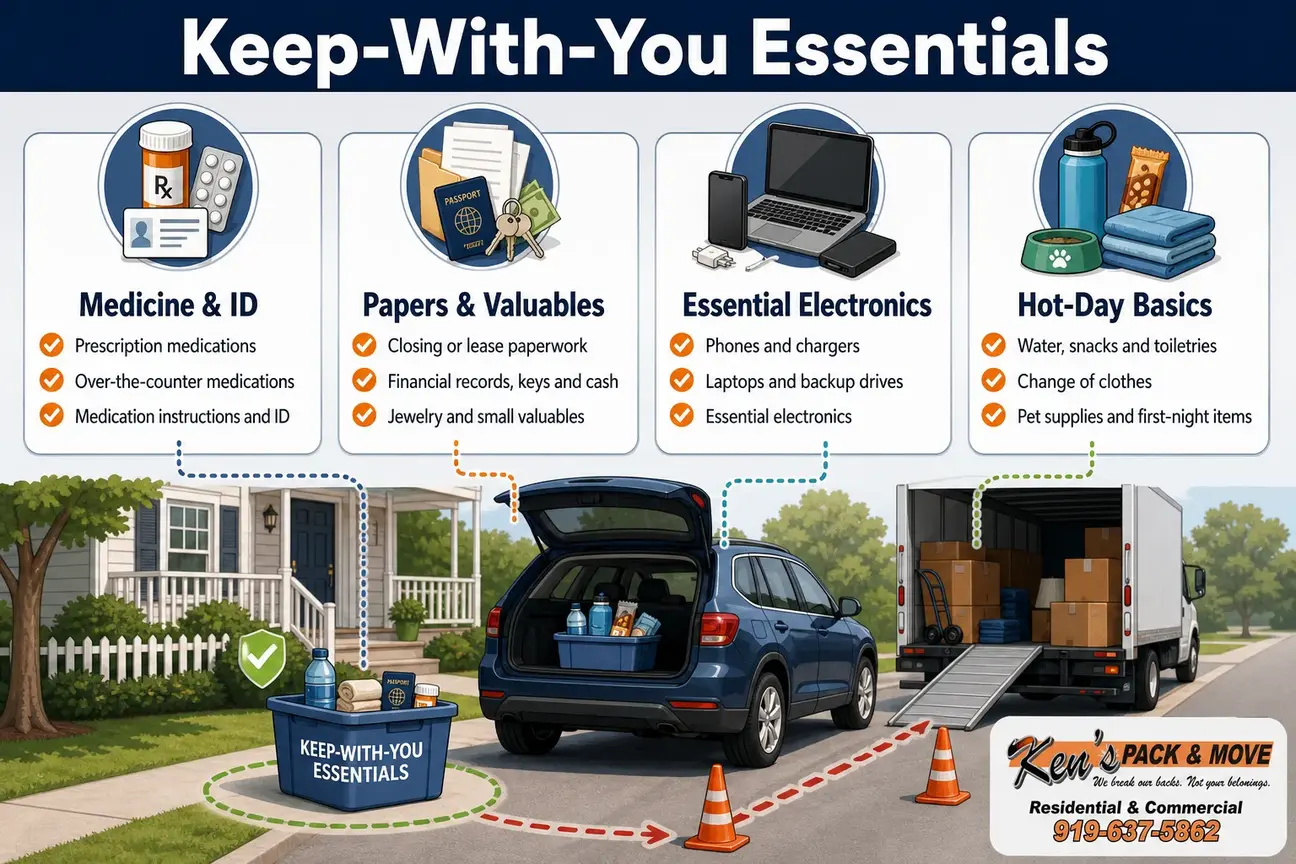
A summer move goes smoother when there is one bag or bin that does not enter the truck-loading stream. Keep it in your vehicle, with a responsible adult, or in a clearly marked room that is not being packed. Tell the crew what is staying with you so it does not get wrapped, stacked, or carried out by mistake.
Include prescription and over-the-counter medications, medication instructions, identification, closing or lease paperwork, financial records, keys, cash, jewelry, small valuables, phones, chargers, laptops, backup drives, and essential electronics. Add water, snacks, toiletries, a change of clothes, pet supplies, and first-night items. In hot weather, essentials should not sit on a sunny porch or in an unattended vehicle.
Do not assume a moving truck or personal vehicle provides the right storage conditions for medications or electronics. Follow the medication label, pharmacist instructions, and manufacturer guidance. If you have temperature-sensitive items, ask the pharmacist or manufacturer what conditions are required, then keep those items under your direct control.
This is also the right time to separate items movers should not carry or that require special discussion. Lithium batteries, chemicals, fuels, cleaners, and other household hazardous products do not belong in ordinary box packing without review. The U.S. Pipeline and Hazardous Materials Safety Administration provides guidance on lithium battery safety, and the EPA explains common household hazardous waste concerns. Confirm restricted items with the mover before moving day.
If you want help deciding what to pack yourself and what to leave for the crew, use the same principle: essentials and valuables stay with the household; ordinary household goods can be discussed as part of full or partial packing. Ken’s Pack & Move offers packing services for local moves when that scope is confirmed in the quote.
A clear essentials bag supports hot weather moving because nobody has to dig through loaded boxes for medicine, chargers, pet food, or cooling supplies. It also supports summer moving safety by keeping fragile, valuable, and time-sensitive items away from open doors and outdoor staging areas.
Electronics, medications, and refrigerator-related items need a different plan from furniture. Do not stage laptops, tablets, backup drives, chargers, medication bags, or small electronics in direct sun while people load furniture. If these items must be near the door for a few minutes, keep them shaded, watched, and separated from the main carry path.
If a refrigerator or freezer is part of the move, discuss preparation before moving day. Do not wait until the crew arrives to decide what happens to food, ice, water lines, loose shelves, or appliance contents. Ken’s Pack & Move should not be presented here as providing appliance disconnection, plumbing, or refrigeration service unless that is confirmed for the job. The safe planning point is to ask early and prepare the appliance according to the manufacturer, property rules, and the mover’s confirmed scope.
Perishable food is not a good candidate for the moving stream in hot weather. Use coolers or your own vehicle when appropriate, and keep food safety decisions with the household. If the appliance is going into storage elsewhere or the move has a delayed delivery, discuss that scenario separately before anyone starts loading.
Heat index moving decisions can also affect load order. If certain household items should be kept out of sun or loaded near the end, say so during the walk-through. Do not expect the crew to know which box contains a laptop, medication, legal file, or backup drive unless you have kept it separate or clearly communicated it.
Safety check 6: Plan apartment access, floor protection and storm pauses before rain starts
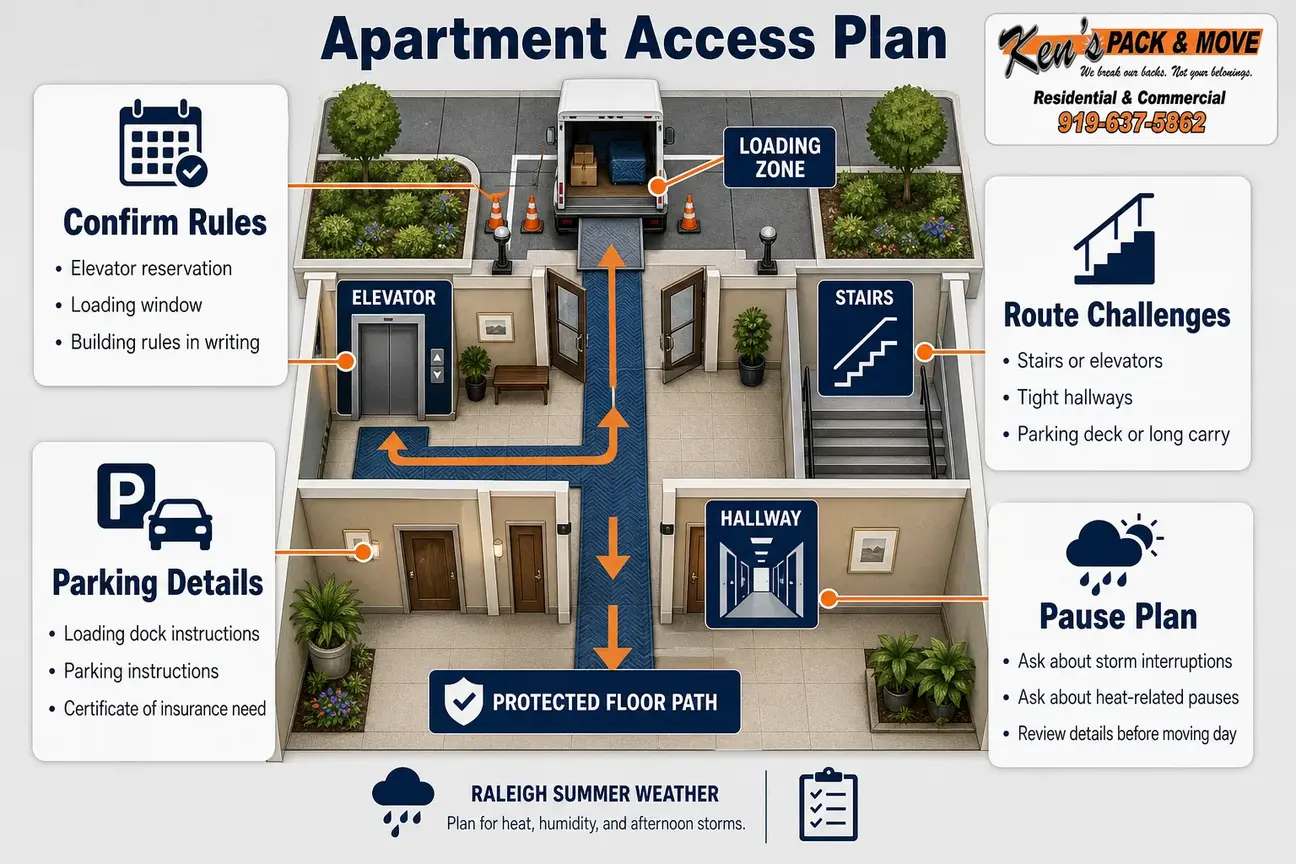
Apartment moves in Raleigh summer heat require more coordination than a simple front-door move. Confirm the elevator reservation, loading window, loading dock or parking instructions, certificate of insurance requirement, and building rules in writing. If the building has a move-in or move-out window, ask what happens if a storm or heat-related pause interrupts that window.
Ken’s Pack & Move handles local household moves, including apartments and condos, when the scope and schedule are confirmed. If your move involves stairs, elevators, tight hallways, a parking deck, or a long carry, review the details with apartment movers in Raleigh before moving day. Access details can affect timing, crew planning, and how the move is sequenced.
Ask the property manager whether floor protection is required, where trucks may stop, which doors may be used, and whether mats, runners, elevator pads, or other protection are building-controlled. Do not assume every building allows the same setup. If the building supplies elevator pads or requires a specific entry route, get that instruction in writing and share it before the move.
For townhouses, think about heat and weather at each transition point: driveway to porch, porch to entry, entry to stairs, stairs to bedrooms. A shaded front door can still lead to a hot stairwell. A back entrance may be shorter but slick after rain. Decide which route is safest based on the weather, surfaces, and what the mover can confirm on site.
Hot weather moving in an apartment building also depends on elevator access and door timing. Holding doors open for long periods may affect cooling, security, and building rules, so clarify the route and loading window before the crew arrives.
Raleigh summer weather can switch from heavy heat to a fast storm. That changes the move. Wet steps, slick thresholds, damp cardboard, and open truck doors can create problems for people and belongings. Before the day starts, choose the clearest route and remove anything that can slide, curl, or catch a foot.
Ask what floor and entry protection will be used for your move, but do not assume a particular material or equipment package unless it is confirmed. Furniture pads and stretch wrap may be part of a moving plan for certain items, but the exact protection depends on the scope, surfaces, weather, and access. If a landlord, HOA, or property manager has rules, share them early.
Keep towels or other household-approved materials available for moisture near entries, but do not create a trip hazard. A towel that bunches up under a dolly, foot, or furniture leg can make the route less safe. Recheck floors after rain, after carrying items from a damp truck area, and before moving heavy furniture through a tight hallway.
If a truck, container, or loading activity may affect a public sidewalk, curb lane, or street, review City of Raleigh right-of-way rules in advance. Raleigh’s right-of-way services page is the place to start for current requirements. Do not block public access without confirming what applies to your situation.
Summer moving safety includes the entryway after the storm passes. Even when the rain stops, wet cardboard, damp shoes, and humid air can keep floors slick. Slow the carry path down until the route is clear again.
Safety check 7: Moving in Raleigh heat means confirming the mover questions in writing
Summer moving safety is not only about heat. Thunderstorms can bring lightning, heavy rain, gusty wind, and slick surfaces. A good plan says what stops immediately, what can wait indoors, and who makes the next call. It should not depend on the crew, family, and property manager all making decisions at the same time in a storm.
National Weather Service Raleigh lightning guidance says to get everyone inside at the first sign of thunder or lightning and keep them inside until at least 30 minutes after the last sign. For a move, that can mean pausing carrying, closing truck doors when safe, securing loose boxes, staying off a wet ramp, and keeping people out of exposed areas until conditions improve.
Heavy rain can also change which items move next. Electronics, paperwork, mattresses, upholstery, and open boxes may need to stay protected while the crew and household discuss the next safe step. If the destination has an elevator window or the origin has a lease deadline, discuss weather pauses early instead of assuming the original order will still work.
No article can promise a specific weather procedure for every home, apartment building, or moving day. The right choice depends on current conditions, surfaces, access, building rules, and what has already been loaded. The important part is to discuss the options before conditions deteriorate.
Heat index moving and storm planning belong in the same conversation because Raleigh summer weather can shift quickly. A safer sequence may mean loading certain items earlier, holding sensitive items indoors, or pausing until the route is safe enough to use.
The best time to talk about heat, rain, and lightning is before the truck is open and the hallways are full. Use the walk-through or quote conversation to ask practical questions. Write down the answers where possible, especially if a change in timing, scope, price, valuation, or building access might result from a weather delay.
- Which heat-index forecast or weather alert should trigger a conversation before work begins?
- Where can the crew and household members take shaded or air-conditioned breaks?
- How will moving day hydration be handled without blocking doors, ramps, stairs, or hallways?
- Is there a safer alternate route if the first route becomes too hot, wet, or crowded?
- How should the loading order change for electronics, medicine, paperwork, mattresses, or upholstered items?
- What happens if thunder, lightning, gusty wind, heavy rain, or slick surfaces make work unsafe?
- Are elevator, loading dock, parking, HOA, or building-hour restrictions affected by a delay?
- How will any revised scope, timing, price, or valuation choice be confirmed in writing?
For in-state household moves, North Carolina consumers can review the NCUC’s Moving 101 guidance on estimates, valuation, and checking a mover. A summer weather plan does not replace the estimate. It helps make sure the estimate conversation includes access, stairs, elevators, parking, packing, large or fragile items, and weather-related constraints.
If your move is short notice because a lease changed, a closing moved, helpers canceled, or another mover fell through, call to check availability rather than assuming the schedule is open. Ken’s Pack & Move offers same-day and last-minute moving help only when a crew is available, and a form submission is a request, not a reservation.
These questions keep hot weather moving practical instead of vague. They also make summer moving safety easier to follow because everyone knows where water is, where the safe break area is, and what conditions should pause the work.
A sequence keeps the day from becoming a scramble. The exact timing depends on your home, building rules, crew availability, traffic, and weather, but the order below gives Raleigh households a safer way to think through heat index moving, rain planning, moving day hydration, and essentials.
| Move stage | What to check | Why it matters in summer |
|---|---|---|
| Before moving day | Forecast, heat index moving concerns, apartment rules, parking, elevator window, right-of-way needs, and quote details | Weather and access can affect the sequence, break plan, and written scope |
| Morning check | Current forecast, alerts, moving day hydration supplies, cool break area, household essentials bag, children and pet plan | Conditions can change between booking and moving day |
| Before loading | Clear route, floor protection expectations, heat-sensitive items, medication and electronics bag | People should not search for essentials while furniture is moving |
| During loading | Water access, breaks, weather changes, slick surfaces, blocked paths, and open truck time | Heat, humidity, and storms can change the safest next step |
| At delivery | Entry route, wet floors, elevator or stair access, essentials bag, refrigerator or appliance instructions | The destination can have different risks than the pickup address |
For DIY truck users, the same sequence applies. If you only need loading and unloading help, explain the truck size, parking spot, stairs, elevator, and destination access when requesting labor. Ken’s Pack & Move offers labor-only movers for loading and unloading when the scope is confirmed.
For full-service local moves, include packing needs in the quote conversation. Hot weather moving is harder when packing is unfinished, boxes are open, and loose items are spread across rooms. If you need full or partial packing, say so up front so the move plan matches the actual workload.
Ken’s Pack & Move serves local household moves in Raleigh and the Triangle, including homes, apartments, condos, and townhouses. Confirmed services include local moving, full or partial packing and unpacking, labor-only loading and unloading, furniture disassembly and reassembly, apartment moves, senior moves, and debris removal as an add-on to a move. Longer moves within North Carolina require a quote.
For Raleigh households, the matching service page is local moving services. If your move starts or ends in Raleigh, you can also review the Raleigh moving company page for location-specific service information. Ken’s Pack & Move has one office in Cary; customers are served at their addresses.
To discuss a summer move with the team, request a free moving quote or call 919-637-5862. Have both addresses, preferred dates, home size and type, stairs, elevators, parking limits, access restrictions, large, heavy, fragile or high-value items, and whether you need packing, labor-only help, or debris removal. The company confirms date, crew, scope, and price directly.
Short-notice help depends on crew availability. Calling is the best way to check whether a same-day or last-minute move can be discussed, but no form submission or phone call by itself confirms a reservation. If weather may affect the job, ask how the scope and schedule will be confirmed in writing.
When you request the quote, mention heat index moving concerns, apartment access, and any moving day hydration setup you can provide. Those details help the conversation stay specific without promising a schedule, final price, or weather outcome.
Moving in Raleigh heat is more manageable when the household, mover, and property manager are working from the same plan. Check the heat index, not just the temperature. Put water where people can reach it safely. Keep children, pets, medications, documents, valuables, chargers, and electronics out of the work zone. Decide how rain, lightning, slick surfaces, and building rules will be handled before the day gets complicated.
Use hot weather moving planning to make better decisions, not to force unsafe work. If conditions change, pause the conversation, review the route, check the forecast, and discuss the next step with the mover. For apartments and condos, get building rules in writing so an elevator window, parking rule, or COI requirement does not collide with a weather delay.
Summer moving safety comes down to a few repeatable habits: watch the forecast, keep moving day hydration easy to reach, protect vulnerable people and pets, separate essentials, and talk through weather pauses before they are needed. A clear plan helps the day stay organized even when Raleigh heat and storms change the pace.
Moving rules, building policies and prices change. Confirm scope, date, price and coverage with the mover in writing before moving day.
Frequently Asked Questions
What heat index should make me rethink a Raleigh moving day?
Use the current National Weather Service Raleigh forecast and heat-index reading rather than temperature alone. NWS Raleigh advises taking action to stay cool and safe when the temperature reaches 85°F or the heat index reaches 90°F. That guidance is not a universal cancellation rule, so discuss the conditions with the mover.
How often should people take breaks while moving in hot weather?
NWS Raleigh says outdoor workers should avoid overexertion, especially between 11 a.m. and 6 p.m., and take hourly breaks in shade or air conditioning. A household or mover may need a different plan depending on the site, forecast, work intensity, and access to cooling.
What should I do with children and pets during the move?
Keep them away from the loading path in a cool, supervised location. Do not use a parked vehicle as a holding area for children or pets, even briefly. For pets, arrange a secure room, carrier, sitter, or safe off-site location before doors start opening repeatedly.
Should medications and electronics go on the moving truck?
Keep medications, documents, valuables, chargers, and essential electronics with the household. Follow medication labels, pharmacist instructions, and manufacturer guidance for storage. Do not assume a truck, porch, or parked vehicle provides the right conditions.
What happens if lightning or heavy rain starts?
Move people indoors at the first sign of thunder or lightning and discuss next steps with the mover. Loading, ramp use, outdoor staging, open boxes, and electronics handling may need to pause or be resequenced until conditions are safer.
How can I protect apartment floors and entryways in summer rain?
Confirm the building’s moving rules, elevator reservation, loading window, parking instructions, and any certificate-of-insurance requirement. Agree with the mover on the entry route and floor-protection plan, and check surfaces for moisture before carrying heavy items.
What should I tell a mover when requesting a Raleigh summer quote?
Provide both addresses, preferred dates, home size and type, stairs, elevators, parking restrictions, long carries, large or fragile items, and whether you need packing, labor-only help, or debris removal. Also mention heat, storm, building-access, or right-of-way concerns.
Sources
- National Weather Service Raleigh — local forecasts, heat index and heat safety guidance, lightning safety information and weather alerts
- City of Raleigh — Right-of-Way Services
- Pipeline and Hazardous Materials Safety Administration — Lithium Battery Safety
- U.S. Environmental Protection Agency — Household Hazardous Waste
- North Carolina Utilities Commission — Moving 101