
Change Address North Carolina: Easy After-Move Checklist
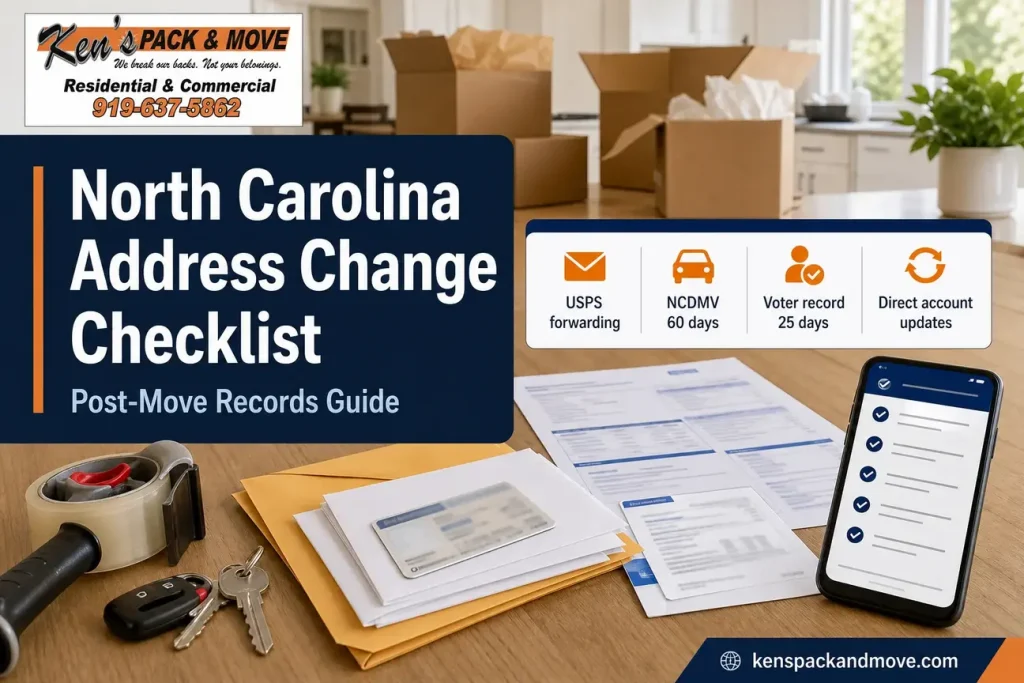
Quick Answer: To change address North Carolina records after a move, start with USPS forwarding, then update NCDMV, voter registration, employer, financial, insurance, school, vehicle, subscription, and delivery records directly. USPS forwarding can help redirect eligible mail, but it is not the same as updating every account. A moving company handles the physical move; it does not submit address changes for government agencies, banks, insurers, schools, employers, or subscription services.
If you just moved in Raleigh or elsewhere in the Triangle, it is easy to focus on unpacking and forget the paperwork. The safest approach is to work by deadline: submit mail forwarding first, handle driver and vehicle records within the state timeline, update voter records before the voter-registration deadline, and then work through the private accounts that affect pay, bills, benefits, deliveries, and insurance documents.
How to change address North Carolina records after the boxes are in
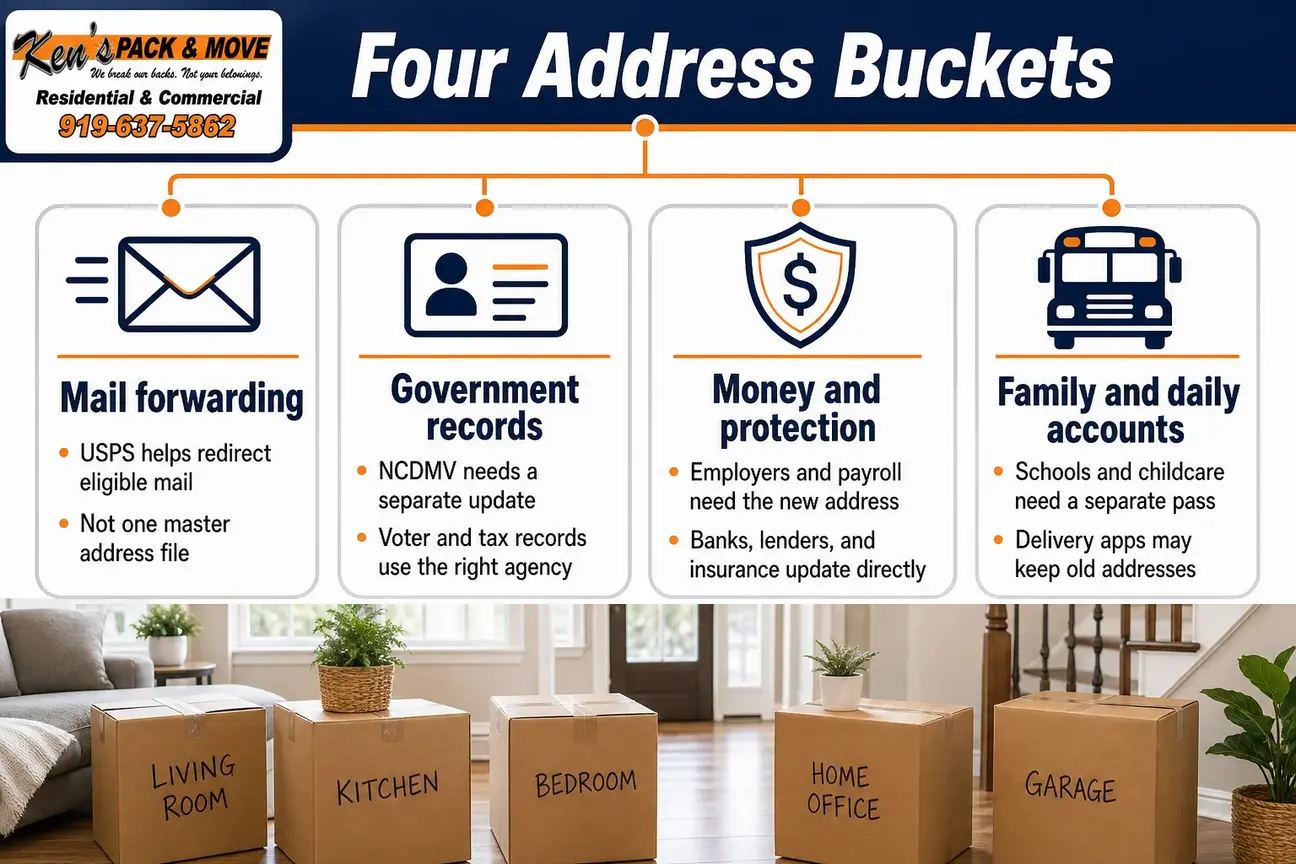
The main thing to remember is that “changing your address” is not one single task. It is a set of separate updates, and each update goes to a different place. Your old landlord, your bank, USPS, NCDMV, your insurance company, your child’s school, and your delivery apps do not automatically share one master address file.
For a practical post move checklist, separate the work into four buckets:
- Mail forwarding: USPS mail forwarding helps redirect eligible mail from the old address to the new one.
- Government records: NCDMV, voter registration, tax-related records, and other public records must be updated with the right agency.
- Money and protection: Employers, payroll, banks, lenders, retirement accounts, and insurers need direct updates.
- Daily life: Schools, childcare, prescriptions, subscriptions, delivery apps, utilities, parking permits, and memberships should be checked one by one.
Use a simple tracking note for each account: “date completed,” “confirmation saved,” and “first statement checked.” That keeps your post move checklist from becoming a pile of half-finished tabs and forgotten emails.
USPS mail forwarding should be your first administrative task
USPS mail forwarding is a good first step because it catches many items that still go to the old address while you update senders directly. USPS says movers can submit a permanent Change of Address request and that an approved request may take at least 7–10 business days to take effect through the official USPS Change of Address process. Start there instead of using an unofficial forwarding site.
USPS mail forwarding is not a complete address update. USPS describes forwarding as mail being redirected piece by piece, which means you still need to tell banks, employers, insurers, government agencies, subscription companies, and recurring senders where you live now.
Use this USPS mail forwarding checklist:
- Choose permanent forwarding if the move is permanent.
- Select the correct option for an individual, family, or business move.
- Complete the identity-verification step using the current USPS instructions.
- If online verification does not work, follow USPS instructions for the paper or in-person option.
- Watch forwarded mail for senders still using the old address.
- Update important senders directly as soon as you spot an old address.
- Keep the confirmation information with your other move records.
For households moving within NC, this is especially helpful during the first few weeks when lease paperwork, school notices, insurance documents, and financial statements may still be catching up.
NCDMV address change comes next for driver and vehicle records
The NCDMV address change is one of the most important government updates after a move. NCDMV says people moving within North Carolina must update their physical address within 60 days and obtain a replacement license or identification card as required under its Moving Within North Carolina instructions.
Do not wait for forwarded mail to handle this. USPS mail forwarding and NCDMV address change tasks are separate. USPS can redirect eligible mail; NCDMV maintains driver, ID, and vehicle records.
Your NCDMV address change checklist should include:
- Update the physical address on your driver license or ID record.
- Request a replacement license or ID when required by current NCDMV instructions.
- Review vehicle-registration instructions for the household’s vehicles.
- Update each driver separately when household members have individual records.
- Check whether vehicle loan, lease, toll, parking, or insurance records also need the new address.
NCDMV also provides broader moving guidance for people relocating to or inside the state. New residents and households with vehicle-registration questions should check current NCDMV pages before assuming every vehicle-document step is the same for every household.
Because procedures can change, avoid relying on old screenshots or forwarded registration mail. Complete the NCDMV address change through the current official process and save confirmation records.
A moving within NC timeline for the first month
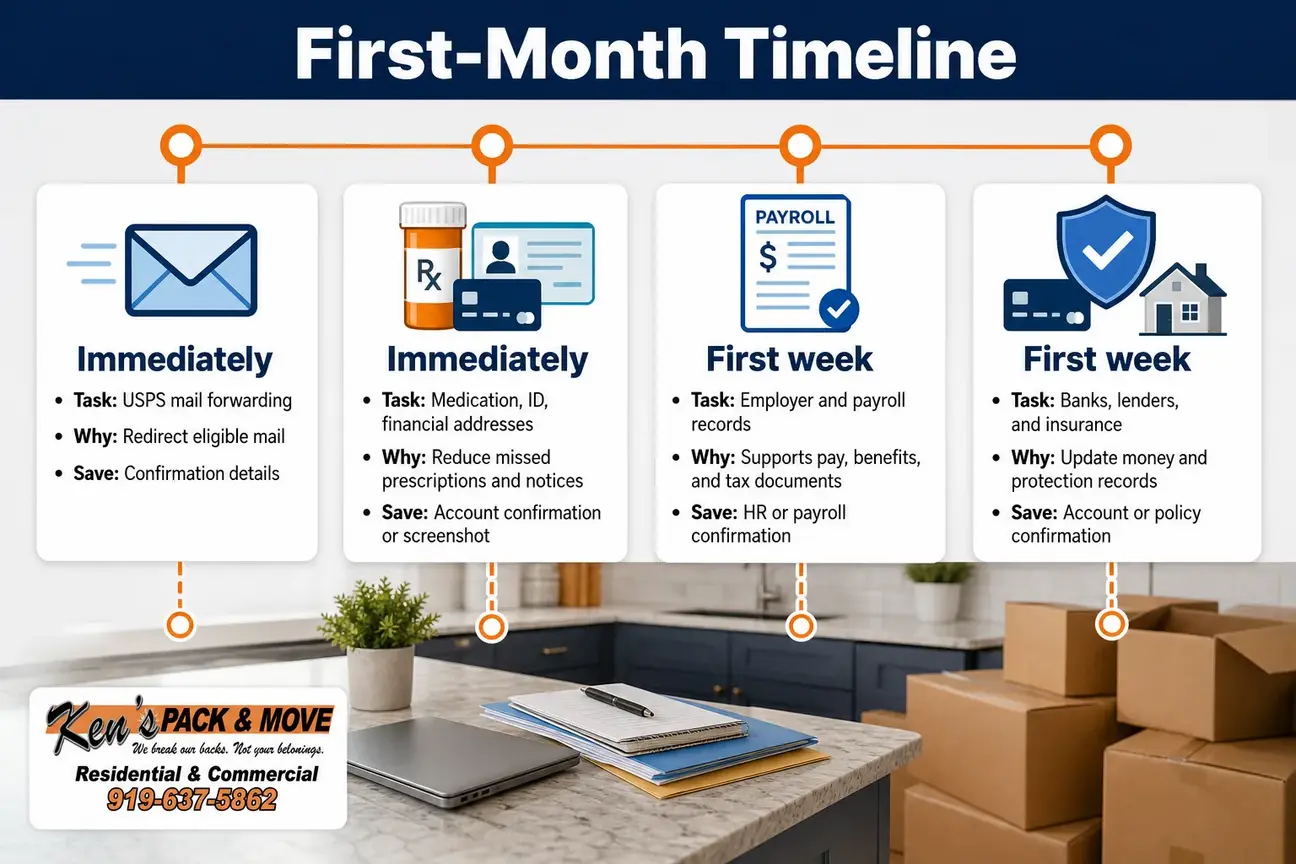
A household moving within NC usually has a mix of urgent tasks and “as mail arrives” tasks. The table below keeps the order practical without pretending every private account has the same deadline.
| Timing | Address task | Why it matters | Proof to save |
|---|---|---|---|
| Immediately | USPS mail forwarding | Helps redirect eligible mail while you update senders directly | Confirmation details |
| Immediately | Medication, ID, and financial-document addresses | Reduces missed prescriptions, replacement cards, and important notices | Account confirmation or screenshot |
| First week | Employer and payroll records | Supports pay, benefits, tax documents, and emergency contacts | HR or payroll confirmation |
| First week | Banks, lenders, and credit cards | Keeps statements, replacement cards, and notices headed to the right place | Confirmation number or secure message |
| First week | Renters, homeowners, and auto insurance | Lets the insurer review the new address and documents | Updated declarations or policy note |
| Within state timeline | NCDMV address change | Updates driver, ID, and vehicle records under current NCDMV instructions | NCDMV confirmation |
| Before voter-registration deadline | Voter registration address | North Carolina describes the voter-registration deadline as 25 days before Election Day | Confirmation from the official election process |
| First month | Schools, childcare, and emergency contacts | Keeps pickup, transportation, and urgent contact records current | School or program confirmation |
| First month | Subscriptions and deliveries | Prevents packages and recurring orders from going to the old address | Updated account profile |
Keep using this moving within NC timeline until your first full billing cycle at the new home has passed. If any statement, shipment, renewal notice, or pay document still shows the old address, update that sender directly and save the confirmation.
Update voter registration 25 days before Election Day
Voter registration belongs near the top of the list, even though it is not handled by the mover, USPS, or your landlord. If you moved across town, into another county, or from another part of North Carolina into the Triangle, your voter-registration address should match your current residence before the next applicable election deadline.
The North Carolina State Board of Elections describes the regular voter-registration deadline as 25 days before Election Day. Put another way, voter-registration address changes are due by that registration deadline, so do not rely on forwarded mail, a landlord notice, or a moving receipt to update your election record.
Because election rules and deadlines can vary by election, check the current North Carolina election instructions or your county board of elections after you move. If you are moving within the same county, ask about the current in-county address-change process. If you moved counties, follow the current registration update process for your new residence.
Put voter records on your post move checklist with these tasks:
- Confirm the correct residential address for registration.
- Update your mailing address if it differs from your residence.
- Check the registration deadline for the next election, using 25 days before Election Day as the regular deadline.
- Confirm your record before Election Day instead of waiting until the last minute.
- Save any confirmation or submitted form record.
USPS mail forwarding does not update voter registration. NCDMV address change steps also should not be treated as a substitute unless the current official process specifically says the voter update is included and you complete that step.
Tell your employer and update payroll records
Your employer may need the new address for payroll, benefits, tax documents, emergency contacts, workplace location records, remote-work records, and retirement plan notices. There is no single universal employer deadline that applies to every household, so treat this as an immediate practical task rather than a one-size-fits-all legal rule.
For most renters and homeowners, the employer update is quick but easy to forget. If you changed counties or moved from another North Carolina city into Raleigh, the address may affect where documents are mailed or which local office, benefits portal, or emergency contact file should be updated.
Check these employer-related records:
- Human resources profile
- Payroll system
- Benefits administrator
- Retirement plan or pension portal
- Health savings or flexible spending account portal
- Emergency contact information
- Remote-work or hybrid-work location records, if used by your employer
- Professional licenses, memberships, or credentials tied to a mailing address
After you submit the change, check the next pay stub, benefit notice, and tax-document portal. Save a confirmation screenshot or email if the system provides one.
Update banks, lenders, and financial accounts carefully
Financial accounts should be updated directly, even if USPS mail forwarding is active. Forwarded mail can help you spot missed senders, but it is not a long-term account-management plan. A bank, lender, credit-card issuer, or investment platform needs the address in its own system.
Work through these accounts one at a time:
- Checking and savings accounts
- Credit cards
- Mortgage or landlord-related payment records
- Auto, student, and personal loans
- Investment accounts
- Retirement accounts
- Payment apps and digital wallets
- Tax-preparation and tax-document accounts
- Safe-deposit box or branch records, if applicable
For security, log in through the provider’s official site or app rather than clicking a random email link. After each update, save the confirmation number or screenshot. When the next statement arrives, make sure it shows the new address.
If you are moving within NC because of a closing, lease change, or family downsizing, also check autopay details. The payment method may still work, but the billing profile, mailing address, and property address can be stored in different fields.
Notify insurance providers and ask what changes
Insurance updates matter because the address may be tied to the insured property, garaging location, mailing address, service area, or policy documents. Do not assume your old policy details automatically fit the new home. Contact each provider and ask what the new address changes, if anything.
Review these policies and records:
- Renters insurance
- Homeowners insurance
- Auto insurance and garaging address
- Health insurance mailing address
- Life insurance records
- Umbrella coverage
- Flood, property, or specialty coverage where applicable
- Insurance records tied to a vehicle loan, lease, mortgage, or landlord requirement
Ask the insurer whether the move changes coverage territory, documentation, renewal notices, deductible details, proof-of-insurance documents, or billing. Do not rely on USPS mail forwarding for policy documents or proof of coverage. Update the insurer directly and keep a record of the change.
If you moved from an apartment to a house, from a house to a condo, or from a parent’s long-time residence to a senior-living setting, describe the property accurately. If the insurer asks for documents, follow that provider’s current instructions.
Schools, childcare, and family contact records need a separate pass
Families often complete the physical move and then realize the school, daycare, after-school program, bus record, or emergency contact sheet still lists the old address. Put children’s records on the post move checklist before the first full school week at the new home.
Check the following:
- School address and household contact record
- Daycare or after-school program records
- Pickup permissions
- Bus or transportation information
- Emergency contacts
- Medical and medication contacts held by the school
- Custody or authorized-pickup documents, if applicable
- Student housing or campus records for college students
Ask the school or program what proof of residence, immunization record, transfer document, or parent identification it currently requires. Do not assume one Triangle school, childcare center, or campus uses the same document list as another.
For adult children helping a parent move, the same principle applies. Update the new residence or facility contact list, pharmacy records, physician records, emergency contacts, financial contacts, and mailing addresses for benefits or account notices. The physical move may be complete, but a parent’s daily support system depends on accurate contact records.
If the move includes downsizing, our senior moving checklist can help families think through sorting, essential documents, and move-in planning before the next round of address updates.
Vehicle, parking, and transportation accounts are easy to miss
The NCDMV address change handles official driver and vehicle records through NCDMV, but many vehicle-related accounts live outside NCDMV. Keep a separate list so you do not stop after updating the license or ID.
Review these transportation records:
- Driver license or ID address through NCDMV
- Vehicle registration instructions through NCDMV
- Auto-insurance garaging address
- Toll accounts
- Apartment, condo, HOA, or workplace parking permits
- Vehicle loan or lease records
- Residential parking permissions where applicable
- Campus or employer parking accounts, if applicable
If you moved from a house to an apartment or condo in Raleigh, parking rules may be more specific than they were at the old address. Your building may require resident permits, guest permits, loading-zone instructions, elevator reservations, or a certificate of insurance for the physical move. Get building rules in writing before a move when possible.
For households still planning the physical move, local moving services can cover homes, apartments, condos, and townhouses when the scope, access, date, and availability are confirmed. The crew can plan for stairs, elevators, parking, long carries, and furniture protection, but the household still handles administrative address updates.
Subscriptions, deliveries, and saved addresses need cleanup
Subscriptions are where old addresses hide. Even if your main billing address is correct, an online retailer may still have an old shipping address saved as the default. A meal service, pet-food delivery, prescription shipment, or recurring donation may use a separate profile.
Work through these routine senders:
- Prescription deliveries
- Online retailers
- Meal kits and grocery delivery
- Newspapers and magazines
- Pet-food deliveries
- Professional memberships
- Charities and recurring donations
- Loyalty programs
- Streaming, software, and billing accounts that store an address
- Home-maintenance services
After changing the address, remove the old one if the account allows it. If you keep both addresses during a short overlap, label them clearly so the next order does not ship to the wrong place.
This is where USPS mail forwarding helps as a backstop. When forwarded mail arrives with the old address, treat it as a clue: open the account, update the sender directly, and mark that line complete on your post move checklist.
Keep utilities secondary, but confirm the basics
Utilities are important, but they do not need to take over this address-change checklist. After the physical move, confirm that electricity, gas, water, internet, trash, security, and related services were started, transferred, or closed according to each provider’s instructions.
Check final bills, deposits, autopay, equipment returns, and service addresses. If the account has both a billing address and a service address, review both. If you moved into an apartment, condo, or HOA community, confirm whether any service is included through the property and whether you still need to update a separate billing profile.
For a household moving within NC, utility timing can overlap with the move day itself, but the administrative address updates continue after the truck is unloaded. Keep the utility review short, then return to the accounts that affect mail, records, insurance, and daily deliveries.
Use county guides for local follow-up in the Triangle
Once the statewide and account-level tasks are moving, use local resources for county-specific orientation. If you moved into Raleigh or another Wake County community, start with our moving to Wake County guide. If your new home is in Durham County, use the moving to Durham County guide. For Chapel Hill and nearby Orange County moves, use the moving to Orange County, NC guide.
County relocation guides can help you organize local follow-up, but do not treat a guide as a substitute for official account updates. Your bank, insurer, employer, school, and NCDMV record still need direct changes through the appropriate system.
If you are still planning the physical side of the move, keep your own inventory of large, heavy, fragile, or high-value items. The moving crew needs the pickup and delivery addresses, preferred date, home size and type, stairs, elevators, parking limits, and whether you need packing, loading, unloading, or debris removal. That moving inventory is separate from the administrative checklist, but both help prevent surprises.
Use a post move checklist when the move was rushed
A rushed move needs the same updates, just in a tighter order. If a lease date changed, a closing moved, a helper cancelled, or the rental truck is already in the driveway, do not try to solve everything at once. Protect the essentials first.
Start with this emergency-friendly post move checklist:
- Submit USPS mail forwarding through the official USPS process.
- Put identification, medications, financial documents, chargers, school records, and medical records in a personal bag.
- Complete the NCDMV address change within the state timeline.
- Update voter registration by the regular registration deadline, described as 25 days before Election Day.
- Update payroll, banking, insurance, and prescription delivery accounts.
- Change school, childcare, parent-care, and emergency-contact records.
- Review subscriptions and saved addresses as forwarded mail arrives.
- Confirm utility starts, stops, transfers, final bills, and equipment returns.
If a rental truck is already booked and you only need help loading or unloading, you may not need a full-service move. Labor-only movers can help with loading and unloading when the date, access, truck details, inventory, and crew availability are confirmed.
If the move is short-notice because another helper or mover cancelled, call 919-637-5862 to check current availability. Same-day or short-notice help depends on whether a crew is available, the size of the inventory, access at both addresses, parking, stairs, elevators, and whether the destination is ready.
What Ken’s Pack & Move handles and what stays with you
Ken’s Pack & Move helps with the physical move according to the confirmed scope: local moving, packing or unpacking when requested, labor-only loading and unloading, apartment moves, furniture moving, senior and downsizing moves, and longer moves within North Carolina. The moving crew can use the addresses, inventory, access details, stairs, elevators, parking limits, and service requests to plan the physical work.
Administrative address changes stay with the household. The mover does not submit USPS forms, complete the NCDMV address change, update voter registration, revise insurance policies, change payroll records, transfer school files, or update subscriptions.
For in-state household moves, consumers can also review the North Carolina Utilities Commission moving guide for general guidance on estimates, mover responsibilities, and written move documents. Ken’s Pack & Move is listed by the North Carolina Utilities Commission as a certificated household-goods mover for moves within the state; the NCUC certificated carrier list is the public record to check for certificate information.
If the administrative list is under control but the household still needs physical moving help, request a free moving quote. Have both addresses, preferred dates, home size and type, stairs, elevators, parking limits, large or fragile items, and whether you need packing, loading or unloading, or debris removal. A request is not a confirmed reservation until the date, crew, scope, and price are confirmed directly.
Final pass before you close the checklist
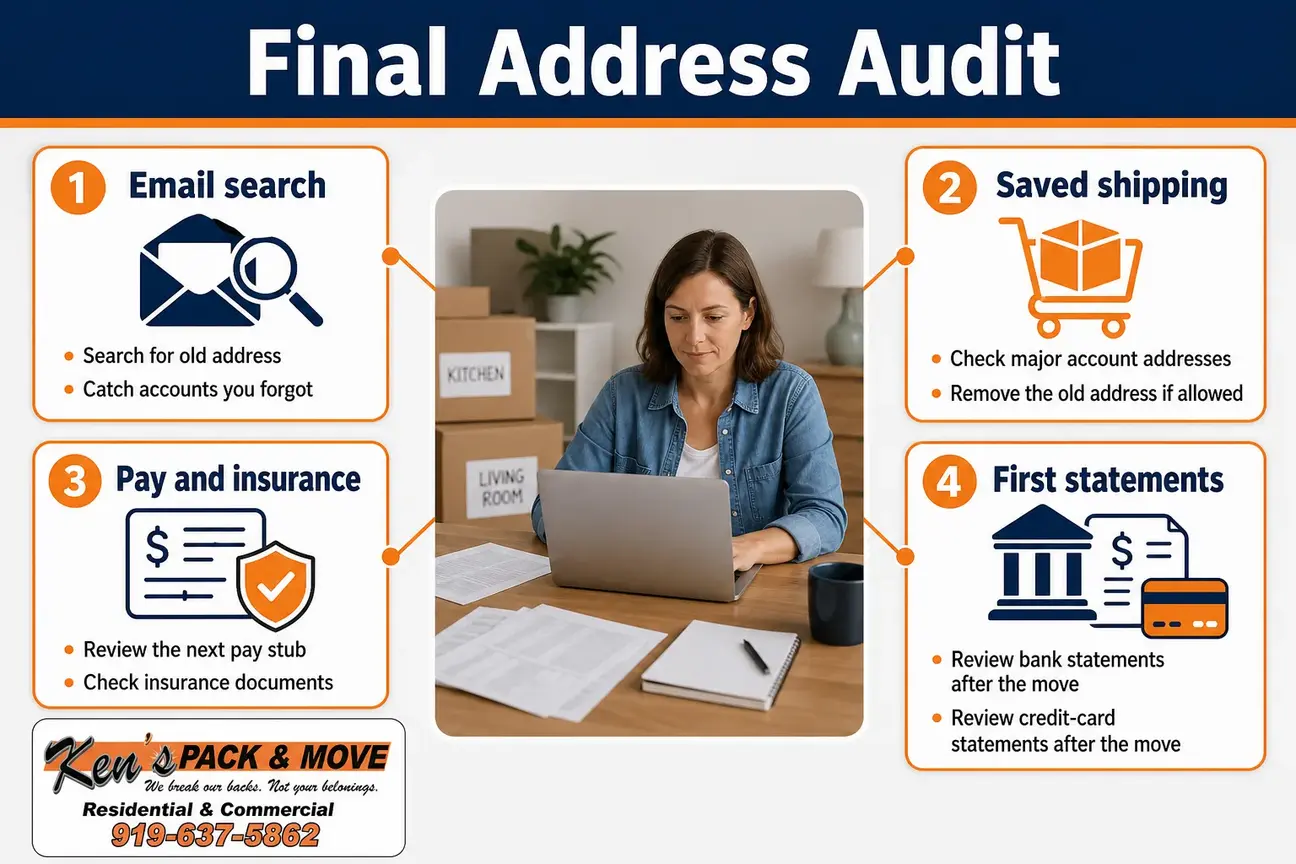
Before you mark the move complete, do one final address audit. Search your email for “old address,” check saved shipping addresses in major accounts, review your next pay stub and insurance documents, and look at the first bank or credit-card statement after the move.
For households moving within NC, the key is not perfection on day one. The key is having a system: USPS mail forwarding as an early backstop, NCDMV address change within the state timeline, voter records by the regular registration deadline of 25 days before Election Day, and direct updates for every private account that affects money, insurance, school, healthcare, deliveries, or daily life.
Keep the post move checklist open for at least one full billing cycle. Every forwarded letter or misdirected delivery is a reminder to update one more sender directly as you change address North Carolina records after the physical move.
Moving rules, building policies and prices change. Confirm scope, date, price and coverage with the mover in writing before moving day.
Frequently Asked Questions
How quickly should I submit a USPS change of address?
Submit it as soon as the move date and destination are known. USPS says an approved Change of Address request may take at least 7–10 business days to take effect, and forwarding does not replace direct updates with important senders.
How long do I have to update my address with NCDMV after moving within North Carolina?
NCDMV says people moving within North Carolina must update their physical address within 60 days and obtain a replacement license or ID as required by current instructions. Check current NCDMV guidance for driver, ID, and vehicle-registration steps.
Does USPS forwarding update my bank, employer, or insurance address?
No. USPS forwarding redirects eligible mail, but each bank, employer, insurer, lender, benefits provider, and subscription company should be updated directly through its own system.
When should I update my North Carolina voter registration?
Update voter registration by the regular voter-registration deadline, which North Carolina describes as 25 days before Election Day. Confirm your record through the current official process, especially if you moved to a different county.
Does a moving company change my address with NCDMV or USPS?
No. The moving company handles the physical move or requested moving labor. The household is responsible for USPS, NCDMV, voter, financial, insurance, school, employer, and subscription updates.
What should I update if I rented a truck and only need loading or unloading help?
Update the same administrative records as any other household. For the physical move, provide both addresses, date, truck or storage details, access restrictions, stairs, elevators, parking information, and the loading or unloading scope.
What should adult children check when moving a parent?
Confirm the new residence’s move-in rules, update emergency contacts and medical or pharmacy records, notify insurers and financial institutions, and keep identification, medications, legal documents, and essential records with the family.