

Quick answer: Start with the university’s current housing instructions, because assigned windows, routes, placards, check-in, unloading, and guest procedures can change by campus and year. Then build a small-load plan around the student’s room, allowed items, vehicle limits, weather, and a rapid unload.
This guide answers How should families plan move-in at NC State, Duke, or UNC? for households in Raleigh and the greater Triangle. It is an educational planning resource, not a binding estimate, legal opinion, insurance interpretation, safety certification, or guarantee. Current contracts, property rules, manufacturer instructions, and government guidance control when they apply.
How should families plan move-in at NC State, Duke, or UNC?
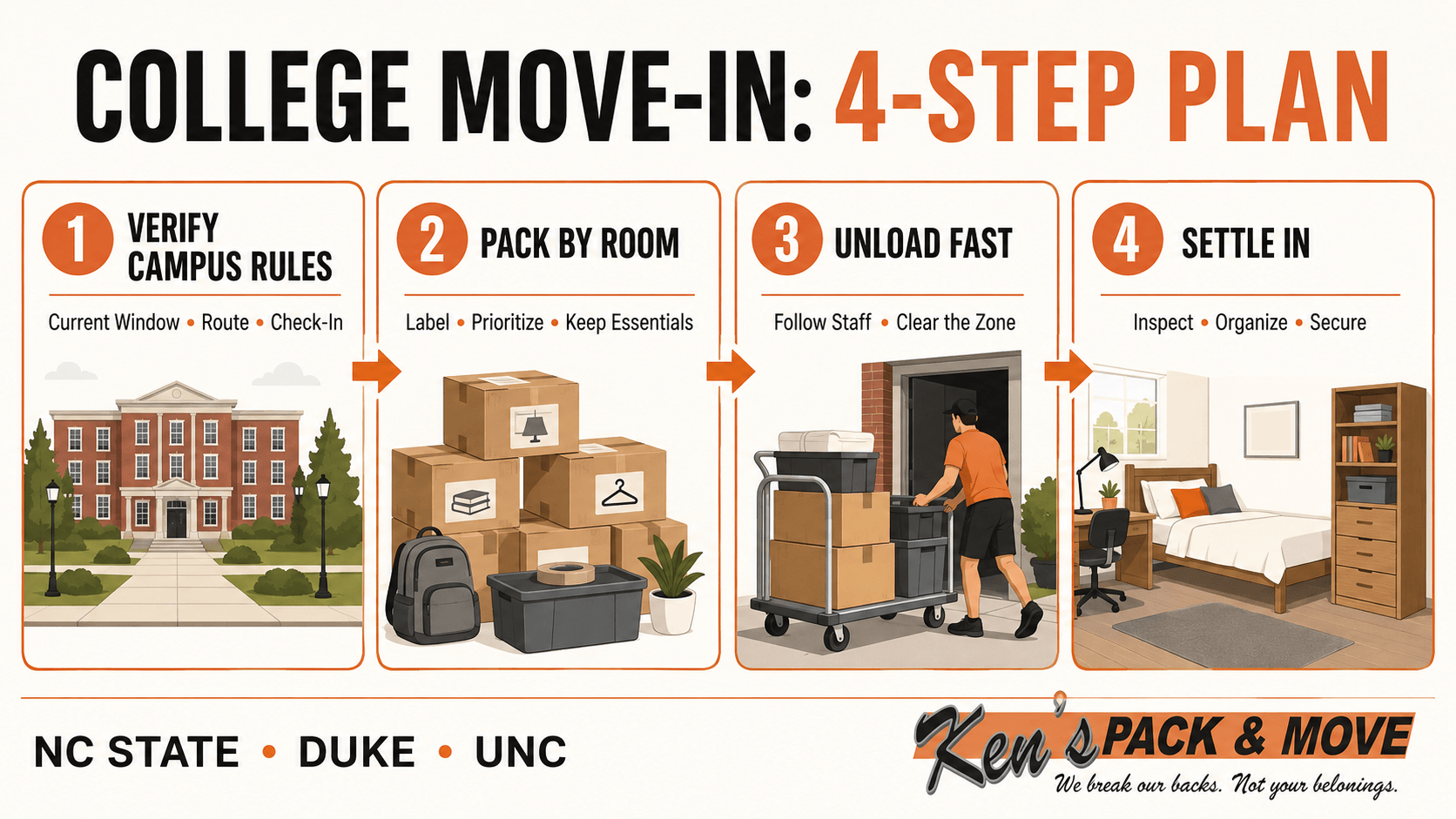
Start with the university’s current housing instructions, because assigned windows, routes, placards, check-in, unloading, and guest procedures can change by campus and year. Then build a small-load plan around the student’s room, allowed items, vehicle limits, weather, and a rapid unload. The practical standard is simple: convert each assumption into a named owner, deadline, and form of confirmation. That creates a plan the customer, mover, property contact, and other professionals can execute.
Use the official campus page as the controlling source
Do not rely on last year’s social post, a parent-group comment, or another university’s process. Open the current housing instructions for the student’s campus and residence assignment. Save the official link and any confirmation email where the family can reach it on move-in day.
Record the assigned date and time, check-in location, approved route, parking or unloading instructions, required ID, placard or pass, guest limits, and cart availability. Recheck shortly before travel because construction, weather, or operational needs can change directions.
Separate campus rules from mover logistics
The university controls campus access; the mover controls crew, vehicle, inventory, and service scope. Share the official instructions with the mover early and ask whether the requested service fits the window and loading environment.
Never imply that Ken’s Pack and Move is affiliated with a university unless a real, current relationship is documented. The article should help families coordinate independent moving support while directing rule questions to the applicable housing office.
Build a room-specific inventory
Use the university’s current room and packing guidance. Confirm furnished items, dimensions when available, roommate plans, prohibited appliances, wall-hanging rules, and storage limits. Do not pack a full apartment for a residence hall room.
Group the shipment into sleep, clothing, study, hygiene, approved food preparation, and accessibility needs. Label the student name, residence hall, room, and a contact number only as campus guidance permits; avoid exposing unnecessary personal information.
Design for a fast unload
Pack in sturdy containers that one person can safely manage, keep handles usable, and place the destination label on more than one side. Separate the student’s check-in documents, medications, keys, wallet, phone, and essential devices from the load.
Sequence the vehicle so first-needed items and bulky pieces can be accessed without rebuilding the load at the curb. Keep pathways clear and move the vehicle when directed; an unloading zone is not automatically all-day parking.
Plan around heat, storms, and crowds
Triangle move-in periods can involve heat, thunderstorms, pedestrian congestion, and traffic control. Bring water, weather-appropriate clothing, and a simple communication plan. Follow university alerts and staff directions.
A rushed unload is not a reason to block fire lanes, leave children unattended, overload carts, or create trip hazards. Decide where family members will meet if phones fail or vehicles are separated.
Coordinate roommates before buying duplicates
Use a shared list for permitted common items such as a rug, cleaning supplies, or approved appliances. Decide who brings what and how ownership will be handled at move-out. Wait for official room details before purchasing dimension-sensitive items.
Keep receipts and packaging until key items are confirmed to fit and comply. A tightly edited load reduces unloading time and makes the room usable sooner.
Make the room functional in the right order
Complete check-in first, inspect the assigned room, and document pre-existing condition through the university’s process. Establish a clear walking path, position large items only as allowed, make the bed, and set up essential study and charging needs.
Do not cover required equipment, defeat safety devices, or alter furniture without permission. Keep exit routes and ventilation clear. Ask housing staff about anything unclear instead of treating a general moving guide as campus policy.
Handle off-campus apartments as a different project
An off-campus lease may require utility activation, renter’s insurance, elevator reservations, loading rules, keys, and a condition report. Those requirements come from the lease and property manager, not the residence-hall instructions.
If the student is moving between campus and an apartment, list each stop and access window in the moving scope. Avoid optimizing a separate city-swapped post for each campus unless the intent and operational guidance are genuinely different.
Prepare the family departure and student first night
Before family leaves, verify the student has keys or credentials, medication, food plan, bedding, hygiene supplies, chargers, emergency contacts, and the ability to secure the room. Remove packaging through approved disposal channels.
Expect that orientation or residence-life instructions may take priority over finishing every decorative task. A calm handoff is more valuable than keeping an unloading zone or crowded room occupied longer than permitted.
Build a campus comparison sheet without merging the rules
Use separate columns for NC State, Duke, and UNC rather than writing one blended rule set. For each campus, capture the official source, assigned window, check-in sequence, vehicle instructions, unloading location, parking transition, identification, placard or pass, cart guidance, guest limits, and contact for accommodation questions.
Mark every entry with the date it was checked. If the student changes residence hall or arrival program, start a new row because building, class-year, and program instructions may differ. The comparison helps planning; it does not imply that one university’s rule applies to the others.
Use a two-vehicle decision carefully
A second vehicle can separate people, essentials, and bulky items, but it also creates another driver, parking need, meeting plan, and risk of entering the wrong campus route. Confirm whether both vehicles can use the move-in process and where the non-unloading vehicle should go.
If a professional mover is involved, do not assume a family vehicle can travel beside the truck or occupy the same controlled area. Give each driver the official route and a fallback meeting location outside the active unloading zone.
Plan accessibility and health needs directly with the university
Contact the appropriate university office in advance for disability-related access, medical equipment, service animals, temperature-sensitive medication, or other accommodations. Do not rely on a general blog, an unofficial volunteer, or a moving crew to authorize an exception.
Keep essential medical items with the student or responsible adult. If equipment requires power, installation, or qualified handling, verify the room and service plan before arrival and identify who can resolve a problem during the assigned window.
Create a move-out-aware move-in
Label and inventory durable containers, keep ownership records for shared items, and store only the packaging worth retaining. Note how large purchases will leave the room at the end of the term. An item that barely fits during a staffed move-in may be difficult to remove during a different traffic plan.
Record the condition of student-owned items and the assigned room through the institution’s process. Save the current housing contact and move-out page so the family can check procedures before the next transition rather than rebuilding the plan from memory.
Build a verification record for college move in guide Raleigh Durham Chapel Hill
A strong plan should be usable by a backup decision-maker. Create a one-page control record headed “How should families plan move-in at NC State, Duke, or UNC?” and list the current move date, origin, destination, inventory version, requested services, and the people authorized to approve changes. Add the local and topical entities that affect the work—NC State University; Duke University; UNC-Chapel Hill; Raleigh; Durham; Chapel Hill—only when they are genuinely relevant to the address or service. This keeps local optimization connected to real logistics instead of repeating place names for search engines.
- 1. Use the official campus page as the controlling source: Do not rely on last year’s social post, a parent-group comment, or another university’s process. The responsible party is customer, and the record to retain is written confirmation or photo.
- 2. Separate campus rules from mover logistics: The university controls campus access; the mover controls crew, vehicle, inventory, and service scope. The responsible party is customer + mover, and the record to retain is current document or contact record.
- 3. Build a room-specific inventory: Use the university’s current room and packing guidance. The responsible party is controlling property/provider, and the record to retain is written confirmation or photo.
- 4. Design for a fast unload: Pack in sturdy containers that one person can safely manage, keep handles usable, and place the destination label on more than one side. The responsible party is customer, and the record to retain is current document or contact record.
- 5. Plan around heat, storms, and crowds: Triangle move-in periods can involve heat, thunderstorms, pedestrian congestion, and traffic control. The responsible party is customer + mover, and the record to retain is written confirmation or photo.
- 6. Coordinate roommates before buying duplicates: Use a shared list for permitted common items such as a rug, cleaning supplies, or approved appliances. The responsible party is controlling property/provider, and the record to retain is current document or contact record.
- 7. Make the room functional in the right order: Complete check-in first, inspect the assigned room, and document pre-existing condition through the university’s process. The responsible party is customer, and the record to retain is written confirmation or photo.
Attach the current source used for time-sensitive guidance. For this topic, begin with NC State University Housing Move-In Information and record the date it was checked. Then attach the written estimate, property or institutional instructions, contact sheet, access photos, and any approved revision. The goal is not paperwork for its own sake; it is to ensure that the customer, mover, and controlling third party are working from the same facts.
Keep the search boundary visible during editing. This page answers “How should families plan move-in at NC State, Duke, or UNC?” and may support the Triangle-area moving help page, but it should not be expanded to target apartment movers Raleigh; Chapel Hill moving company; generic Raleigh relocation. If an editor adds broad service copy, move that material to the established service owner and preserve this article’s specialized decision task.
college move in guide Raleigh Durham Chapel Hill: control table
| Checkpoint | Required action | Owner | Evidence |
|---|---|---|---|
| Use the official campus page as the controlling source | Do not rely on last year’s social post, a parent-group comment, or another university’s process. | Customer | Written confirmation or photo |
| Separate campus rules from mover logistics | The university controls campus access; the mover controls crew, vehicle, inventory, and service scope. | Customer + mover | Current document or contact record |
| Build a room-specific inventory | Use the university’s current room and packing guidance. | Controlling property/provider | Written confirmation or photo |
| Design for a fast unload | Pack in sturdy containers that one person can safely manage, keep handles usable, and place the destination label on more than one side. | Customer | Current document or contact record |
| Plan around heat, storms, and crowds | Triangle move-in periods can involve heat, thunderstorms, pedestrian congestion, and traffic control. | Customer + mover | Written confirmation or photo |
| Coordinate roommates before buying duplicates | Use a shared list for permitted common items such as a rug, cleaning supplies, or approved appliances. | Controlling property/provider | Current document or contact record |
| Make the room functional in the right order | Complete check-in first, inspect the assigned room, and document pre-existing condition through the university’s process. | Customer | Written confirmation or photo |
A practical 30-day-to-moving-day sequence
About 30 days before
Confirm the move type, target dates, complete inventory, both addresses, and the services you may need. Collect property rules and source documents. Request estimates using the same facts, compare the scope and terms, and identify any task controlled by a university, builder, employer, contractor, association, closing professional, or government office.
About two weeks before
Resolve parking, elevators, keys, utility timing, packing materials, personal-carry items, and any specialty or prohibited-item questions. Update the mover if the inventory, access, date, destination, or requested services have changed. Put one decision-maker and one backup on the contact sheet.
During the final 72 hours
Reconfirm the written scope, addresses, arrival arrangement, destination authorization, payment method, and access. Finish the packing assigned to the customer, label destination rooms, clear the approved route, charge phones, and separate identification, medication, contracts, keys, and irreplaceable valuables.
On moving day
Complete an origin walkthrough, disclose last-minute changes, keep children and pets outside the work zone, and preserve a clear communication chain. At destination, verify authorization before unloading, direct placement, document visible concerns through the mover’s process, and complete the final walkthrough before the crew departs.
Questions to ask the moving company
- Does the written estimate list the inventory, addresses, access, dates, and services discussed?
- Which events can change the charge, crew plan, equipment, or schedule?
- What valuation or liability option is shown, and what are the claim instructions?
- Which items will not be accepted, and when must specialty handling be arranged?
- How are waiting, storage, extra stops, access changes, or rescheduling documented?
- Who provides updates, who can authorize changes, and when is payment due?
Common planning mistakes to avoid
- Comparing headline prices built from different inventories or service scopes.
- Assuming a destination is available without keys, possession, or written property approval.
- Waiting until moving day to disclose stairs, elevators, long carries, gates, difficult roads, or restricted items.
- Loading documents, medication, credentials, keys, or small irreplaceable valuables.
- Using an old policy page, campus date, building rule, or disposal instruction without rechecking it.
- Creating a city-swapped copy of a broad service article instead of answering a distinct task.
Frequently asked questions
When are NC State, Duke, and UNC move-in dates?
Dates and assigned windows change. Use the current official housing page and the student’s university communications rather than hardcoding a date from this guide.
Can professional movers enter a residence hall?
Rules can vary by campus, building, and year. Confirm with housing and give the mover the official instructions before booking.
What should stay with the student?
Keep ID, check-in documents, phone, wallet, medications, keys, accessibility items, and small valuables with the student or responsible adult.
Should families bring a moving truck to campus?
Only after confirming current route, vehicle, unloading, and parking rules. A large vehicle can be impractical or restricted in a tightly controlled move-in operation.
How should boxes be labeled?
Follow campus guidance. Use the student name and destination details needed for the handoff without displaying unnecessary private information.
What if the assigned window conflicts with the mover?
Contact housing and the mover early. Do not assume either party can ignore the assigned window; obtain an approved revised plan.
Does this guide cover off-campus housing?
It identifies the difference, but the lease, property manager, and local access rules control an off-campus move.
How can Ken’s Pack and Move help?
Ask about service availability for the actual addresses, dates, campus instructions, inventory, vehicle limits, and requested labor or transportation.
Request a move-specific plan
Ken’s Pack and Move serves Raleigh, Cary, and surrounding Triangle communities. The appropriate crew, equipment, timing, packing, and transportation plan depend on the actual inventory, addresses, access, date, and requested services.
Request a moving quote or call 919-637-5862. Share the planning details described in this guide so the conversation starts with a complete scope.
Sources and editorial verification
- NC State University Housing Move-In Information
- North Carolina Public Staff — Moving 101 Consumer Guide
- FMCSA — Protect Your Move (interstate context)
- Duke Student Affairs — Move-In Day
- UNC Housing — Arrival and Departure
Editorial requirement: Recheck all external links, company claims, dates, access policies, and regulatory language immediately before publication. Update the visible FAQ answers and structured data together.