
How to Plan a Move Between Cary and Raleigh: Moving Cary Raleigh
A successful moving Cary Raleigh plan starts with the two addresses, not just the town names. For a local household move between Cary and Raleigh, the biggest planning details are inventory, parking, stairs or elevators, building rules, preferred dates, furniture handling, and whether you need packing or labor-only help. Ken’s Pack & Move serves customers at their pickup and delivery addresses; the Cary address at 1903 N Harrison Ave, Suite 200, Cary, NC 27513 is an office, not a customer-facing branch or drop-in storefront.
Quick Answer: Gather both full addresses, preferred and backup dates, property type, inventory, stairs, elevators, parking rules, and any large or fragile items before asking for a quote. Confirm apartment, condo, HOA, or neighborhood restrictions in writing. Ask the mover to confirm the scope, date, crew, price, and valuation in writing. Short-notice help may be possible when a crew is available, but it should not be assumed until confirmed directly.
Start with a two-address plan for moving Cary Raleigh
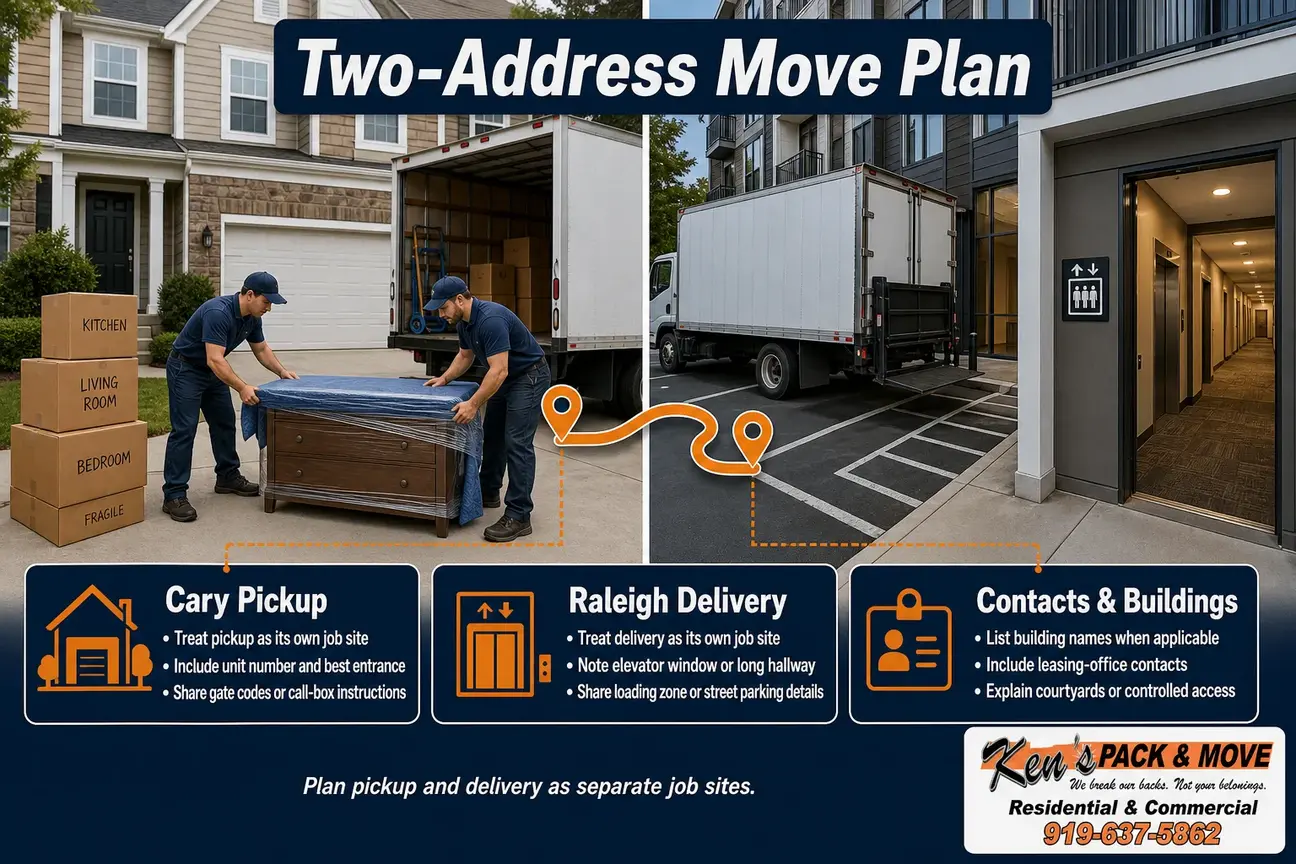
A Cary pickup and a Raleigh delivery can look simple on a map, but the work happens at the curb, the doorway, the elevator, the stairwell, and the rooms. Treat the pickup address and delivery address as separate job sites. A townhouse in Cary with driveway access may be straightforward to load, while the Raleigh destination may have a loading zone, elevator window, long hallway, or public-street parking concern.
Start your plan with complete address details. Include unit numbers, building names, gate codes, call-box instructions, leasing-office contacts, and the best entrance for the crew. If either property has multiple buildings, courtyards, parking decks, or controlled access, spell that out before move day. A crew can plan better when it knows whether the entrance is right by the truck or across a long walkway.
For a Cary to Raleigh move, note whether you will have possession of both places at the same time. If the pickup is tied to a closing, lease handoff, elevator reservation, or property-manager inspection, those deadlines can shape the move plan. If the delivery address is not ready until later in the day, that timing matters too. Do not assume the route is the only schedule issue.
Home type matters. A detached home, apartment, condo, townhouse, or senior-living destination can each require a different access plan. For example, a single-family home might have a steep driveway or narrow street, while a downtown or mixed-use Raleigh building may have a designated loading area and specific move-in rules. The move should be planned around the actual property conditions at both ends.
If you are comparing local options, use the town pages as starting points, not as a substitute for a quote. Ken’s Pack & Move has information for customers looking for a Cary moving company and for households comparing a Raleigh moving company. The details that confirm the move, however, are the actual addresses, inventory, access, scope, and requested date.
Build an inventory for a Cary to Raleigh move
An accurate inventory is one of the most useful things you can give a mover. “Two bedrooms” is helpful, but it does not show whether you have a sleeper sofa, a large sectional, garage shelving, a full patio set, heavy bookcases, or a storage closet full of boxes. A good inventory reflects what has to be carried, protected, disassembled, loaded, unloaded, and placed.
Walk room by room and list the big furniture first: beds, dressers, tables, sofas, desks, wardrobes, entertainment units, bookcases, and appliances that are part of the move. Then estimate boxes by room or category. If packing is not finished, say so. A half-packed apartment can change the workload, especially if the crew is also being asked to pack selected rooms or fragile items.
For a Cary to Raleigh move, pay attention to items that can surprise the schedule: garage tools, attic boxes, balcony furniture, plants, exercise equipment, oversized mirrors, glass tables, and awkward pieces that need careful handling. If an item is heavy, fragile, high-value, or difficult to maneuver, identify it early. The goal is not to make the move sound bigger than it is; the goal is to avoid an incomplete scope.
| Include in the inventory | Why it matters |
|---|---|
| Sofas, beds, wardrobes, bookcases, tables | Helps the mover plan handling, space, and possible disassembly |
| Appliances and unusually heavy items | May require advance discussion about preparation and access |
| Fragile, glass, antique, or high-value items | Helps clarify handling notes and valuation questions |
| Patio, garage, attic, basement, and shed contents | Prevents an incomplete moving list |
| Items staying behind, being donated, or going elsewhere | Keeps the moving scope accurate and avoids loading the wrong items |
Photographs or a short walk-through video can help when requested, especially for apartment moves, storage units, or homes with several access points. If something must be taken apart and reassembled, point it out before the quote is confirmed. Furniture disassembly and reassembly can be part of a local move scope, but it should be discussed rather than assumed.
A second pass through closets, patios, garage shelves, and storage areas can make the inventory more accurate. These areas often hold items that are not visible during a quick room count, but they still affect carrying time, truck space, packing needs, and unloading placement.
Prepare for Raleigh relocation access rules
A Raleigh relocation from Cary often depends on building rules as much as furniture volume. Apartments, condos, and HOA communities may have move-in windows, elevator reservations, loading-dock rules, certificates of insurance, parking instructions, and floor or wall-protection requirements. These rules are property-specific, so get them from the leasing office, property manager, HOA, or building contact in writing.
Do not wait until the truck is on the way to ask about elevators. If a building requires an elevator reservation, ask how the reservation is made, how long the window lasts, whether padding is provided, and which entrance the crew should use. If the building requires a certificate of insurance, request the exact wording and delivery instructions early enough for the mover to review the request.
For apartment and condo moves, ask whether the crew must use a service elevator, loading dock, freight entrance, or particular hallway. Some buildings limit moves to certain hours or require check-in with security. Others may restrict where a truck can stand. A Raleigh relocation goes smoother when the building contact, reservation window, and access route are written down before the move starts.
HOA communities can have their own logistics. Ask about gate access, guest parking, quiet hours, truck placement, and whether a large vehicle may block a narrow street or cul-de-sac. If the destination has a long driveway, low branches, tight turns, or limited curb space, mention those conditions in the quote request. The same is true for the Cary pickup if it has parking limits, steep grades, or construction nearby.
If you are moving from or into a building with strict rules, the planning issues in Ken’s Pack & Move’s guide to apartment movers in Raleigh may help you organize elevator, parking, COI, and move-window questions before the quote is finalized. A household move that involves an elevator or loading dock should be treated as a building-coordination project, not just a loading job.
Plan parking, loading zones, and the door-to-truck path
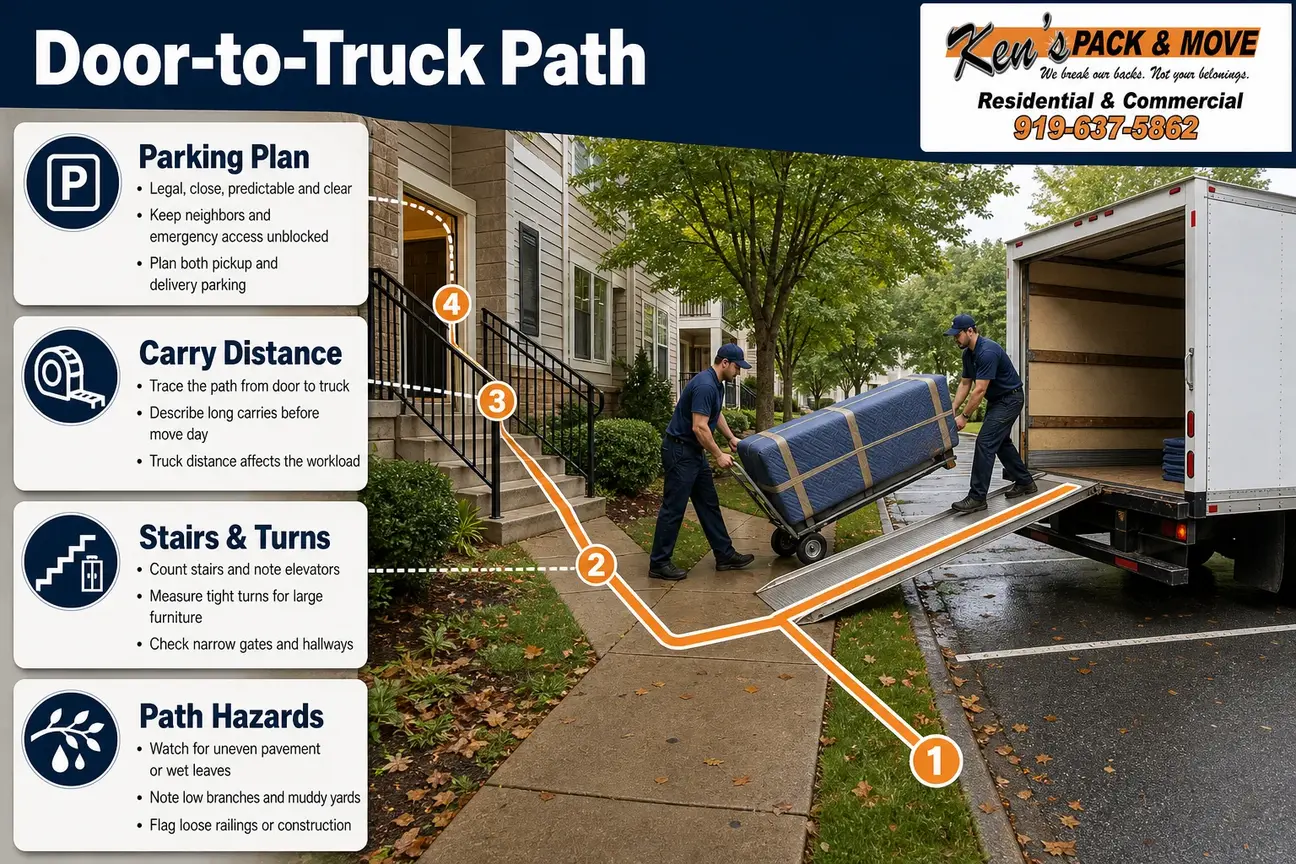
Parking is not just a convenience. It affects how far items must be carried, how safely the crew can work, and whether neighbors, residents, visitors, or emergency access are blocked. For a Triangle local move, the best parking plan is legal, close, predictable, and clear at both addresses.
Look at the path from the door to where the truck can stand. Count stairs, note elevators, measure tight turns if you are worried about large furniture, and look for hazards such as uneven pavement, wet leaves, low branches, muddy yards, loose railings, narrow gates, or construction. If the truck cannot park near the entrance, describe the long carry so the moving plan reflects the real workload.
In Raleigh, be careful with public streets and sidewalks. If a moving truck may occupy or obstruct public right-of-way, check whether Raleigh approval or other right-of-way arrangements are required through the City of Raleigh right-of-way services page. Do not assume a curb space can be reserved casually, and do not block sidewalks, driveways, fire lanes, or traffic lanes without confirming the proper process.
At apartments, ask whether the truck can use a loading zone, visitor area, parking deck, or street space. At single-family homes, check whether the driveway is usable for a moving vehicle and whether low trees, tight turns, steep slopes, or soft ground create concerns. A driveway that is fine for a car may not be the right spot for a moving truck.
Traffic on I-40, I-440, I-540, and US-1 can affect the practical move-day schedule, especially during commuting periods, storms, crashes, or construction. Treat traffic as a planning variable, not as a promise of travel time. A good schedule leaves room for access, loading, unloading, building check-ins, and final walkthroughs, not just the drive between Cary and Raleigh.
A Raleigh relocation that uses street parking or a shared loading zone needs extra attention to neighbors, residents, and public access. A local move in the Triangle is easier to coordinate when everyone knows where the truck can stand before the crew arrives.
Choose the right scope for a Triangle local move
The right scope depends on how much help you need. Some households want the crew to handle furniture and already-packed boxes. Others need full or partial packing, unpacking, furniture disassembly and reassembly, or labor-only loading and unloading for a rented truck or storage unit. A Triangle local move works best when the quote matches the actual work.
Ken’s Pack & Move provides local moving services for homes, apartments, condos, and townhouses, along with confirmed related services such as full or partial packing and unpacking, labor-only loading and unloading, furniture handling, and apartment moves. If you need debris removal after the move, ask whether it can be included in the quoted scope; do not assume it is part of every move.
| Situation | Scope to discuss |
|---|---|
| You have packed everything | Local moving, loading, unloading, and furniture handling |
| You need selected rooms or fragile items packed | Partial packing |
| You want help packing household contents | Full packing |
| You rented a truck | Labor-only loading or unloading |
| Furniture will not fit assembled | Disassembly and reassembly |
| You are sorting for a downsizing move | Inventory, destination floor plan, and items staying behind |
| You expect post-move debris | Ask whether debris removal can be included in the quoted scope |
If you are not sure which scope fits, describe the situation plainly. A renter leaving a third-floor apartment may need a different plan from a homeowner moving from a Cary townhouse into a Raleigh condo. A family helping a parent downsize may need more sorting time, a smaller destination floor plan, and careful separation of what stays, what moves, and what goes elsewhere.
For packing decisions, review the company’s packing services guide and decide what you want the crew to pack versus what you will carry yourself. Important documents, medications, valuables, chargers, keys, and overnight essentials should stay with you. If you are renting your own truck and only need lifting help, the guide to labor-only movers can help you think through loading and unloading details.
A local Triangle move can also be split into parts when that is what the household needs. For example, you may pack most boxes yourself but ask about partial packing for fragile kitchen items, then use the crew for furniture, boxes, loading, unloading, and placement. If your Cary-to-Raleigh plan includes a storage unit, rental truck, or separate drop-off, describe that route clearly.
Pick dates that fit a Cary to Raleigh move
A Cary to Raleigh move date should fit more than your preferred calendar day. It should fit lease turnover, closing timing, building move windows, elevator availability, family schedules, packing progress, and destination readiness. If either property has a narrow access window, share that before the move is confirmed.
End-of-month lease turnover can tighten local schedules. University move-in and move-out periods can add activity around certain Raleigh corridors and apartment communities. Summer heat and humidity can affect how people pace the day, while afternoon storms or wet surfaces can change how the crew protects walkways and belongings. These are planning factors, not reasons to expect a specific finish time.
Backup dates can help, especially if a closing changes, a lease handoff moves, or the building has limited elevator availability. If you need short-notice help because a prior plan fell through, be ready with a complete inventory, both addresses, access notes, and a ready destination. Same-day, weekend, and holiday help depends on crew availability, and a quote-form submission by itself does not confirm a reservation.
For short-notice questions, call 919-637-5862 to check availability. Have both addresses, preferred timing, home size, stairs, elevators, parking, large or fragile items, and whether you need packing, labor-only help, or debris removal ready before you call. A short-notice Triangle local move is more realistic to evaluate when the move details are complete.
If your Raleigh relocation depends on a lease office, elevator key, loading dock, or property-manager approval, confirm those pieces before the requested move date. A calendar opening does not help if the building will not allow access during that window.
Understand how access and inventory affect the quote
A local moving quote is shaped by the work required. Inventory, distance within the local move, pickup and delivery access, stairs, elevators, long carries, parking limitations, packing, unpacking, crew and equipment needs, preferred date, and heavy or fragile items can all matter. The more complete your information is, the easier it is to discuss scope and avoid surprises.
For an in-state household move, written-estimate and valuation questions should be handled carefully. The North Carolina Utilities Commission’s Moving 101 consumer guide says, “If you request it, a mover is required to give you a free written estimate on a Commission-approved form.” The same guide says most movers will not provide a written estimate unless they see the items to be moved, and it is a good idea to get written estimates from several moving companies and compare them.
The estimate should be based on accurate information. If the actual inventory, access, stairs, elevator situation, long carry, parking, or packing needs differ from what was provided, the scope and final charges may change. That is why photographs, videos, building rules, and a room-by-room inventory are useful when requested. A Raleigh relocation with a loading dock and service elevator should not be described the same way as one with street parking and several flights of stairs.
Valuation is also separate from the access plan. The Moving 101 guide says, “You must select your level of valuation before the move begins” and “Once it starts, the selection cannot be changed.” Do not wait until move day to ask how valuation works. Choose and confirm the valuation option in writing before the move begins.
The North Carolina Utilities Commission’s Maximum Rate Tariff No. 1 is another source for in-state household-goods tariff rules. You do not need to become a tariff expert to plan a local move, but you should review your estimate documents, understand whether the estimate is binding or nonbinding, and ask questions before the crew arrives.
For a Triangle local move, small access details can have a real effect on the scope. A Cary to Raleigh move from a ground-floor home into a building with a loading dock is different from one with stairs, a long hallway, limited parking, or a narrow elevator window.
Protect property and belongings before the crew arrives
Property protection starts before the truck pulls up. Clear walkways, remove trip hazards, and keep children and pets away from work areas. If a stair rail is loose, a floor is delicate, a wall was recently painted, or a doorway is tight, point it out during the walk-through. These notes help the crew plan how to move carefully through the property.
For buildings with rules, confirm whether floor protection, wall protection, elevator padding, or designated routes are required. Some apartment and condo communities may specify how moves must be handled in common areas. Get those rules in writing and share them before move day. If the building needs paperwork, do not wait until the elevator window begins.
Photograph existing damage at both properties before the move. That can include scratched floors, dented door frames, loose handrails, cracked tiles, or marks in common-area hallways. Photos are useful for your own records, especially when security deposits, HOA rules, or move-out inspections are involved.
Separate what movers should not load. Keep documents, medications, jewelry, small valuables, laptops, chargers, keys, checkbooks, irreplaceable photos, and overnight items with you. If you have cleaning supplies, fuel, paint, propane, batteries, plants, or other items that may be restricted or unsafe for a moving truck, ask how they should be handled and plan to transport or dispose of them separately when appropriate.
For a Raleigh relocation, common areas deserve the same attention as the unit itself. Walk the route from the truck space to the unit and note tight doors, shared hallways, turns, elevators, railings, and lobby surfaces before move day.
Send the right details with a quote request
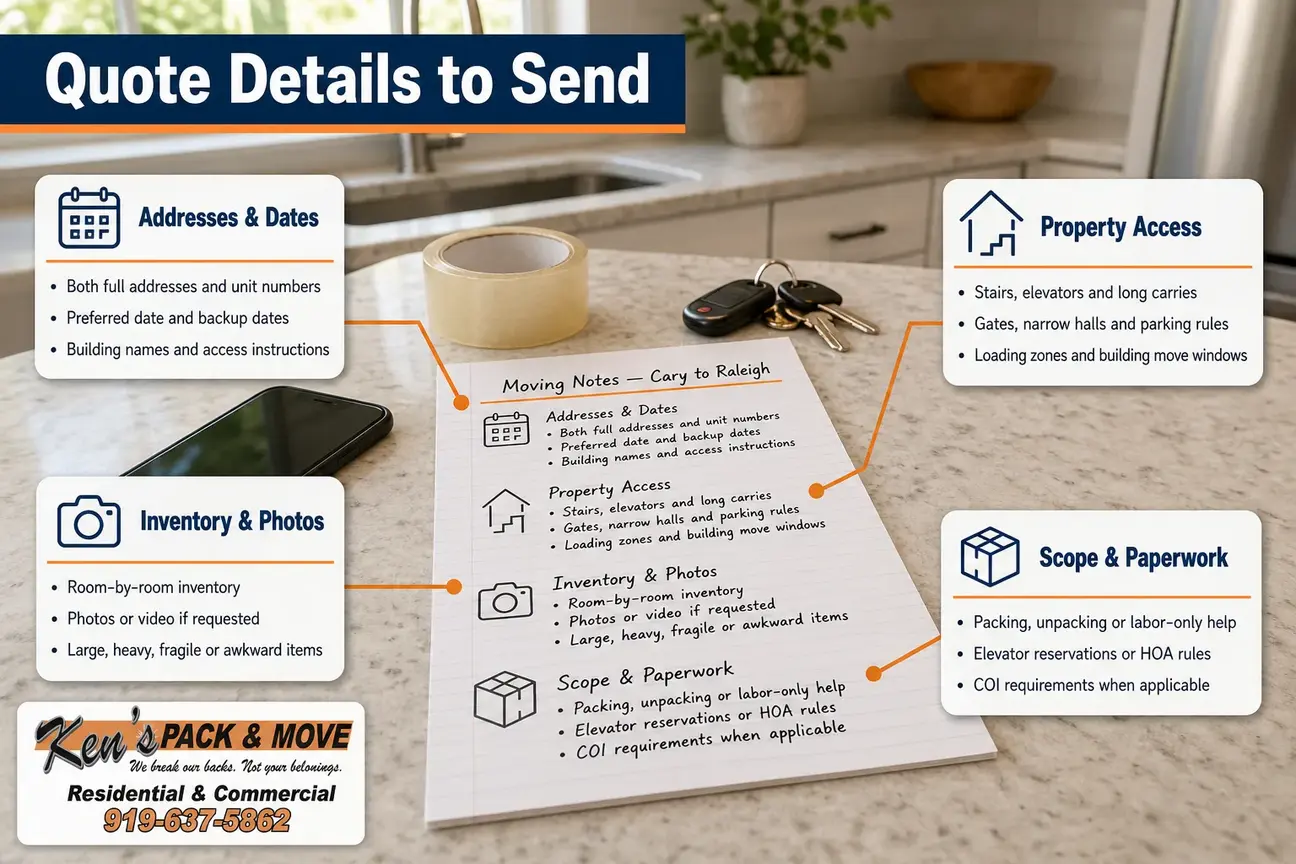
A quote request should help the mover understand the job. Before you request a free quote, gather the facts that shape the schedule, access, crew planning, and scope. If you are moving on a tight timeline, complete information matters even more.
- Both full addresses, including unit numbers, building names, and access instructions
- Preferred date and any acceptable backup dates
- Property type and size at pickup and delivery
- Stairs, elevators, long carries, gates, narrow halls, parking rules, and loading zones
- Building move windows, elevator reservations, COI requirements, or HOA rules
- Room-by-room inventory, plus photos or video if requested
- Large, heavy, fragile, glass, high-value, or awkward items
- Furniture that may need disassembly or reassembly
- Packing, unpacking, loading, unloading, or debris-removal needs
- Rental-truck or storage-unit details if you need labor-only help
- Closing, lease, possession, or elevator deadlines
For a Triangle local move, it is better to over-explain access than to leave the crew guessing. “Second-floor apartment” is useful; “second-floor apartment, exterior stairs, no elevator, visitor parking only, long walk from lot to breezeway” is much better. The same goes for a Raleigh condo, Cary townhouse, or senior-living destination.
When you are ready, you can request a free moving quote. A form submission is a request, not a confirmed reservation; date, crew, scope, and price should be confirmed directly. Include whether you need local moving, packing, furniture handling, labor-only loading or unloading, or debris removal so the quoted scope matches what you actually need.
A clear quote request also helps separate a simple Cary-to-Raleigh household move from a more involved Raleigh relocation with elevator paperwork, loading limits, partial packing, or multiple access points. Put those details in the first request instead of saving them for move day.
Verify the mover and the move documents
For household-goods moves within North Carolina, verification is part of smart planning. The North Carolina Utilities Commission states on its Transportation page that a household-goods mover is required to obtain a Commission certificate to engage in intrastate transportation of household goods. Ken’s Pack & Move is certificated by the North Carolina Utilities Commission for household-goods moves within the state under certificate C-2551.
You can check certificated movers through the NCUC list of certificated carriers. This verification is for in-state household-goods moves; do not treat it as interstate authority or as a rule for office moves. This article is focused on local household moves between Cary and Raleigh.
Once you choose a mover, review the written documents. Confirm the pickup and delivery addresses, move date, arrival arrangements, inventory assumptions, packing scope, stairs, elevators, parking, long carries, furniture disassembly, valuation selection, and any building requirements. If something changes after the estimate is prepared, tell the mover before move day.
The goal is simple: everyone should know what is being moved, where it is being moved, when access is available, what the building requires, and what services are included. That matters whether your Cary to Raleigh move is a one-bedroom apartment, a townhouse, a single-family home, or a downsizing move.
For a move inside a managed Raleigh building, confirm that the written move documents line up with the building’s own rules. A Triangle local move is still a regulated in-state household move when it involves household goods within North Carolina, but the property rules are separate from mover verification.
Use a final move-day checklist
The last walkthrough is where small problems get caught. Before loading starts, confirm the building window, elevator access, parking plan, and contact person at both addresses. Walk the crew through special items, fragile pieces, furniture that needs disassembly, and anything that is not going on the truck.
Keep essentials separate and clearly marked. Your documents, medications, chargers, keys, valuables, snacks, pet supplies, and overnight bag should not disappear into the moving load. If you are driving between addresses during the move, keep what you need in your vehicle.
- Confirm elevator reservations, gate codes, and building contacts
- Keep parking and loading areas available
- Clear walkways inside and outside both properties
- Review the inventory and special handling notes
- Check closets, cabinets, patio areas, attic spaces, garage areas, and storage rooms
- Keep personal essentials and restricted items separate
- Walk through the delivery address after unloading
- Photograph and document any concerns promptly
A final check at the Cary pickup prevents forgotten items. A final check at the Raleigh delivery helps confirm placement, visible concerns, and whether anything needs to be noted. Do not rush the walkthrough just because the route between the towns feels familiar.
If your Cary-to-Raleigh plan includes an apartment elevator, a gated community, or a parking deck, keep the access notes handy during the day. If your Raleigh relocation has a property-manager contact, make sure that person’s instructions are easy to find.
Get local help for a Cary-to-Raleigh household move
If you are planning a local move between Cary and Raleigh, Ken’s Pack & Move can discuss the scope that fits your household: local moving, full or partial packing, furniture handling, loading and unloading, labor-only help, or move-related debris removal when included in the quoted scope. The important part is to describe the actual addresses, access, inventory, and timing so the move can be planned realistically.
Use the moving guides for more planning help, review the Cary and Raleigh location pages, and send the full details through the quote form when you are ready. If you are working on short notice because of a lease change, closing change, or canceled helpers, call 919-637-5862 to check crew availability. Same-day or weekend help depends on schedule availability and must be confirmed directly.
A well-planned moving Cary Raleigh job is really a clear-address, clear-access, clear-inventory project. Whether you think of it as a Cary to Raleigh move, a Raleigh relocation, or a Triangle local move, the best next step is to confirm the scope, date, price, valuation, and building requirements in writing before moving day.
Moving rules, building policies and prices change. Confirm scope, date, price and coverage with the mover in writing before moving day.
Frequently Asked Questions
Is Ken’s Pack & Move’s Cary address a branch I can visit?
No. The Cary address is an office, not a customer-facing branch, storefront, or drop-in location. Customers are served at their pickup and delivery addresses.
What information should I prepare before requesting a Cary-to-Raleigh moving quote?
Prepare both full addresses, preferred and backup dates, property type and size, stairs, elevators, parking limits, building rules, inventory, large or fragile items, and whether you need packing, furniture handling, loading, unloading, or debris removal.
Can a mover help with apartment or condo rules in Raleigh?
A mover can plan around rules you provide, such as elevator reservations, loading windows, COI requirements, floor protection, and parking instructions. Get the rules from the property manager or building office in writing before move day.
What if my Cary to Raleigh move is short notice?
Short-notice help depends on crew availability, inventory, access, and whether the destination is ready. Call 919-637-5862 with both addresses, timing, home size, stairs, elevators, parking, and service needs to check availability.
Do I need packing help or just local moving?
That depends on how much is already packed and what you want the crew to handle. You can discuss local moving for packed boxes and furniture, partial packing for selected rooms, full packing, or labor-only loading and unloading.
How do stairs, elevators, and parking affect the plan?
They affect access, carrying distance, timing, equipment needs, and the overall scope. Share details for both addresses, including long walks, elevator windows, narrow halls, loading zones, gates, parking decks, and street restrictions.
Should I confirm valuation before the move?
Yes. For an in-state household move, valuation should be selected and confirmed in writing before the move begins. Ask questions before move day so your estimate documents and valuation selection are clear.