
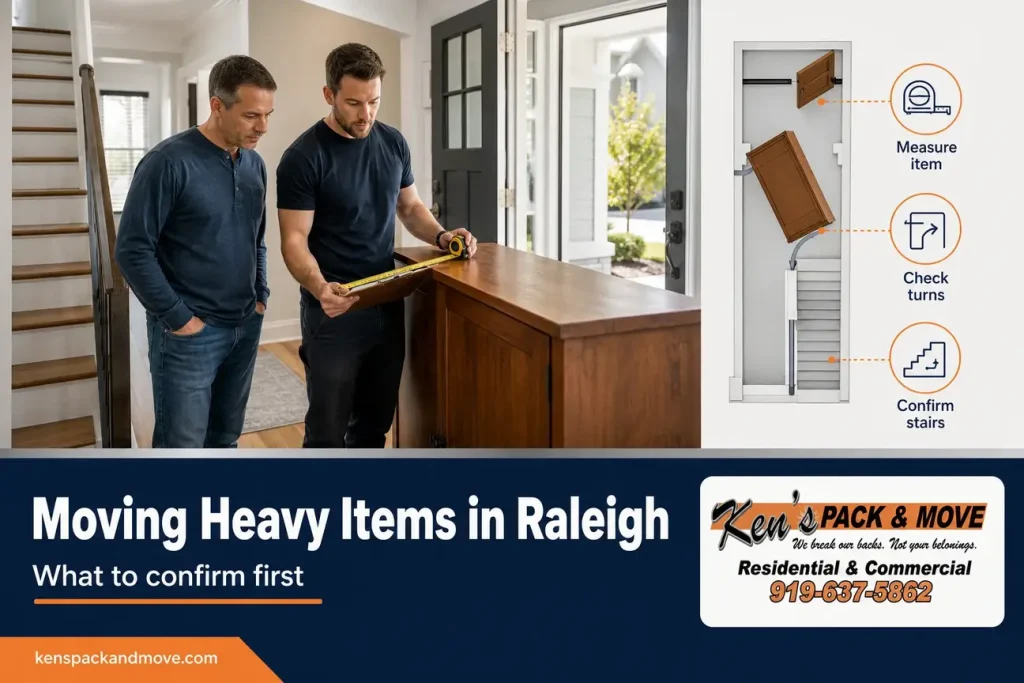
Moving Heavy Items Raleigh: What to Confirm First
Planning for moving heavy items Raleigh homeowners care about is mostly a pre-booking job. Before a mover can decide whether a safe, pool table, oversized appliance, large cabinet or other bulky item fits the job, the crew needs details about the item, the route, the parking and the building rules. A vague request like “heavy furniture” can miss the exact problem that affects the quote, such as a tight turn, elevator limit, long carry, stairs or an item that needs third-party preparation.
Quick Answer: Before requesting a quote, record the item’s dimensions, approximate weight, condition and removable parts. Measure the full access route at pickup and delivery, including stairs, elevators, doorways, turns, flooring, parking and carry distance. Send photos or video, then ask the mover to confirm the equipment plan, crew requirements, disassembly scope, handling limits and any restrictions in writing.
Why heavy-item quotes need more detail than ordinary furniture quotes
Heavy-item moves can look simple from the room where the item sits. The hard part is usually the route between that room and the truck, then the route from the truck into the destination. A sofa, dresser or bed frame may be challenging, but a safe, pool table, commercial-style refrigerator, stone-topped cabinet or oversized armoire can create a different planning problem.
That is why this article is not a general guide to moving heavy furniture. It is a pre-quote checklist. The goal is to help you collect enough information for the mover to decide whether the item, route and requested scope fit the crew, equipment and handling limits for that specific job.
Weight matters, but it is not the only factor. The OSHA ergonomics guidance says, “Limit weight you lift to no more than 50 pounds” and also says, “When lifting loads heavier than 50 pounds, use two or more people to lift the load.” That is workplace safety guidance, not Ken’s Pack & Move policy or a promise about any mover’s residential service limit. It does show why a quote request should include more than “it is heavy.”
Dimensions can be just as important as weight. A cabinet that is not extremely heavy may still be difficult if it is tall, wide, top-heavy, fragile or unable to tilt through a stair landing. An appliance may be manageable in a straight hallway but not around a tight turn. A safe may be impossible to evaluate accurately without knowing whether it is bolted down, where it sits and how far it must travel.
Access conditions also affect the quote conversation. Stairs, elevators, long carries, parking distance, flooring transitions, building move windows and public right-of-way limits can change the time, crew planning and equipment discussion. In Raleigh, apartment buildings, condos, townhomes, older homes and HOA communities can all have different access rules. The more complete your first message is, the fewer surprises you and the mover have to sort through later.
The heavy-item information to gather before contacting a mover
A useful heavy-item request starts with a clean inventory. If you are sending one item, describe that one item clearly. If you have several, list each one separately instead of grouping them as “heavy stuff.” For each item, collect the following details before you ask for a quote.
- Item type and quantity: State whether it is a safe, pool table, refrigerator, washer, dryer, large cabinet, armoire, stone table, oversized entertainment center or another item.
- Manufacturer, model and serial number when available: These details can help a mover understand the item’s construction and can help you find manufacturer dimensions.
- Approximate weight: Use a manufacturer sheet, manual, product label, service document, reliable scale or another reasonable source. If the weight is uncertain, say that.
- Maximum exterior dimensions: Measure height, width and depth at the widest points, including trim, handles, legs, doors, rails, hinges and any fixed hardware.
- Removable parts: Note doors, shelves, drawers, handles, legs, rails, glass panels, stone tops or interior components that may or may not come off.
- Fragile or special materials: Mention glass, mirror, marble, granite, slate, electronics, refrigerant, liquid, mechanical parts or anything that affects handling.
- Anchoring and connections: Identify bolts, wall straps, floor anchors, water lines, gas lines, electrical connections, alarm wiring, security systems or ventilation connections.
- Current and destination locations: Include the room, floor level, exterior route and whether the item starts in a garage, basement, upstairs room, storage unit or apartment.
- Photos and video: Take pictures of the item from several angles, plus the doorway, hallway, stairs, elevator, parking area and tightest turn.
For an oversized furniture move, the most useful details are usually the outside measurements, the narrowest doorway, the tightest turn and whether the item can be safely disassembled. For a safe, the most useful details are usually approximate weight, anchoring, stairs and carry distance. For a pool table, construction and disassembly expectations matter early in the conversation.
If you are not sure what a part is called, send a clear photo. A good photo can show whether a cabinet has glass panels, whether a table has a stone top, whether a safe is bolted down or whether a hallway turn has a railing that reduces usable width. Ask the mover to confirm receipt of the photos and to tell you if anything is missing before you treat the quote request as complete.
A short heavy item moving checklist also helps keep each item separate. Write one line for a safe, one for a pool table and one for a bulky cabinet or appliance if those are separate tasks. That keeps the quote conversation from blending very different handling questions into one vague request.
Use a heavy item moving checklist before you measure the route
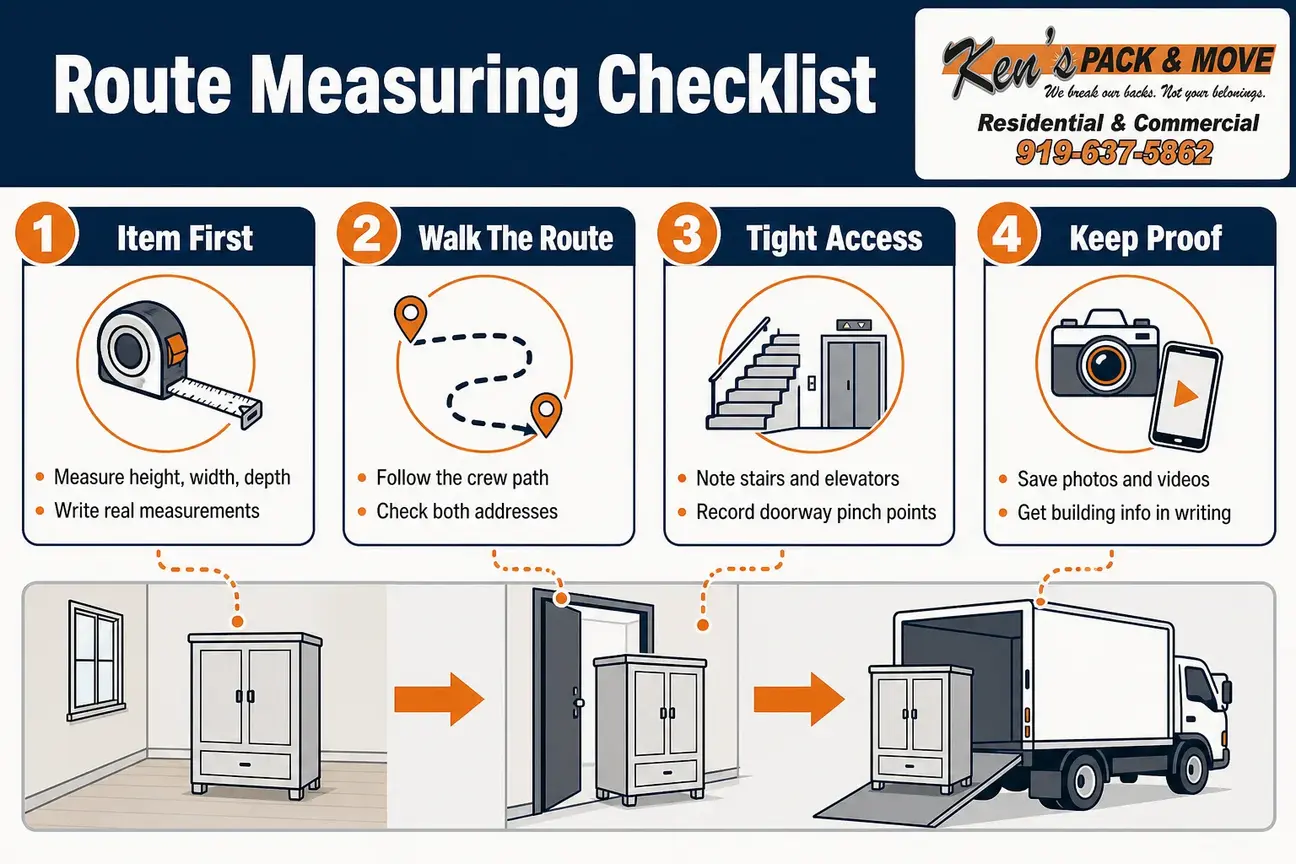
A heavy item moving checklist helps you avoid the common problem of measuring only the item and forgetting the path. Start with the item, then walk the route exactly as the crew would have to move it. Do this at both addresses if you have access to the destination.
Use a tape measure and write down real measurements rather than estimates. If the item is already wedged into a room, measure the route from that room to the door. If the destination is not ready yet, ask the landlord, seller, property manager or building office for elevator and loading information in writing.
Keep the route notes with your photos and videos. If the mover asks a follow-up question about stairs, elevator depth or parking distance, you can answer from the same notes instead of rechecking each space from memory.
Stairs, landings and exterior steps
Count the stairs at pickup and delivery. Separate interior stairs from exterior steps. Note whether the stairs are straight, curved, narrow or broken by landings. Measure the stair width, the landing depth and the ceiling height where the item must turn. Handrails, light fixtures and low ceilings can reduce the space available.
For heavy objects, do not assume that more helpers automatically solves the problem. Stairs change balance, lifting height and available body position. OSHA’s guidance about mechanical assistance and two-or-more-person lifting is safety information for workplaces, not a residential quote guarantee. It is a reminder to ask the mover how the route changes the handling plan.
Elevators and building move windows
For apartment and condo buildings, elevator details should be in your first message. Ask the building for the elevator interior height, width and depth, door opening, weight rating, reservation process, service-elevator requirement and move window. Also ask whether the building requires a certificate of insurance (COI), floor protection, wall protection or a specific loading area.
If the elevator is too small, the item may need another route or may be outside the workable scope for that job. If the elevator must be reserved, do not wait until moving day. A missing reservation can delay the crew, affect building compliance and change the plan. For broader access planning in multi-unit buildings, the guide to apartment movers in Raleigh covers move windows, elevators and building rules in more detail.
Doorways, hallways, turns and ceilings
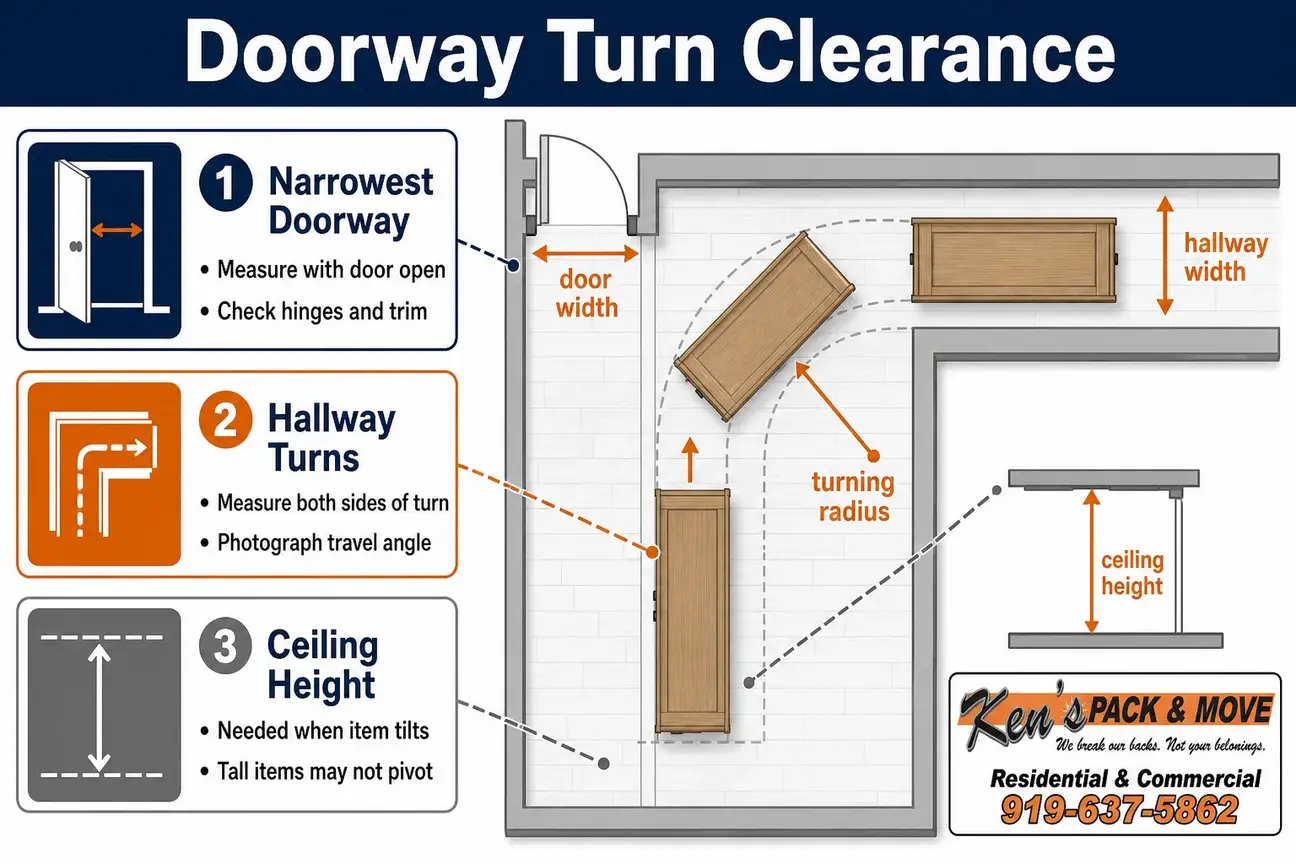
Measure the narrowest doorway on the route, not just the front door. Interior doors, garage entries, stairwell doors, hallway pinch points and gates can be tighter than the main entrance. Measure door width with the door open, then look at hinges, trim, thresholds and nearby walls that may reduce usable space.
Turns are often the real test. A long cabinet might pass through one doorway but fail at a hallway turn. A pool table section or large appliance may need more turning radius than expected. Measure the hallway width on both sides of the turn and take a photo from the angle the item must travel.
Ceiling height matters when an item must tilt. A tall armoire, safe cabinet or appliance may need vertical clearance to rotate. Low ceilings, light fixtures, fans and stairwell slopes can limit the angle. If you are not sure whether an item can tilt safely, ask the mover to evaluate it before confirming scope.
Flooring, thresholds and wall protection
Flooring is part of access planning. Tell the mover whether the route includes hardwood, tile, laminate, carpet, vinyl, thresholds, uneven transitions or freshly finished surfaces. Also note loose rugs, cracked tiles, soft ground, steep driveway slopes or exterior steps that become slick in rain.
No mover should be asked to guess about surface conditions. A photo of the floor and thresholds helps the crew understand what protection may be discussed, where transitions are located and whether the route has uneven spots. If the building or HOA has protection rules, send those rules before the quote is finalized.
Parking, truck access and long carries
Parking can change the whole plan. A heavy item that can be moved a short distance on a level route may be a different request if the truck must park far away, around a corner or at the bottom of a sloped driveway. Measure the distance from the truck’s likely parking spot to the entrance. Include steps, gates, ramps, gravel, grass and uneven pavement.
For Raleigh properties, think about street width, apartment loading zones, downtown parking limits, townhome alleys and whether a truck can turn around safely. If a street, sidewalk, loading zone or other public area may be blocked, confirm the current rules with the property manager or the City of Raleigh Right-of-Way Services page before moving day. Do not assume a curb space will be open just because it was open during your walk-through.
What to confirm about equipment and handling limits
The most important question is not “Can someone lift it?” The better question is: “Does this item, route and scope fit the mover’s confirmed crew, equipment and handling limits?” That wording keeps the conversation practical and avoids assumptions about specialty handling.
Ask what equipment the mover expects to use, who supplies it and whether the item requires equipment beyond ordinary furniture-moving tools. Do not assume the answer. If an item needs a particular piece of equipment, a safe technician, an appliance technician, a pool table specialist, a locksmith or another third party, that should be discussed before you book.
Ask whether the mover needs a walk-through or additional photos before accepting the item. A visual review is especially useful when the item is unusually heavy, top-heavy, fragile, anchored, connected to utilities or located up stairs. The more unusual the item, the more important it is to confirm whether the job is within scope.
Also ask what happens if site conditions differ from the description. If the quote request says “ground floor,” but the item is up a flight of stairs, the quote and plan may change. If parking is described as “right out front,” but the truck must park far away, the move may take a different approach. Complete details protect both the customer and the crew.
This is where your heavy item moving checklist becomes useful again. Review the list while you ask about equipment, crew planning, floor protection, disassembly and written scope. If the answer depends on another professional or a building approval, note that before you choose a move date.
Moving a safe: details to confirm before anyone quotes
Moving a safe requires a careful pre-quote conversation because the item’s outside appearance may not show its actual weight, anchoring or internal construction. Start by emptying the contents before the move discussion. Do not leave documents, valuables, firearms, cash, jewelry or sensitive items inside for the moving crew to handle.
Provide the manufacturer, model, approximate weight and dimensions. If you found the weight in a manual or manufacturer listing, say so. If the weight is only an estimate, say that too. Include photos of the front, sides, back, bottom area and the route out of the room.
Ask whether the safe door, shelves or interior components can be removed and whether removing them affects the item, security features or warranty. Do not remove parts unless you know how and are allowed to do so. If a locksmith, safe technician, installer or other third party must prepare or reinstall the safe, arrange that separately and tell the mover what will be ready on moving day.
Anchoring matters. Tell the mover whether the safe is bolted to the floor, wall, cabinet or platform. If it is connected to an alarm, power source or security system, confirm who will disconnect it. After anchors are removed, inspect the floor area and tell the mover about holes, uneven surfaces or weak flooring near the safe.
The access route is just as important as the safe itself. Count stairs, measure landings, note thresholds and photograph turns. Include parking distance from truck to entrance. With moving a safe, even a short carry can become complicated if the route includes steps, slope, tight turns or delicate flooring.
For an upstairs room, basement, garage or storage unit, say exactly where the safe sits now and where it will land at delivery. The phrase “ground floor” is not enough if the route includes porch steps, steep driveways, gravel, a tight gate or a long walk from the truck.
If the safe involves a security system, floor anchors or a locked compartment, do not leave those questions for moving day. Confirm who handles access, unlocking, disconnection and preparation. A moving crew should not be surprised by an attached, locked or partially loaded safe.
When the details are ready, ask the mover to confirm whether the item appears to fit the requested scope based on the information you provided. If the mover needs more photos, a walk-through or third-party preparation, handle that before the date is treated as confirmed.
Pool table moving questions to settle early
Pool table moving is a good example of why you should not treat every large item as general furniture. A pool table may have slate or non-slate construction, removable rails, pockets, legs, felt and sections that require special handling. The quote request should say whether the table is assembled, partially disassembled or already broken down.
Include the table size, overall exterior dimensions and manufacturer or model if known. If the table has slate, state whether you know the number of slate sections and the approximate weight of each section. If you do not know, say so and send photos from underneath the table if you can do that safely.
Ask exactly what is included in the requested scope. Moving the table is not the same as leveling, refelting, precision setup or specialty repair. Do not assume a general moving quote includes those services. If you expect disassembly, reassembly, leveling or refelting, ask whether those tasks are included, excluded or require a third party.
The route still matters. For pool table moving, measure doors, stair turns, hallways and flooring at both properties. If the destination room is upstairs, below grade or behind a tight turn, say that before the mover quotes. Send photos of the pickup room, destination room and any stairs or elevators along the way.
Make sure the quote request separates transport from specialty setup. If you want the table playable after delivery, ask what the mover can and cannot confirm and whether another professional is needed for leveling or felt work.
Good notes include the room layout, nearby walls, flooring type and whether the table has enough clearance to be worked around before it is moved. Photos from all four sides are more helpful than one front-facing picture.
If pool table moving is part of a larger household move, list the table as its own line item. Do not bury it under “garage items” or “rec room furniture.” That keeps the pool table construction, route and disassembly questions visible during the quote review.
Oversized furniture move planning for appliances, cabinets and fragile pieces
An oversized furniture move can involve more than furniture. Many Raleigh homeowners use the same planning process for large appliances, armoires, cabinets, display cases, stone-topped pieces and oversized storage units. The key is to identify what makes the item unusual before the quote request goes in.
For any bulky item, ask yourself whether the problem is weight, size, shape, fragility, route access or disassembly. One item may be light enough to carry but too tall to turn. Another may fit through the door but have glass, stone or electronics that change the handling discussion.
Oversized appliances
For refrigerators, commercial-style appliances, washers, dryers and similar items, measure height, width and depth at the widest points. Include handles, doors, hinges, vents, trim and door-swing clearance. Ask whether doors, handles, shelves or other parts can be removed, and whether a qualified technician must handle that work.
Confirm water, gas, electrical, ice-maker or ventilation connections before the move. A moving crew should not be surprised by a connected appliance on arrival. If the appliance must be disconnected, drained, defrosted, dried or prepared according to the manufacturer’s instructions, handle that before moving day and tell the mover what has been done.
Ask whether the appliance must remain upright or stand before use after transport, but rely on the manufacturer or a qualified technician for appliance-specific instructions. Do not use a moving quote conversation as a substitute for the appliance manual.
In an oversized furniture move involving appliances, photos of the back and sides can matter as much as photos of the front. Connections, vents, door handles and floor transitions may affect how the item is prepared and moved.
Large cabinets, armoires and stone or glass pieces
For a large cabinet, armoire or display piece, measure with doors, drawers, trim and hardware attached. Then note which pieces are removable. Empty shelves and drawers before the move, and ask whether doors, shelves or glass panels should be removed by you, by the mover or by another professional.
Fragile materials should be called out plainly. Glass, mirror, marble, granite, stone, slate and electronics can change the handling conversation. A stone top may have a different center of gravity than a wood top. A glass-front cabinet may need extra discussion about packing, padding and route protection. Do not assume those details are obvious from a short description.
For an oversized furniture move, ask whether the item can be safely tilted and whether disassembly is recommended, required or outside scope. Wall anchors, anti-tip straps, built-in sections and custom cabinetry should be identified before the mover arrives. If a contractor must detach or reinstall something, schedule that before moving day.
If the piece has a removable stone top, glass doors or loose shelves, label those parts in your photos. Ask whether each part should be packed, wrapped, detached or handled separately, and confirm who is responsible for that work.
What to send with the quote request
A strong quote request is specific, organized and honest about unknowns. If you want Ken’s Pack & Move to evaluate a heavy or bulky item, you can request a free moving quote with the details below. A form submission is a request, not a confirmed reservation; date, crew, scope and price should be confirmed directly.
| Information to send | Why it matters before booking |
|---|---|
| Pickup and delivery addresses | The mover needs the route, location context and access details for both ends. |
| Preferred date and timing needs | Availability depends on schedule, crew planning and the confirmed scope. |
| Home type and floor levels | House, apartment, condo, townhome, garage, basement and upstairs locations affect access. |
| Item type, quantity and dimensions | Height, width and depth help determine whether the item can fit through the route. |
| Approximate weight and source | Manufacturer data, manual information or a good-faith estimate helps evaluate handling limits. |
| Stairs, elevators and doorways | Turns, landings, elevator ratings and door openings can change the plan. |
| Parking and carry distance | Truck access, long carries, slopes and loading-zone limits affect the quote conversation. |
| Photos or video | Images can reveal tight turns, anchors, flooring, fragile parts and missing details. |
| Requested service type | State whether you need packing, disassembly, reassembly, loading and unloading or labor-only help. |
Here is a better request than “large cabinet”: “Wood armoire, approximately 78 inches high by 48 inches wide by 24 inches deep. It is on the second floor. There are 14 stairs with a landing turn. The narrowest doorway is 30 inches. Truck parking is about 60 feet from the entrance. Photos attached. We need disassembly if possible and reassembly at delivery.”
If you do not know the exact weight, say: “Approximate weight unknown; manufacturer and model attached in photos.” That is more useful than guessing with false confidence. Your goal is not to make the job sound easier. Your goal is to help the mover identify the right plan or tell you what cannot be confirmed yet.
Use the same format for moving a safe, pool table moving or an oversized furniture move. A line-item description lets the mover review each unusual item separately instead of trying to decode one long message about everything in the home.
How estimates and written confirmation fit into the decision
For North Carolina household-goods moves, estimates and valuation should be part of the pre-booking conversation. The North Carolina Utilities Commission Moving 101 guide says, “If you request it, a mover is required to give you a free written estimate on a Commission-approved form.” The same guide also says most movers will not provide a written estimate unless they see the items to be moved.
That matters for heavy items because a written estimate depends on the information supplied and what the mover can verify. Inventory, distance, stairs, elevators, long carries, parking, access restrictions, packing, crew requirements, dates and unusual items can all affect the quote. If the item was not described accurately, or if site conditions are different than stated, the plan may need to change.
The NCUC guide also notes situations where a mover is not required to provide a written estimate, including requests made less than five business days before the move and shipments under 500 pounds. Those specifics should not be treated as a guarantee that your move will or will not qualify for a written estimate exception. Ask what can be confirmed in writing for your specific move, especially the item, access assumptions, disassembly scope, valuation choice and final reservation details.
North Carolina’s household-goods moving rules also sit within the state tariff framework. The NCUC Maximum Rate Tariff is the approved tariff source for regulated in-state household-goods moves, but you do not need to interpret tariff details on your own before asking for a quote. Ask the mover to explain the estimate type, scope and valuation options in writing.
If you are checking a mover, Ken’s Pack & Move may be described as certificated by the North Carolina Utilities Commission for household-goods moves within the state, certificate C-2551. You can verify household-goods carriers on the NCUC list of certificated movers. That state certificate should not be confused with interstate authority or a promise that every unusual item is within scope.
Written confirmation is especially useful when the notes show several conditions at once. For example, a safe going up stairs, a pool table with disassembly questions or a large cabinet through a narrow hallway should be described clearly in the final scope.
When labor-only help may or may not fit
Some customers already have a rental truck, trailer or storage unit and only need loading and unloading help. In that situation, labor-only movers may be relevant. The heavy-item questions still apply.
A truck rental does not automatically solve the handling problem. The crew still needs to know the item’s weight, size, route, stairs, parking, loading height and tie-down expectations. If the item requires equipment that is not part of the labor-only plan, or if the route creates a handling issue, that should be discussed before anyone arrives.
Labor-only help can also be misunderstood. Loading a heavy item into a customer’s truck is different from providing the truck, driving, valuation, packing, disassembly or specialty preparation. Be clear about what you are asking for: loading, unloading, rearranging, disassembly, reassembly, packing, unpacking or debris removal after the move.
If you need help quickly because a closing shifted, a lease changed or other helpers cancelled, call 919-637-5862 to check availability. Short-notice help depends on whether a crew is available and whether the item and access details can be confirmed in time. Do not wait to gather the measurements and photos.
For labor-only requests, say whether the job includes a safe, pool table or bulky cabinet before the crew plan is discussed. Those details affect whether the request is a simple loading job or a heavier access-planning conversation.
Moving heavy items Raleigh homeowners should confirm before booking
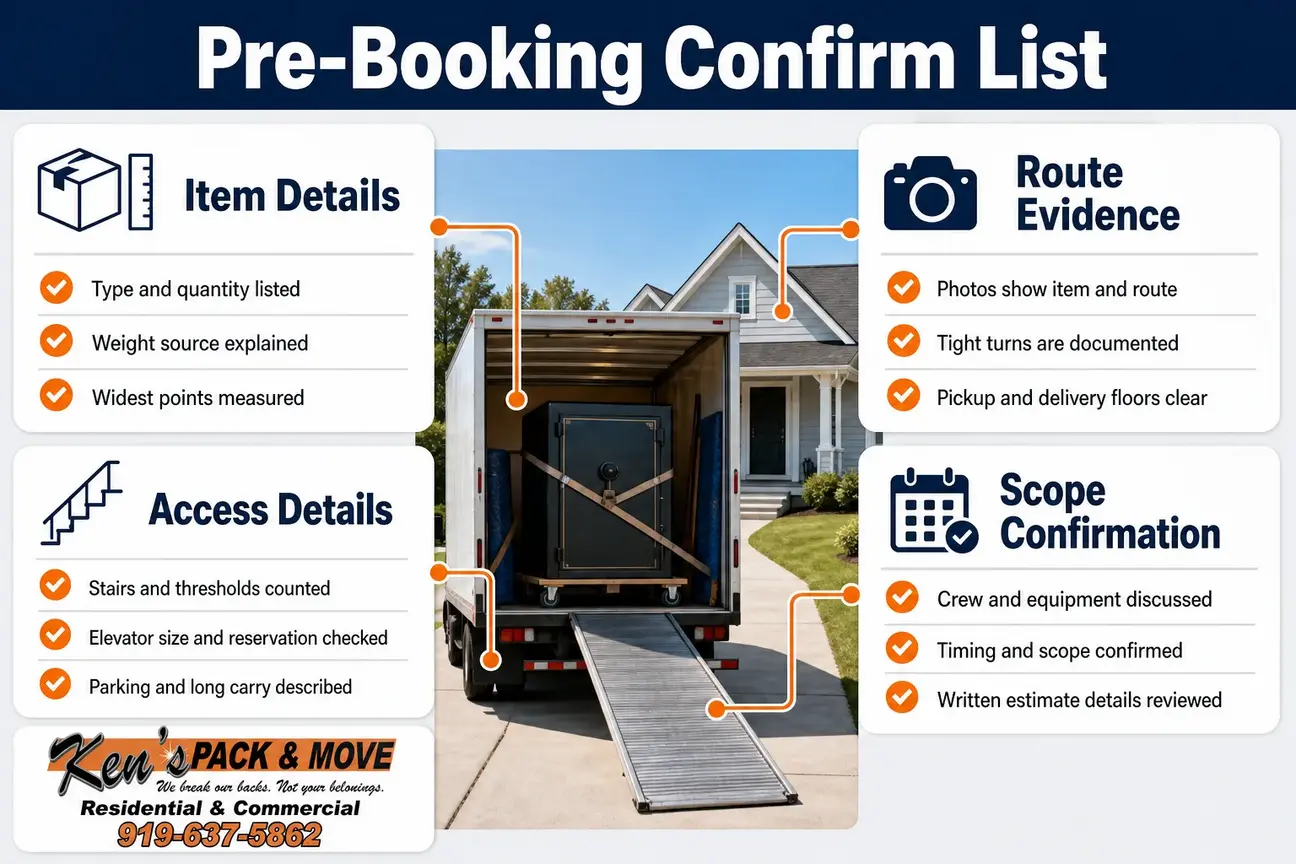
Before you treat the quote as ready, run through this final pre-booking list. It works whether you are moving a safe, arranging pool table moving, planning an oversized furniture move or building your heavy item moving checklist for several pieces.
- The item type and quantity are listed separately.
- Approximate weight is documented, and the source of that weight is explained.
- Height, width and depth are measured at the widest points.
- Photos or video show the item, route, parking area, stairs, elevators and tight turns.
- Pickup and delivery floor levels are clear.
- Stairs, landings, exterior steps and thresholds are counted and described.
- Elevator size, door opening, weight rating, reservation status and move window are confirmed if applicable.
- Doorways, hallways, gates, low ceilings and turning space are measured.
- Flooring, wall protection needs and building rules are identified.
- Parking location, truck access and carry distance are described.
- HOA, condo, apartment, senior-living or property-manager restrictions are in writing.
- Disassembly, reassembly, leveling, refelting, anchoring, utility disconnection or third-party preparation is identified.
- The mover has confirmed whether the item appears to fit the requested scope, equipment plan and handling limits.
- Estimate, valuation choice, scope, date and reservation details are confirmed in writing before moving day.
If your move is in Raleigh, you can also review the local service page for movers in Raleigh to understand local moving support in the area. For a heavy item, the next step is still the same: send the measurements, photos and access details so the quote conversation is based on the real job.
Common details people forget until moving day
Heavy-item planning often fails on small details that are easy to check early. One forgotten handrail, locked loading dock, unreserved elevator or missing model number can slow down the quote process. Before you book, look for these common misses.
Loose or attached parts: Drawers, doors, shelves, glass panels, handles and decorative trim may shift or make the item wider than expected. Tell the mover what is removable and what is fixed.
Anchors and built-ins: Safes, cabinets, appliances and wall units may be attached to floors, walls or surrounding cabinetry. Identify those attachments and confirm who will remove them.
Service connections: Appliances and some specialty items may involve water, gas, electrical, alarm, ventilation or security connections. If a qualified technician is needed, schedule that before moving day.
Access permissions: Apartment, condo, HOA and senior-living communities may require elevator reservations, COIs, move windows and loading-area approval. Get the rules in writing before the quote is finalized.
Public access: If a truck may occupy a curb lane, sidewalk area, loading zone or other public right-of-way, check current Raleigh requirements before the move. Rules can change, and the property manager may not know every city requirement.
Valuation assumptions: Do not assume what coverage is included. Ask about valuation choices and confirm your selection in writing before the move.
Mixed heavy-item jobs: If the same move includes a safe, a pool table and another bulky piece, keep a separate note for each one. A single checklist should make each item easier to review, not hide important differences.
Moving rules, building policies and prices change. Confirm scope, date, price and coverage with the mover in writing before moving day.
Ready to request a quote for a bulky or heavy item?
When you are ready to ask for help, send both addresses, preferred dates, home size and type, stairs, elevators, parking, large or fragile items, approximate weight, dimensions, photos and whether you need packing, disassembly, reassembly, labor-only help or debris removal. You can get a moving quote online or call 919-637-5862 to discuss availability.
For moving heavy items Raleigh residents should avoid guessing. Whether the job involves a safe, pool table moving, an oversized furniture move or a full heavy item moving checklist, clear measurements, honest limits and written confirmation make the quote conversation more useful for everyone involved.
Frequently Asked Questions
What information should I provide when requesting a quote for a heavy item?
Provide the item type, approximate weight, dimensions, photos, removable parts, current and destination locations, stairs, elevators, doorways, turns, flooring, parking and carry distance. Also state whether you need disassembly, reassembly, packing or labor-only help.
Should I weigh a safe or pool table before contacting a mover?
Provide the best available approximate weight and explain its source. If the weight is uncertain, say so and send photos, the model number and measurements. Ask the mover to confirm whether the item is within the crew’s handling and equipment limits.
Does a written estimate guarantee that the mover will handle the item?
No. A written estimate addresses the quoted move based on the information supplied; it should not be treated as confirmation that an unusual item is within the mover’s scope unless the mover confirms that separately. Ask for the item, access conditions, equipment assumptions and disassembly scope to be identified in writing.
What should I ask about an apartment elevator?
Ask for the elevator’s interior dimensions, door opening, weight rating, reservation process, service-elevator requirement, move window and building protection rules. Send those details to the mover before requesting a final scope.
Can a mover move a safe or pool table without disassembly?
That depends on the item, access route, construction and the mover’s confirmed equipment and handling limits. Ask whether disassembly, reassembly, leveling, refelting, anchoring or third-party preparation is included or outside the requested scope.
Is labor-only help appropriate for a heavy item?
It can be relevant when the customer has rented a truck or storage unit and needs loading or unloading assistance, but the heavy item still requires complete weight, dimension and access information. Confirm whether the requested labor-only job fits the crew’s handling limits and equipment plan.
What if the building or street has moving restrictions?
Get the rules in writing from the property manager, HOA or local authority before requesting the quote. Confirm elevator reservations, loading windows, parking restrictions, certificates of insurance and any public-right-of-way requirements.