

Moving Into Senior Living in the Raleigh Triangle
Moving into senior living is ready to schedule only after the destination community confirms the assigned unit, what will fit inside it, what furnishings are already included, the delivery entrance, elevator or loading procedures, parking rules, access process, and check-in requirements. For families in Raleigh and the Triangle, the move has two tracks: sorting and packing the home, and matching the move plan to the senior-living community’s written instructions.
Quick answer for moving into senior living
A successful senior living move starts with the destination community, not the truck. Confirm the unit, access route, move-in window, elevator reservation, loading area, parking plan, documentation, and first-night needs before deciding what furniture or boxes should go. Measure the destination before loading large pieces, keep medications, documents, valuables, chargers, and move-in paperwork under family control, and send the mover the full inventory plus facility rules when requesting a written quote.
Why the destination community controls the senior living move
A move from a long-time home into independent living, assisted living, memory care, or another senior-living setting is not just a downsizing project. The destination building may have its own move-in hours, service entrance, elevator process, check-in desk, parking limits, access codes, and rules for cardboard or packing materials. Those policies are not standardized, so the safest planning step is to get the community’s instructions in writing.
The National Institute on Aging’s Aging in Place page, updated in 2025, explains aging in place as staying in one’s own home while getting older, and says that staying at home “requires careful consideration and planning.” That context matters because a family may be comparing several living arrangements, not simply booking a move. The NIA also notes that home changes “could make” a home easier and safer to live in, but it does not make a medical decision for any one household. Use the senior living move plan to support the resident’s chosen arrangement, and get medical, legal, or care questions answered by the appropriate professionals.
For moving logistics, start with the community’s move-in packet or email. A verbal answer can help, but a written instruction sheet reduces confusion when different family members, staff contacts, and movers are involved. If the community updates the unit number, arrival window, or access point, share the change with everyone before moving day.
Ken’s Pack & Move helps with senior and downsizing moves, packing, loading, unloading, furniture moving, and local household moves in the Triangle. For the broader sorting side of the project, families can also use this senior moving checklist. This article focuses on the facility move-in details that should be confirmed before the truck arrives.
Confirm these facility move-in details before booking
A facility move-in is ready to quote and schedule when the community has confirmed the physical unit, the access route, and the check-in process. Ask for the specific community name, building, floor, and unit number. If the unit is still subject to change, do not finalize the furniture plan until the community confirms the final space.
Ask the destination community for the unit dimensions, room layout, doorway widths, elevator dimensions, turning clearances, closet sizes, and any areas where furniture cannot be placed. If a community gives you a floor plan, treat it as a starting point, not the whole answer. A floor plan may not show hallway turns, elevator depth, ceiling height, thresholds, or the distance from the loading area to the unit.
Confirm what remains in the room or apartment before bringing duplicate items. Ask about beds, dressers, refrigerators, window treatments, lamps, shelving, trash cans, television mounts, telephone or internet equipment, and bathroom accessories. “Included” can vary by unit, lease, care level, or building, so request a room inventory or inclusion list instead of assuming.
Move-in access deserves the same attention as furniture. Ask whether the move must happen during office hours, whether the crew must use a loading dock or service entrance, whether the elevator must be reserved, whether a staff escort is required, and where the truck may park. If the community requires a certificate of insurance, vendor registration, delivery paperwork, or specific identification at check-in, collect those details early.
For a smooth facility move-in, also ask what happens if the truck is delayed by traffic, weather, or a prior appointment. Raleigh-area moves can be affected by I-40, I-440, I-540, US-1, end-of-month lease turnover, summer heat, and afternoon storms. A backup contact and a written schedule-change procedure can prevent family members from chasing answers on moving day.
The same facility move-in details should go to the mover before the estimate is finalized. That includes the allowed arrival window, loading entrance, elevator rules, parking location, long-carry distance, check-in steps, and any items the community will not allow into the unit.
Measure the unit before deciding what furniture goes
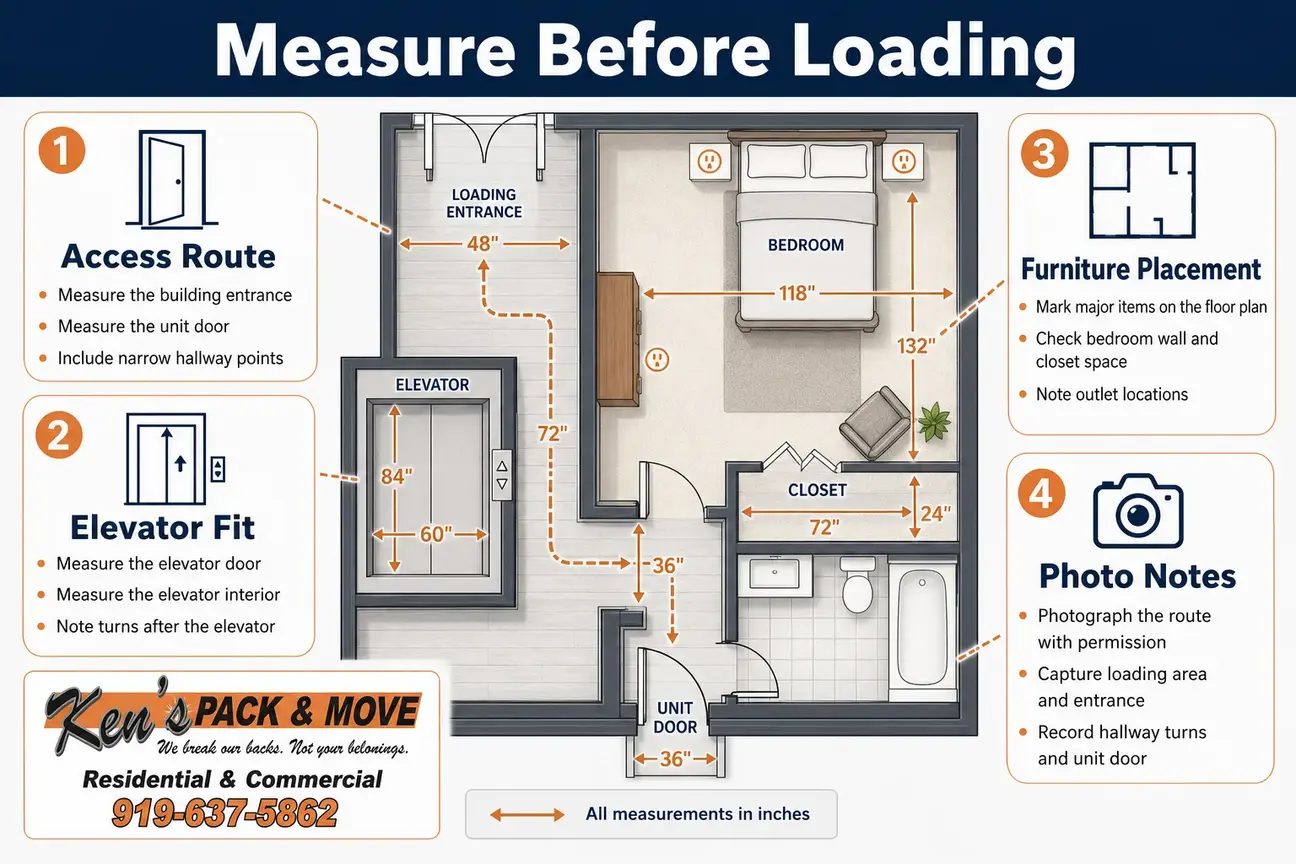
The biggest planning mistake in an assisted living move is deciding what to move before measuring where it will go. Measure the entrance to the building, the unit door, interior doorways, narrow hallway points, the elevator door, the elevator interior, and any turn between the elevator and the apartment or room. If stairs, ramps, thresholds, or security doors are part of the route, include them in the access notes.
Photograph the route with the community’s permission. Take pictures of the loading area, entrance, elevator, hallway turns, unit door, bedroom wall, closet, and outlet locations. Then mark the intended location of each major item on the floor plan. That helps the family decide whether the bed, recliner, dresser, table, television, and lamps are worth loading.
Do not treat measurements as medical or accessibility advice. The goal is practical: confirm the space needed for the resident’s belongings and routine, while keeping the final decision with the resident, family, community, and any care professionals involved.
For an assisted living move, measurement also protects the schedule. If a recliner, dresser, or bed frame cannot clear the elevator or hallway turn, the family may need a different item, a different layout, or a separate decision before moving day.
| Item to verify | Why it matters |
|---|---|
| Bed frame and mattress | Doorway, elevator, room fit, and placement before boxes arrive |
| Recliner or lift chair | Width, turning space, outlet location, and clear walking path |
| Dresser | Height, depth, wall placement, and drawer-opening clearance |
| Dining table | Leg removal, hallway turns, and whether the community already provides seating |
| Television | Stand size, wall restrictions, cable location, and outlet access |
| Mobility or daily-use equipment | Storage location and clear passage, subject to facility instructions |
| Rugs and lamps | Floor area, outlet placement, and whether similar items are included |
Build the senior move checklist around the new room
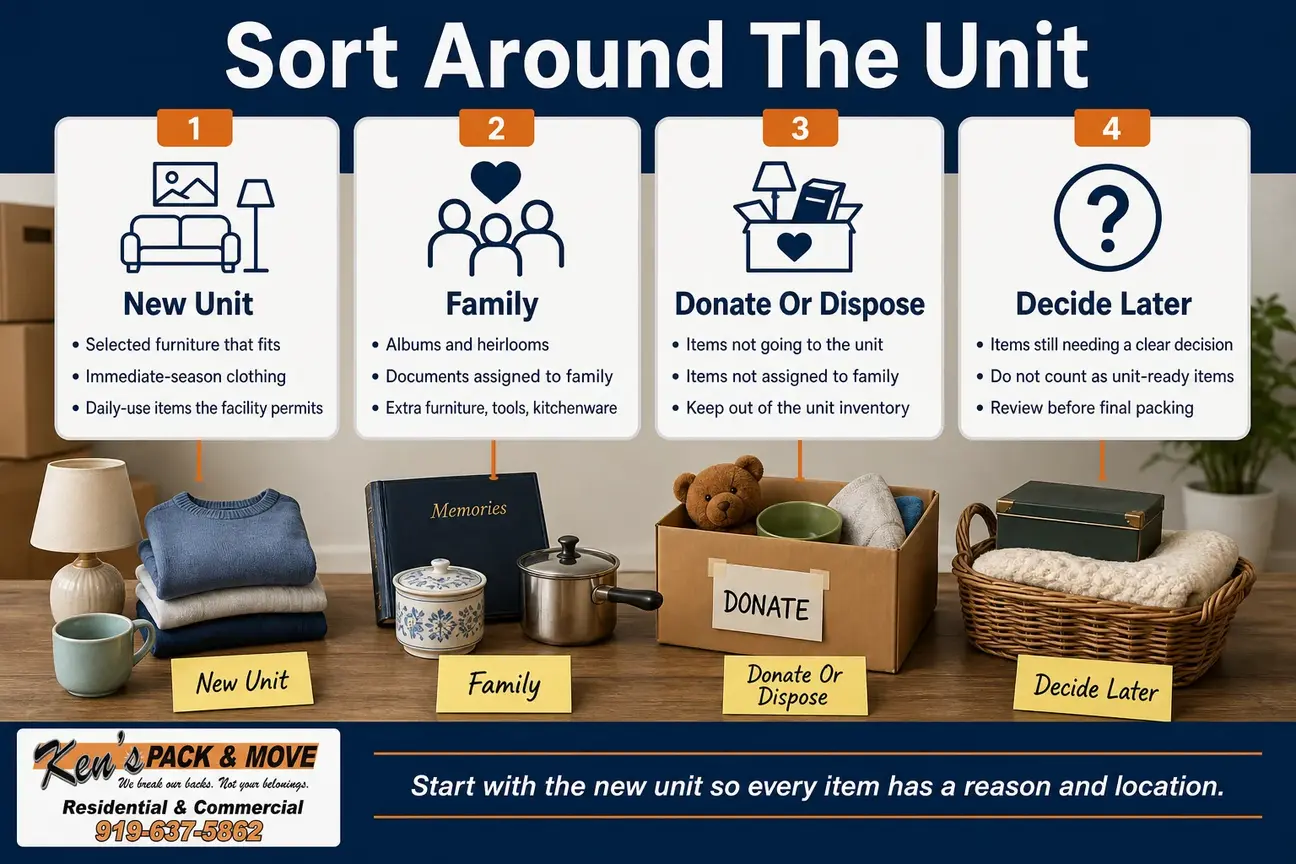
A senior move checklist works best when it starts with the destination unit instead of the old home. In a full house, nearly everything has a place. In a senior-living unit, every item needs a reason, a location, and a clear decision. That is why the first inventory should be “moves into the unit,” not “things in the house.”
Make three lists. The first list is for items that fit the new unit: selected furniture, clothing for the immediate season, toiletries, personal décor, electronics, framed photos, favorite books, and daily-use items that the facility permits. The second list is for family distribution: albums, heirlooms, documents, extra furniture, tools, kitchenware, and items assigned to named relatives with a pickup deadline.
The third list is for donation, sale, recycling, disposal, or debris removal. This can include duplicates, furniture that will not fit, unsafe or unusable items, outdated electronics, extra décor, and household chemicals. Ken’s Pack & Move has confirmed debris removal as an add-on connected with moving, but donation pickup, recycling options, disposal rules, and third-party services should be confirmed separately before relying on them.
For household chemicals, paints, cleaners, pesticides, fuels, and similar materials, do not pack them casually in ordinary moving boxes. The EPA’s household hazardous waste guidance explains that household products can contain corrosive, toxic, ignitable, or reactive ingredients. Ask the mover and the destination community what cannot go on the truck or into the new unit, and use appropriate local disposal guidance for anything restricted.
Label boxes by destination, not just by room. For example: “Unit closet,” “Unit bathroom,” “Family pickup,” “Do not load,” “Carry in family car,” and “Open first.” That helps the crew and family avoid placing a donation box in the resident’s new closet or loading medication paperwork onto the truck by mistake.
Keep the senior move checklist visible during sorting. A printed copy on a clipboard, shared note, or clearly marked folder helps family members see which items are approved for the unit, which items still need a decision, and which boxes should never be loaded.
Plan the assisted living move around access and check-in
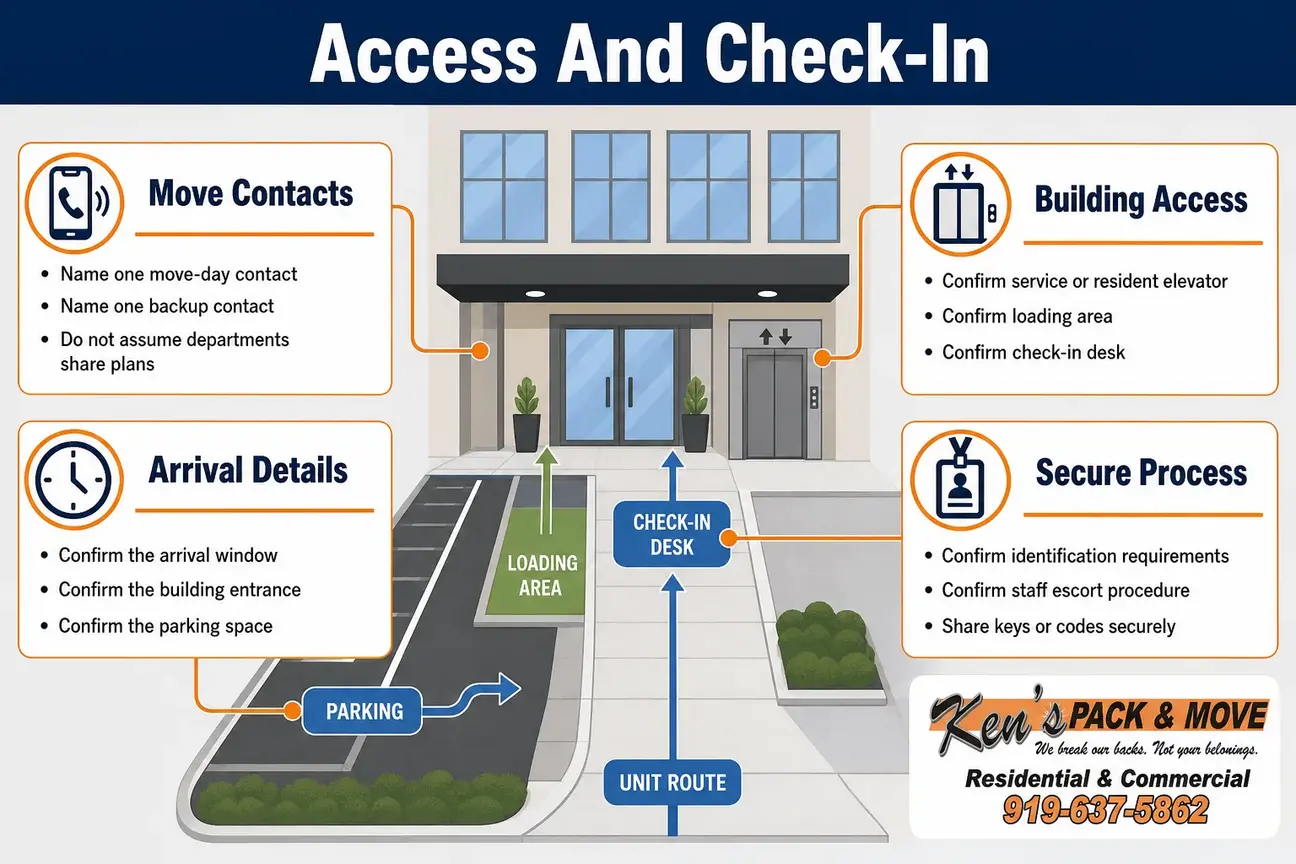
An assisted living move may involve more check-in steps than a typical apartment move. The community may have separate instructions from leasing, care staff, the front desk, maintenance, dining, or resident services. Do not assume those departments share one move-in plan. Ask the community to name one move-day contact and one backup contact.
Before move day, confirm the arrival window, building entrance, service elevator or resident elevator, parking space, loading area, check-in desk, identification requirements, staff escort procedure, and access method. If access codes, cards, or keys are involved, share them only through an appropriate secure channel and only with the people who need them.
Ask whether the family must unload personal vehicles separately from the moving truck. Some residents arrive with clothing, medications, documents, and first-night items in a family vehicle, while movers bring furniture and boxes. That can work well, but only if the community allows both arrivals and everyone knows where each vehicle should park.
If the facility requires elevator padding, ask who provides it and when it must be installed. If the community has a loading dock, ask about height limits, truck-size limits, dock availability, and whether the truck can remain there during the delivery. If the loading area is shared, ask whether a second delivery appointment would be needed if the first window is missed.
A well-planned assisted living move should have one written access plan. The plan should say who checks in, where the truck goes, which elevator is reserved, who opens the unit, and who gives the final placement answer when furniture arrives.
For building-style logistics, the same questions apply to many apartment, condo, and senior-living moves: elevators, move-in windows, certificates of insurance, parking, floor and wall protection, and long carries. Families who want a deeper look at those building-access issues can review Ken’s Pack & Move’s guide to apartment movers in Raleigh.
Parking, public access, and Raleigh-area move timing
Parking can make or break a senior living move. A truck parked at the wrong entrance may create a long carry, block a fire lane, interfere with residents, or violate community rules. Before the move, ask for a parking diagram or written loading instructions. If the community has gated access, visitor spaces, underground parking, narrow entrances, or a covered drop-off area, send those details to the mover.
In Raleigh, also think about public streets and sidewalks. On its Right-of-Way Services page, updated in 2026, the City of Raleigh says a person who wishes to install an object in or occupy the public right-of-way must obtain a permit through its Right-of-Way Services process. That does not mean every ordinary move automatically needs a permit, but if a truck, container, lift, or other object will occupy a public street, sidewalk, or other right-of-way, confirm the requirement with the city or the facility before moving day.
Timing matters across the Triangle. End-of-month lease turnover, appointment windows at senior-living communities, afternoon storms, and major roadway congestion can all affect the plan. Build a realistic move-day order: load the old home, travel to the facility, check in, protect approved paths if needed, place large furniture first, then bring in boxes that belong in the unit.
If the new residence is in Raleigh and the old home is nearby, link both schedules together. If the move starts in Cary or another Triangle community and ends in Raleigh, include the drive route and unloading window when asking for a quote. Ken’s Pack & Move serves customers at their addresses from one office in Cary; it should not be treated as having a separate facility or office at the destination community.
What family should carry and what to discuss for packing
Packing choices should be clear before the crew arrives. Some items are better kept with the resident or responsible family member; other items can be discussed for crew packing or transport as part of the confirmed scope. If you want help packing the old home, ask about full or partial packing services when you request the quote.
| Carry personally or keep under family control | Discuss for crew packing or transport |
|---|---|
| Identification, insurance cards, and legal papers | Clothing, linens, and towels if permitted and not needed immediately |
| Medication and written medication instructions | Books, framed décor, and nonessential room items |
| Cash, jewelry, small valuables, and irreplaceable keepsakes | Furniture and household goods included in the written scope |
| Phone, chargers, hearing-device supplies, glasses, and daily electronics | Boxes prepared for loading and labeled by destination |
| Keys, access cards, check-in paperwork, and facility contact list | Fragile items after discussing packing method and valuation choices |
| First-night toiletries and clothing | Approved kitchen, bath, or décor items that the community allows |
Medications should not disappear into an unidentified moving box. Keep them with the resident or responsible family member, and confirm the community’s medication intake, storage, labeling, and handoff process with the facility or appropriate licensed care staff. This is operational move planning, not medical advice.
Keep financial records, wills, deeds, powers of attorney, passports, birth certificates, passwords, account information, small electronics, and valuable jewelry under family control unless the family has made a specific informed decision. If authority over documents or valuables is unclear, consult the relevant legal or care professional before moving day.
For larger furniture, ask whether pieces need disassembly or reassembly. Bed frames, dining tables, shelving, and certain desks may require extra planning. If heavy pieces are going to the new unit, review the route and measurements first. Ken’s Pack & Move also has a guide on moving heavy furniture for families thinking through access, padding, and placement.
For a senior living move with partial packing, separate “crew can pack,” “family packs,” and “family carries” before boxes are sealed. That keeps documents, medications, chargers, and check-in paperwork out of the general load.
First-night essentials should not ride buried in the truck
The first night is easier when one bag or tote is kept in the family vehicle, not buried under loaded boxes. Label it clearly and tell everyone that it is not for the moving truck. If the resident needs immediate items at check-in, the person handling paperwork should know where the tote is.
Pack one or two changes of clothing, toiletries, towels if the community does not supply them, phone and charger, backup charging cable, glasses, hearing-device supplies, remote controls, device instructions, identification, facility paperwork, and a small comfort item or familiar décor if allowed. Include medication and written instructions according to the community’s process, not according to a generic moving checklist.
Confirm what the community already provides before duplicating bedding, linens, lamps, trash cans, small appliances, or bathroom items. Too much “just in case” packing can crowd a smaller unit and make the first week harder to organize.
Add the first-night tote to the senior move checklist so it does not become an afterthought. The tote should be assigned to a person, not simply placed near the front door with other boxes.
Estimate details for an in-state senior living move
For an in-state North Carolina household-goods move, the North Carolina Utilities Commission’s Moving 101 guide, updated in 2026, says that if requested, a mover “is required to give a free written estimate on a Commission-approved form,” when the rule applies. The same guide says most movers will not provide a written estimate unless they see the items being moved, and that customers should provide the same information to each mover when comparing estimates.
The NCUC guide also says a mover is not required to provide a written estimate when the request is made fewer than five business days before the move or when the total shipment weighs less than 500 pounds. Treat that as North Carolina household-goods guidance, not a universal rule for every move type or every state.
To prepare the estimate, send both addresses, preferred date, permitted facility move-in window, home size and type, senior-living unit size, building and unit number, stairs, elevators, parking, long-carry conditions, loading dock or service entrance instructions, and any access restrictions. Include the number and type of boxes, large or fragile items, heavy furniture, high-value items, and pieces that may need disassembly or reassembly.
Also be clear about the scope. A senior living move may be a full move, a partial move, full or partial packing, loading and unloading, labor-only help for a rental truck, or a small furniture delivery from one family member’s home. If the family rented a truck and only needs loading or unloading, review the guide to labor-only movers before deciding what kind of help to request.
For an assisted living move, send the facility’s written instructions with the quote request instead of summarizing them from memory. A move-in window, elevator reservation, parking rule, or certificate of insurance request can affect the crew plan and should be part of the written scope.
Valuation should be discussed in writing. The NCUC Moving 101 guide describes basic value protection and full value protection as different choices, and states that basic protection provides a maximum liability of $0.60 per pound based on the weight of lost or damaged items, regardless of actual value. Do not assume a particular coverage is included. Ask questions, choose valuation in writing, and keep a copy with the moving paperwork.
Ken’s Pack & Move is certificated by the North Carolina Utilities Commission for household-goods moves within North Carolina under certificate C-2551; families can check the NCUC list of certificated household-goods carriers before hiring a mover. Do not use that North Carolina certificate as proof of interstate authority, and do not assume out-of-state service from it.
When you are ready to compare the scope and schedule, you can request a free moving quote. Include both addresses, preferred dates, home and unit details, stairs, elevators, parking, facility instructions, large or fragile items, and whether you need packing, loading, unloading, labor-only help, or debris removal. A form submission is a request, not a confirmed reservation; date, crew, scope, and price must be confirmed directly.
Short-notice changes during a facility move-in
A facility opening, closing delay, lease change, canceled helper, or family schedule change can turn a senior living move into a short-notice project. Short notice does not make the planning steps disappear; it makes written details more important. The destination still needs to be ready, the move-in window still needs to be confirmed, and the inventory still needs to be realistic.
Short-notice feasibility depends on the assigned unit, confirmed facility access, parking, elevator availability, how much has already been sorted and packed, and whether a crew is available. A partial move, loading-only job, or unloading-only job may be easier to evaluate quickly than a whole-home pack and move, but the details still control the quote and schedule.
If timing is tight, call 919-637-5862 to check availability. Do not wait for every distant relative to agree on every small item before asking about the moving window. Start with the items that must go to the resident’s unit, then handle family distribution and donation decisions as separate lists.
For moves that need quick help in the Triangle, Ken’s Pack & Move has last-minute moving help when a crew is available. Availability, arrival timing, finish timing, scope, and price must be confirmed directly; a short-notice request is not a promise of same-day service.
During a rushed facility move-in, keep the senior move checklist shorter and more decisive. Prioritize the resident’s approved furniture, clothing, toiletries, documents, medications, chargers, and first-night items, then schedule family pickups or debris decisions separately.
Move-day communication keeps the handoff calm
The best move-day plan assigns roles before anyone starts carrying boxes. Choose a resident contact, a family decision-maker, a facility contact, a mover contact, the person holding documents and valuables, the person receiving furniture at the unit, and the person checking the old home after loading. One person can hold more than one role, but everyone should know who has the final answer.
Create one shared written message with the unit number, arrival window, parking instructions, elevator reservation, access process, facility contact, items not to move, first-night tote location, family distribution plan, and emergency contact information. Send it to the family members who will actually be present. Avoid long group threads where critical details get buried under side conversations.
At the old home, mark items with simple labels: “Move to unit,” “Family pickup,” “Do not move,” “Carry in car,” and “Dispose or confirm.” At the new unit, place large furniture before opening small boxes. If space is tight, do not unload every décor box at once; leave a clear path while the main pieces are positioned.
A move-day communication plan is especially useful for an assisted living move because staff, family members, and movers may all arrive with different assumptions. Put the facility move-in rules in the same message as the furniture layout and first-night tote plan.
After delivery: settle the room before unpacking everything
Once the truck is unloaded, walk through the unit before opening all boxes. Confirm that the community’s included furnishings are still present, large items are in the intended locations, and doors, closets, bathrooms, and walking paths are accessible for the resident’s routine. Photograph the placement of major items and any notable condition issues for family records.
Keep boxes and debris out of prohibited areas. Ask the community where cardboard, packing materials, and trash may go. If unpacking will take more than one visit, leave labels facing out and keep the first-night tote separate.
After the move, handle address updates that apply to the household through the appropriate agencies, service providers, account providers, and utility contacts. The right update list depends on the former home, the new residence, vehicle and license needs, banking and insurance accounts, medical contacts, subscriptions, and who is authorized to make changes for the resident.
If the resident is moving within Raleigh, families may also want a mover familiar with local building access, traffic, and parking patterns. Ken’s Pack & Move has a Raleigh service page for households looking for a Raleigh moving company for local move help.
After the senior living move, keep the checklist for a few weeks. It can help the family find documents, identify boxes that still need unpacking, and confirm which items were assigned to relatives or disposal.
Use the facility rules as the final plan
Moving into senior living works best when the family treats the facility instructions as the final operating plan. The truck, packing list, furniture layout, first-night tote, and quote request should all match the assigned unit and the community’s move-in process. If the community changes the unit, window, entrance, or required paperwork, update the mover and family plan right away.
For a full move, partial move, packing, loading, unloading, or furniture-only move into a Raleigh-area senior-living community, Ken’s Pack & Move can review the scope when you request a quote. Share both addresses, preferred dates, home size, unit details, stairs, elevators, parking, large or fragile items, and all written facility instructions.
A careful senior living move, a measured assisted living move, and a clear facility move-in plan all depend on the same habit: get the details in writing before moving day. Moving rules, building policies and prices change. Confirm scope, date, price and coverage with the mover in writing before moving day.
Frequently Asked Questions
How early should we start planning a senior-living move?
Start as soon as the community can give written move-in instructions, even if the exact move date is not final. The most important early steps are confirming the unit, measuring the access route, deciding what fits, and asking the community about elevators, parking, check-in, and required paperwork.
What should we ask the senior-living community before hiring movers?
Ask for the building, floor, unit number, move-in window, loading entrance, elevator process, parking location, access procedure, check-in requirements, contact person, certificate of insurance rules if any, and disposal rules for boxes and packing materials. Send those details to the mover before the estimate is finalized.
Can movers pack everything for an assisted living move?
Some household goods may be discussed for packing as part of the confirmed scope, but family members should usually keep medications, identification, legal documents, cash, jewelry, chargers, access cards, and first-night essentials under their own control. Ask the mover about restricted items before packing.
What if the facility changes the unit or move-in window?
Update the furniture plan, inventory, parking instructions, elevator reservation, and mover right away. A different unit can change what fits, how far items must be carried, and whether the same entrance or elevator can be used.
Should we bring all furniture from the old home?
No. Measure the destination unit and access route first, then choose only the pieces that fit the room, the resident’s routine, and the community’s rules. Extra furniture should go on a family distribution, donation, sale, recycling, or disposal list.
What belongs in the first-night tote?
Pack clothing, toiletries, phone and charger, glasses, hearing-device supplies, identification, move-in paperwork, essential instructions, permitted snacks or water, and a familiar comfort item if allowed. Keep medications and medication instructions according to the community’s handoff process.
Can Ken’s Pack & Move help with a short-notice senior-living move?
Short-notice help depends on crew availability, destination readiness, a confirmed facility window, access details, parking, and how much is already packed. Call 919-637-5862 to check availability, but confirm the schedule, scope, and price directly before relying on the move date.
Sources
- National Institute on Aging: Aging in Place: Growing Older at Home, updated 2025
- North Carolina Utilities Commission: Moving 101, updated 2026
- North Carolina Utilities Commission: List of Certificated Household Goods Carriers
- City of Raleigh: Right-of-Way Services, updated 2026
- U.S. Environmental Protection Agency: Household Hazardous Waste