
KEN’S PACK & MOVE · MOVING TIPS
Moving Inventory List: Track Boxes, Furniture, and Condition Before Moving Day
A practical system for identifying belongings, organizing delivery, and keeping useful condition records for your Raleigh or Cary move.
A moving inventory list connects what you packed with what was loaded, delivered, and unpacked. For Raleigh and Cary households, a useful moving inventory list gives every carton and large item a recognizable ID, destination, and status. Without a consistent record, a missing lampshade can mean a misplaced carton, a forgotten closet, or an item that was never intended to move.
This guide explains a simple household system using box numbers, destination rooms, condition photographs, and delivery checks. It also distinguishes your personal organizing list from a mover’s shipment documents. You do not need to describe every teaspoon. You need enough detail to identify a container, find an important item, and communicate an exception without searching through the entire shipment.
QUICK ANSWER
How Do You Make a Moving Inventory List?
Give each box and large item a unique identifier, record its destination room and a short contents description, and track whether it is packed and received. Photograph valuable or fragile items and any existing damage. Keep a backup of the list with you. Review the mover’s own inventory where applicable because a personal spreadsheet does not replace shipment documents or determine claim eligibility.
What Should a Moving Inventory List Include?
A useful moving inventory list records the information needed to identify and locate an item. Begin with the box or item ID, destination room, short description, packing status, and received status. Add condition notes and a photograph reference when those details will help distinguish one item from another. Leave highly sensitive information out of visible box labels.
For ordinary cartons, a category description is often enough: “everyday mugs and cereal bowls” is more useful than “kitchen miscellaneous.” For a television, desk, cabinet, or framed artwork, record the specific item rather than treating all furniture as one entry. Accessories can have their own identifiers or be linked to the main item when they are packed separately.
The inventory is also a scope record. Mark items that are being donated, staying with the property, traveling in your car, or going to another destination. This prevents a complete list of everything you own from becoming an inaccurate list of what the mover should load. Keep those categories clearly separated and tell the crew how your labels identify them.
Start With These Six Fields
- ID: A unique code for the box or large item.
- Destination: The property and room where it belongs.
- Description: A short, recognizable contents or item summary.
- Condition: Relevant existing marks or a photo reference.
- Ready status: Whether it is packed or prepared for loading.
- Received status: Whether it arrived at the intended destination.
How Is Your List Different From the Mover’s Inventory?
Your personal moving inventory list organizes the household. The mover’s inventory, where provided or required, records the shipment under the move’s applicable procedures. The two lists may use different numbering, descriptions, and condition codes. Keep both and establish a connection between them when possible rather than assuming one document substitutes for the other.
For interstate moves, the Federal Motor Carrier Safety Administration moving checklist recommends accompanying the movers during inventory and resolving questions about condition. Its shipment pickup guidance explains the importance of accurate shipment and condition entries before signing. Ask what an unfamiliar abbreviation means and retain the documents provided for your move.
For a move that begins and ends in North Carolina, consult the NC Public Staff Transportation Division for consumer information applicable to intrastate household-goods transportation. Do not use an interstate moving summary as a substitute for the rules governing your local move. Your agreement and applicable requirements determine the documentation, reporting process, and protection that apply.
How Should You Number Boxes on Your Moving Inventory List?
Use a numbering system that stays unique from the first box to the final delivery. A single sequence such as B001, B002, and B003 is easy to maintain because a box can change rooms without changing its identity. Use a separate sequence such as F001 for furniture if that helps distinguish unpacked items from cartons.
Room-based numbers can also work, such as K-01 for a kitchen box or LR-01 for a living-room carton. Decide whether the room prefix refers to the original room or the destination room. A dining cabinet might become office storage after the move. If the identifier describes its old room, record the destination separately. Avoid renumbering an already photographed carton because that breaks the connection between the picture, label, and list.
Let one person issue numbers or assign nonoverlapping ranges to different packers. Two relatives independently using “box 12” can create a delivery problem even when every carton has a label. If you discover a duplicate, correct it before loading, update the record, and replace all matching labels. Retired numbers can remain unused rather than being recycled for a different box.
What if One Box Becomes Two?
If a carton must be split, record the relationship between the original entry and the replacement boxes. For example, B-01 can become B-01A and B-01B, with a note explaining which contents moved into each. Mark the original entry as replaced rather than leaving three active entries that appear to describe three separate cartons. Update the labels and any photograph references before loading.
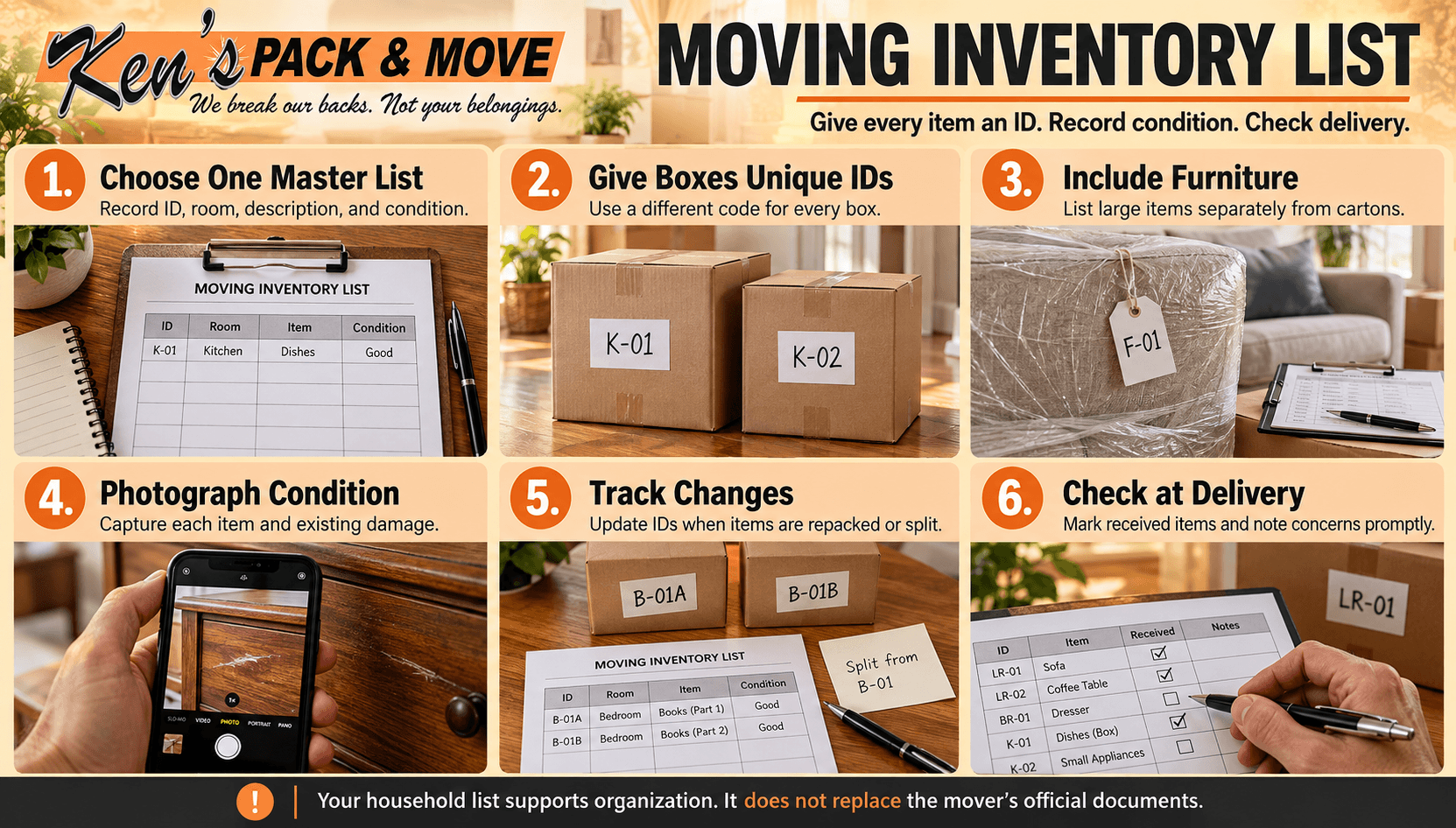
What Should Your Moving Inventory List Columns Look Like?
Keep the core columns short enough to read on a phone and detailed enough to resolve a delivery question. Start with the following structure and add fields only when they support an actual decision. A complicated moving inventory list that stops being updated halfway through packing is less useful than a simple record maintained consistently.
| ID | Destination Room | Description | Condition / Photo | Packed / Ready | Received |
|---|---|---|---|---|---|
| K-01 | Kitchen | Everyday mugs and bowls | Photo K-01 | Packed | Not yet |
| BR-01 | Bedroom 1 | Bed linen and towels | No condition photo recorded | Packed | Not yet |
| F-01 | Living room | Three-seat sofa | Left rear scuff; photo F-01 | Ready | Not yet |
| OF-01 | Office | Desk hardware and accessories | Linked to desk F-03 | Not packed | Not yet |
| F-02 | Dining room | Round wood table | Tabletop photos F-02 | Ready | Not yet |
These are illustrative entries, not a customer’s shipment. On smaller screens, swipe horizontally to see every column.
A phone note, notebook, or spreadsheet can all use the same structure. If belongings go to two destinations, add a destination-property column and filter the list before loading. If you want to locate open-first items, add a priority field. Avoid storing passwords, financial account numbers, or full identity documents in the packing inventory.
How Do You Record Contents Without Listing Everything?
Record contents at the level that helps you find a box later. “Kitchen tools” is broad, while “spatulas, measuring cups, and can opener” is specific enough to identify a useful first-week carton. For clothing, “summer shirts and shorts” may be enough. For a mixed office box, distinguish stationery from confidential records without putting sensitive details on its exterior.
Use more detail for high-value, fragile, or difficult-to-replace items. Record identifying features, dimensions when useful, and serial numbers in a private record when appropriate. Keep receipts or appraisals separately and reference their file names rather than inserting documents into a list shared with everyone helping the move. Estimated value should not be confused with agreed moving protection or a guaranteed settlement amount.
If a carton is reopened, update its description on your moving inventory list before sealing it again. Adding the router to a box originally listed as books is a small change that can cause a large search later. A clear description also helps the receiving person decide which boxes need inspection first. The system should reflect the final contents, not the contents at the start of packing.
Which Photos Should Support Your Moving Inventory List?
Useful photographs show the item’s identity and condition clearly. Take an overall image and closer pictures of fragile surfaces, existing marks, or important details. Use adequate light and avoid filters that change appearance. For packed cartons, a photograph before sealing can help locate contents, but it may not show whether each piece was cushioned appropriately.
Name the photograph using the inventory ID or record where it can be found. A folder full of unrelated images is difficult to use during unloading. For an item with several photographs, use a consistent suffix, such as F-02-front and F-02-top. Keep the original files and a backup accessible to the household contact who will attend delivery.
A photograph is supporting information, not automatic proof of when or how damage occurred. Before-and-after images, packaging condition, shipment documents, and written communications can all matter. Do not assume a photo guarantees a successful claim. Ask the mover what records it recommends for concerns, and follow the applicable reporting process if an issue appears.
A Useful Photo Sequence
- Photograph the complete item so it can be recognized.
- Capture existing marks and delicate areas in clear light.
- Connect each image to the item’s inventory ID.
- Keep original files and an accessible backup.
How Do You Label Boxes for Fast Unloading?
Put the unique ID and destination room on the top and at least one visible side of each box. Add a short contents description and any appropriate handling note. Keep the ID large enough to read while boxes are stacked. A color can help identify a room, but written labels remain necessary when lighting or color recognition makes the system unclear.
Use destination names that match the new home. “Bedroom 2” is ambiguous if nobody knows which room it means. Before delivery, post temporary room signs or give the receiving person a simple floor plan. If the new home has an office and guest room that look similar, use those exact names on both the doors and the cartons.
Labels do not replace suitable packing. “Fragile” written on an overloaded carton does not make it safe to handle. Discuss packing responsibilities and protection methods with your mover before sealing questionable boxes. Ken’s moving tips library covers related preparation topics. Here, the priority is making every label connect to a useful record and an unmistakable destination.
For a household with multiple people packing, place a finished example label where everyone can see it. Show the order of the ID, destination, description, and priority note. This small reference keeps labels consistent without forcing each helper to guess the format. Check readability before stacking cartons against a wall, where a label on the wrong side may become difficult to find.
How Should You Track Furniture Parts and Accessories?
Track detachable parts by linking them to the item they belong to. A hardware bag, shelf support set, remote control, or power cable can be recorded under the main furniture or equipment identifier with a separate container location. The useful record says where the parts are, not merely that the parts exist.
For example, a desk entry can state that its bolts are in OF-01 and its keyboard tray travels with the wrapped desk. If the mover handles disassembly, ask how the parts will be secured and identified. Do not tape bags to finished surfaces without approval. Adhesives and sharp hardware can damage furniture or disappear during removal of the protective covering.
At the destination, check the linked containers before deciding that an accessory is missing. Keep assembly instructions with the household documents or record a clean manufacturer link in a private planning note. If parts are needed for later assembly, mark their container as open first. Your moving inventory list should help reunite pieces while keeping the crew’s handling and assembly scope clear.
What Changes When Belongings Have Multiple Destinations?
Multiple destinations require an explicit destination field and a visible way to distinguish the loads. A room label alone cannot tell the crew whether a kitchen carton belongs in the new home, a relative’s house, or a storage unit. Give each destination a simple name and use that name consistently in the list and on the label.
Confirm the order of stops with the mover before packing is complete. Loading sequence, travel time, access, and additional handling may change the service scope. Do not assume that adding a stop is a minor adjustment because the addresses are nearby. Tell the mover which furniture and box IDs belong at each stop and identify anything whose destination is still undecided.
Prepare a separate received check for each location. If another adult accepts delivery to storage, give that person the relevant portion of your moving inventory list and a way to report exceptions. Keep a record of who received the items and where they were placed. An item can be delivered correctly and still appear missing if the household’s master list is never updated.
How Do You Use Your Moving Inventory List on Loading Day?
Use the list to review the move scope, identify exceptions, and check the origin after loading. Before work begins, point out items traveling with you, items staying behind, and any last-minute changes. Keep those items physically separate when practical. A note buried in the spreadsheet is not enough if the crew never sees it.
During loading, keep records without distracting people carrying furniture. If you are using a loaded field, update it from a safe position or ask how the crew prefers to coordinate tracking. Do not stand on the truck ramp to read labels. The inventory process must fit around safe loading and the mover’s own documentation rather than interrupt every movement.
Before departure, walk through closets, cabinets, balconies, garages, and agreed storage spaces that are safe to access. Compare remaining items with the stay-behind list. Count loose pieces such as lamps, rugs, and chair sets as carefully as cartons. The purpose is to identify an omission while it is easy to resolve, not to assume the house is empty because the main rooms look clear.
How Do You Check Your Moving Inventory List at Delivery?
At delivery, compare the arriving items with the expected destination list and note visible concerns promptly. Check identifiers as cartons enter their rooms, then reconcile any unmarked or unexpected containers with the crew. If the mover provides delivery inventory documents, read their condition and exception process before signing rather than relying only on your personal checkboxes.
For interstate moves, the FMCSA delivery-day checklist advises noting damaged or missing boxes and items on the inventory before signing documents. Your household received status means the container or item arrived. It does not mean every concealed item has been inspected. Use a separate inspected status if you need to distinguish delivery from unpacking review.
If something appears missing, check room placement, personal-vehicle items, alternate destinations, and the origin’s stay-behind list. Record the ID, description, and last known status. Ask the mover how to report the concern and retain the relevant documentation. Reporting deadlines and obligations depend on the applicable move and agreement, so address an issue promptly instead of waiting for every box to be unpacked.
Received Does Not Mean Inspected
Received: The identified box or item arrived at the intended location.
Inspected: You checked its accessible condition or contents and recorded any concerns. Keep these statuses separate when unpacking will continue after delivery.
Should Your Moving Inventory List Use Paper, a Spreadsheet, or an App?
Use the tool you can keep updated reliably. Paper works well when one person records the move and internet access is uncertain. A spreadsheet makes sorting by room or destination easier. An app may connect photographs and codes, but it can add account, subscription, or connectivity requirements that a simple household move does not need.
For a shared spreadsheet, decide who can edit and who should only view. Make a backup before loading so accidental changes can be checked against an earlier version. Keep a downloaded or printed delivery copy available if the destination’s internet is not working. Avoid sharing sensitive item values or serial numbers more widely than necessary.
An app is useful only if the household will use its system throughout packing and delivery. If printed codes fall off or a phone fails, a readable ID on the box should still connect to an offline list. Test the workflow with a few cartons before committing the entire shipment. The best choice reduces effort without making the information dependent on a single device.
| Format | Useful When | Plan For |
|---|---|---|
| Paper | One person maintains a straightforward list. | A photographed backup and legible updates. |
| Spreadsheet | You need sorting, shared access, or multiple destinations. | Editing permissions and an offline delivery copy. |
| App | Photo linking or code scanning fits your workflow. | Device access, exports, and a readable backup system. |
How Can You Keep a Large Moving Inventory Manageable?
Build your moving inventory list as you pack rather than reconstructing it the night before moving. Record and label each completed carton, then move it into the appropriate staging area. Furniture can be listed room by room in a separate pass. This spreads the work and keeps descriptions connected to contents while they are still visible.
Agree on a minimum standard for everyone helping: unique number, destination, contents description, and status. Use the same vocabulary for packed, ready, received, and inspected. A box labeled “done” could mean sealed to one person and delivered to another. Defined statuses reduce that ambiguity without requiring elaborate software or a long household meeting.
For a Raleigh-to-Cary move, the list can stay compact while still tracking two addresses and room placement. A larger Triangle relocation with storage or multiple receivers needs more destination detail. Ken’s local moving services page explains the service starting point. Share the relevant inventory scope when requesting a quote, and update the mover when the amount or destination of belongings changes.
Before the move, review unfinished entries rather than polishing the appearance of completed ones. Look for missing room assignments, repeated IDs, unrecorded furniture, and cartons whose contents changed. At delivery, focus on the exceptions that remain unresolved. A useful inventory stays accurate during the move and helps answer specific questions after it; it does not need elaborate formatting to perform those jobs.
Share a Clear Move Scope With Ken’s Pack & Move
Your moving inventory list helps you explain what needs to move, which items need attention, and how delivery should be organized. Share large furniture, approximate carton counts, stairs, parking, and destination details when discussing your booking. Ask how your household list can work alongside the crew’s documentation.
Confirm packing, transport, and assembly responsibilities separately so the inventory describes the service you actually need for your Raleigh, Cary, or surrounding Triangle move.
Frequently Asked Questions About Moving Inventory Lists
Do I need an inventory for a local move?
A local inventory can help track cartons, furniture, accessories, and room placement even when travel is short. Start with a simple numbered list and add detail for fragile or valuable items. Ask your mover what documentation applies to the booking. Your personal list supports organization but does not replace any required shipment documents or contractual reporting procedures.
Should I number boxes by room?
You can, but a single unique sequence is often easier when a box changes destination rooms. If you use room prefixes, define whether they refer to the old home or the new home. Keep the destination in its own field. Avoid duplicate numbers and update every related label and photograph reference if an identifier must change.
Is an inventory photograph enough for a damage claim?
A photograph can support a condition record, but it does not guarantee coverage or establish responsibility by itself. Packaging, shipment documents, protection selections, timing, and the applicable process may also matter. Keep original images and written communications, report concerns promptly, and ask the mover which records it needs to evaluate the particular item or container.
What should I write on a box label?
Write the unique box number, destination room, a short contents description, and appropriate handling or priority notes. Put the information where it remains visible when boxes are stacked. Avoid exposing sensitive records or detailed valuable-item information. Use the same room names on the cartons and destination doors so unloading decisions stay consistent across the household.
How do I track a box that goes to storage?
Add a destination field and label the box clearly for storage rather than only by room. Track received status at the storage location separately from delivery to your home. Record where the box was placed and who accepted it if another person is responsible. Confirm the stop, access, loading order, and service cost with the mover beforehand.
Should received and inspected be separate statuses?
Yes, if you need to distinguish a container’s arrival from checking its contents. A carton can arrive at the correct address while still holding an unnoticed problem. Use received for delivery and inspected for your unpacking review. Report visible concerns during delivery when possible, and follow the applicable process promptly if a concealed issue becomes apparent later.
How do I prevent duplicate box numbers?
Let one person assign numbers or give different packers separate number ranges. Record an identifier before sealing its carton and check the master list periodically. If a duplicate appears, correct it before loading and update all labels, descriptions, and photo references. Do not reuse an old number for a different carton because earlier records may still refer to it.
Can I send my whole inventory to the mover?
Share the information needed to explain shipment size, special items, destination, and access. Keep unnecessary sensitive information such as passwords, account details, or identity documents out of the shared version. Ask which format is useful for the estimate. A household tracking spreadsheet may need a shorter scope summary for booking and a more detailed private delivery copy.