
Ken’s Pack & Move • Raleigh & Cary Moving Tips
Moving With Cats: A Secure Plan Before, During, and After Moving Day
A practical household plan for secure rooms, suitable carriers, a prepared caregiver, and a calmer introduction to your new home.
Moving with cats requires more than putting a carrier beside the front door. Packing changes familiar surroundings, furniture removal creates unexpected hiding places, and loading keeps exterior doors open. Meanwhile, the people who normally watch the cat may be answering questions, directing movers, or driving between properties. A clear plan helps prevent animal care from becoming an assumption that everyone makes and nobody checks.
For a move within Raleigh, Cary, or another Triangle community, the drive may be relatively short. The important transitions still happen at both ends: placing the cat in a carrier, moving through an open doorway, accessing the new property, and opening the carrier in a secure room. Treat those transitions as planned handoffs rather than incidental moments between furniture deliveries.
This guide focuses on household organization and coordination with your moving crew. Your veterinarian should advise on your cat’s health, travel tolerance, medication, and individual needs. Use the following moving with cats checklist to assign responsibilities, prepare supplies, and decide what must be ready before each stage begins.
Quick Answer
What is the safest practical plan for moving with cats?
Prepare a secure room at each home, assign one adult to manage the cats, and check suitable carriers before moving day. Keep cats away from active loading and transport them in secured carriers in a passenger vehicle with their caregiver. At the destination, close and check the prepared room before opening a carrier. Introduce the rest of the home gradually, with veterinary advice for individual concerns.
1. Build a Separate Plan for Moving With Cats
The furniture move and the cat move involve different responsibilities. The moving crew needs an accessible route for carrying belongings. Your cat needs separation from that route, a suitable travel arrangement, and a caregiver who can remain focused on containment. Writing down both plans makes it easier to coordinate them without asking the crew to supervise an animal while handling furniture.
Choose a primary caregiver and a backup adult. The primary caregiver should know where every cat is, which carrier belongs to each animal, where the travel kit is stored, and who has destination access. The backup should understand the same arrangement so a phone call, delayed vehicle, or unexpected errand does not leave responsibility unclear.
Keep the plan simple enough to explain in a brief conversation. For example: “The cats will stay in the empty bedroom while loading happens. Alex will manage that room and drive the carriers. Jordan will prepare the destination room and confirm it is ready before Alex leaves.” Names and specific locations are more useful than saying that somebody will watch the cats.
Tell the crew leader about the restricted room before loading begins. If furniture must still come out of that room, arrange a different sequence before placing the cats inside. Ken’s guide to items movers will not move is a useful reminder to organize animal care separately from the household-goods shipment.
2. Prepare Veterinary Information and Identification
Contact your veterinarian before moving day if your cat has a health condition, pronounced travel distress, or special care needs. Explain the journey, expected duration, destination, and any overnight arrangements. The American Veterinary Medical Association’s travel guidance recommends discussing a pet’s travel needs with a veterinarian, especially when moving makes travel necessary.
Ask for instructions that fit the individual cat. Questions may include feeding around travel, prescribed medication, appropriate breaks, and what changes should prompt a call. Do not give a human product, borrow another animal’s prescription, or choose a sedative from an online suggestion. Any medication plan should come from the treating veterinarian.
Put relevant records and contact information in the caregiver’s kit. If you are changing practices, arrange records transfer and identify where you will seek care at the destination. A local move may leave your usual veterinary practice accessible, but the caregiver should still have its number available without searching through a packed computer or paperwork box.
Check identification before the move. Confirm that microchip registration details and reachable telephone numbers are accurate. A standard identification microchip is not a live location tracker; it helps connect a scanned chip with registered information. The AVMA microchipping FAQ explains the importance of keeping registry information current. Keep a recent photograph of each cat accessible as well.
Prepare the information, not just the paperwork: Make sure the assigned caregiver can find the veterinary number, identification details, new address, and emergency contact without relying on another person’s phone.
3. Check and Prepare the Cat Carrier
Inspect the carrier before you need it. Check its door, fasteners, handle, seams, and ventilation openings. A carrier that worked for an earlier trip may now have a damaged latch or missing attachment. Follow its manufacturer’s instructions for assembly, capacity, and vehicle securing rather than improvising with a loose strap on moving morning.
Choose a carrier appropriate for the cat’s size and journey. Cats Protection’s carrier guidance discusses choosing and introducing a suitable carrier. Give the cat opportunities to become familiar with it in advance, using an approach appropriate to its behavior. Familiar bedding may help establish a recognizable space, provided it does not obstruct ventilation or prevent secure closure.
Check how the carrier fits in the passenger vehicle before moving day. Confirm the intended position, the manufacturer’s securing method, and the space needed for each animal. Luggage should not press against ventilation openings, and the carrier should not interfere with the driver’s controls or view. Avoid discovering during departure that your packed vehicle has no suitable space left.
Add a clear contact label where it will not interfere with operation. For multiple cats, distinguish carriers using names or another obvious identifier. Keep an individual record of which cat is in which carrier. This makes a handoff easier to verify and prevents a hurried caregiver from treating several similar carriers as one completed task.
4. Set Up a Secure Room Before Loading Starts
Choose a room that can remain closed and stay outside the active loading route. An already-cleared bedroom may be more practical than a room containing the last bed, dresser, or desk the crew needs to collect. The room should be suitable for your cat’s needs, with secure windows, a working door, and no obvious escape gaps or hazards.
Arrange the room before the crew begins opening exterior doors. Bring appropriate supplies into it and check the actual condition of the space. Do not assume a bathroom, laundry room, or spare bedroom is suitable solely because it has a door. Consider cleaning products, appliance access, loose materials, and hiding spaces that could make retrieval difficult.
Use a clear sign and a verbal explanation. “CAT INSIDE — KEEP DOOR CLOSED — CONTACT ALEX” tells helpers what to do and whom to ask. Explain the arrangement to children and anyone who may enter later. A sign supports the plan, but it cannot compensate for using a room the crew must repeatedly access.
The caregiver should check the cats without turning the room into a shortcut or supply station. Keep unrelated moving materials elsewhere. If something must be collected from the room, pause and coordinate access rather than opening the door while someone carries furniture through. Maintain containment until the room is closed again or the cats have been transferred securely.
5. Pack a Cat Travel Kit That Stays With the Caregiver
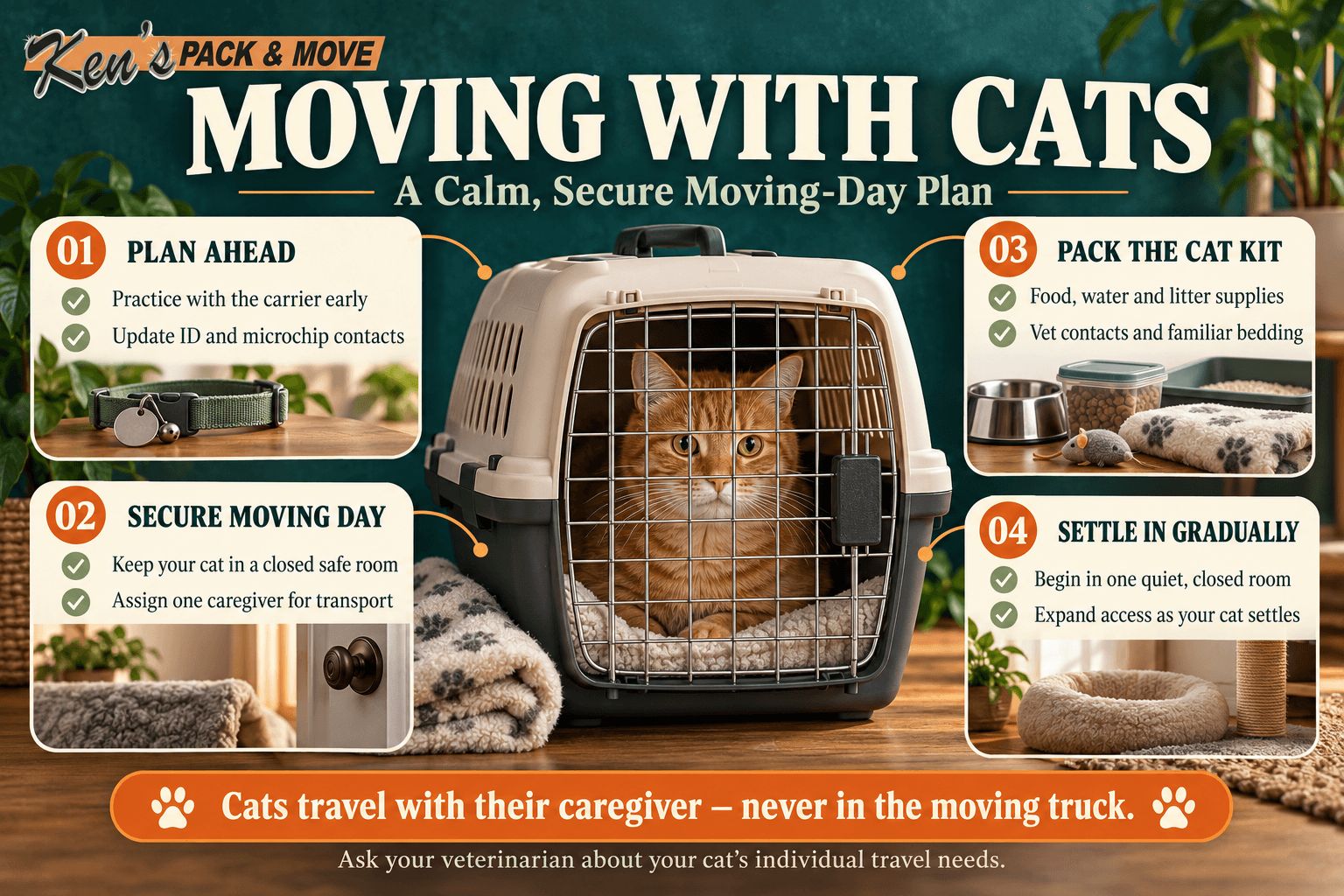
The travel kit should keep essential care independent of the moving truck. An “open first” label does not make a box accessible when it is behind furniture or the truck is at another property. Put the kit in the caregiver’s vehicle or another agreed location that remains available throughout departure, travel, and arrival.
Pack for the actual journey and destination setup. A short local move still needs supplies for unexpected access delays. Use closed containers and secure loose items so a spilled bottle, shifting bag, or misplaced medicine does not create a second problem. Keep anything with storage requirements according to veterinary or pharmacy instructions.
| Kit category | What to keep accessible | Planning check |
|---|---|---|
| Daily supplies | Regular food, water supplies, and familiar bowls | Follow individual feeding and travel advice |
| Destination setup | Litter, tray, familiar bedding, and cleanup supplies | Have the room ready before carrier release |
| Health information | Relevant records and necessary prescribed medication | Keep instructions and storage requirements available |
| Identification | Current photo, chip details, and contact information | Check each cat’s information individually |
| Access and contacts | Destination keys, address, veterinary number, and backup caregiver | Confirm access before departing |
Think through where the kit will go after arrival. Leave it in the prepared room or another secure, convenient location rather than putting it down among general boxes. If two adults share care duties, show the backup where everything is stored. An organized kit is useful only when the person caring for the cat can actually find it.
6. Assign Moving-Day Responsibilities and Handoffs
Moving with cats becomes easier to manage when every transition has an owner and a clear completion check. The crew does not need your entire animal-care schedule, but it does need to know which room is restricted and when that restriction changes. The household needs more detail: carrier checks, travel-kit location, vehicle assignment, and destination readiness.
A handoff should be acknowledged directly. “I have both carriers in my car, and Sam has confirmed the destination room is ready” is clearer than an unanswered group message. Avoid relying on a general household count. Confirm each cat individually before leaving the property and again after arriving inside the prepared room.
| Stage | Assign responsibility for | Confirm before moving on |
|---|---|---|
| Before loading | Secure room and crew briefing | All cats are accounted for; room access is controlled |
| Departure | Carriers, caregiver vehicle, and travel kit | Each carrier is closed and secured appropriately |
| Destination access | Keys and room preparation | The caregiver can enter without joining unloading |
| Arrival | Indoor carrier transfer and room closure | The room is secure before a carrier opens |
| After unloading | Home checks and ongoing care | Exterior doors are controlled and supplies remain available |
Write actual names next to these tasks. If a person is also driving the furniture truck, collecting children, or managing property access, reconsider whether that person can reliably be the cat caregiver. Combining too many time-sensitive responsibilities makes the plan fragile even when every individual task appears straightforward.
7. Transport Cats in a Passenger Vehicle With Their Caregiver
Use suitable secured carriers in a passenger vehicle. Keep cats contained during driving and follow the carrier and vehicle instructions for positioning. Cats Protection’s travel guidance explains the importance of keeping cats in carriers during vehicle journeys. A loose cat can interfere with driving and escape when a door opens.
Plan departure as a separate task from finishing the last furniture load. The caregiver should have time to check closures, secure carriers, collect the kit, and confirm access. Keep the car organized around the animals’ travel needs rather than trying to squeeze carriers into space left over after every miscellaneous box has been packed.
Do not open a carrier outdoors or in a busy parking area to make a quick adjustment. If a stop or delay is possible, discuss a suitable plan before traveling. Longer journeys, special health needs, or unfamiliar travel behavior may require individual veterinary guidance. Avoid treating a carrier as a complete travel plan without considering supervision, ventilation, and destination access.
Never leave cats unattended in a parked vehicle while you help unload. Even a task described as “just a minute” can extend when someone needs directions or a key is missing. The AVMA’s warm-weather safety guidance warns against leaving pets in cars, including in shade or with windows cracked.
Keep animal transport separate from the shipment
Cats should travel with their caregiver in an appropriate passenger-vehicle arrangement. A household-goods truck is not the cat’s travel space, even when the carrier fits among the belongings.
8. Prepare the New Home Before Opening a Carrier
Make destination readiness a condition of departure whenever practical. Someone should confirm that the property is accessible and the selected room is suitable. If the cat caregiver arrives first, allow time for preparation before release. Carrying a closed carrier into a house does not mean the whole house is ready for an uncontained cat.
Check the room’s door, windows, screens, and accessible gaps. Look for unfinished work, cleaning products, unstable stacked items, or openings behind appliances and fixtures. Arrange food, water, litter, and familiar resting materials appropriately. Keep the litter area separate from feeding supplies and leave useful space rather than filling the room with temporary storage boxes.
Cats Protection’s moving-home guidance recommends planning a safe room at the current and new homes. The household’s practical sequence is straightforward: prepare the destination room, bring carriers inside, close the room, and then allow release in that controlled space.
Tell the crew leader which room is now restricted. If a bed or other furniture must be delivered there, complete that delivery before releasing the cats or use a different suitable room. Do not depend on everyone remembering that the room’s purpose changed halfway through unloading. A fresh briefing helps keep the route clear.
9. Introduce the Home Gradually and Monitor Adjustment
Start with the prepared room and familiar supplies. The Humane Society of Missouri’s moving guidance describes using a room with familiar belongings as a starting point. Keep the household’s activity around that room predictable while furniture is placed and exterior doors are still being used.
Before expanding access, walk through the areas the cat may enter. Finish any remaining delivery that requires open exterior doors. Check window screens, renovation gaps, and storage piles. A home can look unpacked enough for people while still containing spaces where a frightened or curious cat would be difficult to retrieve.
There is no universal settling-in deadline that fits every cat. Some will investigate quickly; others need a quieter introduction. Let the cat’s behavior and individual guidance inform the pace. Keep the starting room available as a familiar retreat when appropriate, and avoid forcing exploration simply because the furniture move is finished.
Observe eating, drinking, litter-box use, and general behavior. Contact your veterinarian about concerning or persistent changes rather than assuming everything is ordinary moving stress. If the cat previously went outdoors, discuss the new environment and a suitable plan before allowing outdoor access. A new address changes the surroundings the cat recognizes.
10. Plan for Multiple Cats and Alternative Care
For multiple cats, build the plan around individual animals. Record each name, carrier, identification information, and care instructions. Do not assume that cats who share a home should share a carrier or the same temporary space. Ask your veterinarian about arrangements suitable for their relationship, size, health, and travel needs.
Check each animal during departure and arrival. If one cat hides while another is already contained, pause the transition and maintain the existing containment arrangement. Avoid opening completed carriers or moving furniture through the secure room while searching. An individual checklist prevents the household from mistaking “most of the cats are ready” for completion.
A trusted caregiver or boarding arrangement may be useful when neither property has a suitable room during loading or renovation. Confirm availability, requirements, care instructions, and collection timing in advance. A friend’s home is not automatically suitable if doors are frequently open or there are other animals whose interaction has not been considered.
Make alternative care a confirmed arrangement rather than a vague backup. Identify who transports the cats, who receives them, and what happens if unloading takes longer than expected. The caregiver should know whom to contact about changes. Furniture delivery and cat arrival can happen at different times when that produces a more workable household plan.
11. Coordinate Raleigh and Cary Moving Logistics
For local moving with cats, focus on access rather than assuming a short drive makes timing unimportant. Apartment corridors, shared entrances, reserved elevators, and parking arrangements can affect how the caregiver reaches a secure indoor space. Confirm destination access separately from the truck’s loading or unloading position.
If one adult reaches the new home first, have that person check the room and communicate readiness. If everyone must leave together, decide who handles the cats while another adult coordinates the crew. Avoid placing carriers beside the unloading route while the household debates which room should be used.
Confirm that the destination is ready for occupancy and animal care. If utility activation, key collection, or unfinished work affects the plan, use an agreed care alternative. Do not release cats into an unsuitable room because the furniture has arrived. Access and animal care may need to change independently of the shipment.
Ken’s Pack & Move provides local moving services in the Triangle. When discussing your move, identify the restricted room, furniture that must leave it, and any destination sequencing needs. Clear information helps coordinate the household’s cat plan with the crew’s work.
12. Avoid These Common Moving With Cats Mistakes
Using a room the crew still needs
A closed door cannot remain a reliable boundary if furniture must repeatedly pass through it. Clear the room first, choose another location, or agree on a controlled sequence before the cats are placed inside.
Packing essential supplies on the truck
Food, litter supplies, records, and necessary medication should remain accessible to the caregiver. A clearly labeled box still creates a problem if it cannot be reached during a delay or before the destination room is prepared.
Opening a carrier before checking the room
Complete the room check first. A broken latch, open window, unfinished gap, or scheduled furniture delivery can turn an apparently quiet space into an unsuitable release location.
Assuming someone else is responsible
Assign the caregiver by name and acknowledge every handoff. Responsibility should not change silently because one adult starts helping with boxes or another person picks up the car keys.
13. Your Final Departure and Arrival Checklist
Before departure
- Confirm each cat individually and check every carrier closure.
- Secure carriers according to the relevant instructions.
- Keep the travel kit, veterinary contacts, and destination access information with the caregiver.
- Confirm that the destination room is ready or that another agreed care arrangement is available.
- Tell the household which vehicle contains the cats and who is responsible for them.
Before opening carriers at the new home
- Bring all carriers into the prepared indoor room.
- Close and check the door, windows, and accessible gaps.
- Confirm the crew does not need the room for remaining deliveries.
- Set out the cats’ appropriate supplies and familiar belongings.
- Keep the caregiver responsible for release and the next stage of settling in.
Use these checks at the actual transition points. Reviewing them the night before is helpful, but departure and arrival still need their own confirmation.
Plan the Household Move
Coordinate Your Raleigh or Cary Move With Ken’s Pack & Move
Share your access details, restricted-room plan, and furniture sequence when arranging the move. Your household can manage the cats while the moving crew handles the agreed furniture and belongings.
Request a Moving Quote Call (919) 637-5862
Explore more preparation guides in the Ken’s Pack & Move moving tips library.
Moving With Cats: Frequently Asked Questions
Can my cat ride in the moving truck?
Plan suitable secured carrier transport in a passenger vehicle with the assigned caregiver. A household-goods truck is not an appropriate substitute for the cat’s travel arrangement. Keep animal care separate from the furniture shipment and confirm the carrier, vehicle space, destination access, and travel supplies before departure.
Where should my cat stay while movers load?
Choose a secure room the crew will not need to enter during active loading, with appropriate supplies and no obvious hazards. Move required furniture out beforehand when practical. Tell the crew leader and household helpers that the door must remain closed. If no suitable room is available, arrange a trusted caregiver or another confirmed care option.
Should I give my cat medicine to make travel easier?
Medication decisions should come from your veterinarian for your individual cat. Do not use human products, another pet’s prescription, or an internet dosing suggestion. Discuss travel distress early so any plan can be prepared safely. The veterinarian should provide instructions about use and monitoring, while the household arranges secure carriers, containment, and transport logistics.
Can I release my cat as soon as we reach the new home?
Prepare and close a suitable room before opening the carrier. Check doors, windows, hiding gaps, and hazards, and have the cat’s supplies ready. Keep the room outside the unloading route. Expand access only when the home is secure and the cat’s behavior supports it, using veterinary advice for individual health or behavior concerns.
Should multiple cats share one carrier?
Do not assume sharing is appropriate because the cats live together. Ask your veterinarian about arrangements suitable for their size, relationship, and travel needs, and use carriers according to their instructions. Plan identification and containment for each animal. At departure and arrival, confirm every cat individually rather than relying on a general household count.
How long will my cat take to settle in?
Adjustment varies by cat, health, environment, and the amount of disruption. There is no reliable universal timeline. Maintain a secure starting space and predictable access to food, water, litter, and rest. Discuss persistent or concerning changes with your veterinarian instead of assuming they are always normal moving stress or waiting for a fixed number of days.
Does a microchip track my cat’s location?
A standard identification microchip is not a live location tracker. It helps connect an identified animal with registered contact information, so that information should be kept accurate. Confirm updates through the appropriate registry when you move. Continue using secure containment, suitable transport, and identification practices rather than treating the chip as protection against escape.
What if utility activation delays our arrival?
Use the prearranged safe care option and contact the relevant provider or property representative. Do not leave cats unattended in a parked vehicle or release them into a home that is not ready for their needs. Tell the mover if access also affects unloading. The household’s accommodation and animal-care plan may need to change separately from the furniture shipment.