

KEN’S PACK & MOVE · MOVING TIPS
How to Prepare a Refrigerator for Moving: A Homeowner’s Checklist
Plan food storage, appliance preparation, access, and return to use before your Raleigh or Cary move.
To prepare a refrigerator for moving, start with the appliance’s exact model instructions and the mover’s agreed service scope. Emptying the shelves is only one part of the job. Water connections, loose components, doorway measurements, food storage, and the destination’s readiness all affect whether the appliance can be transported and returned to use without avoidable problems.
For Raleigh and Cary households, a refrigerator can complicate an otherwise straightforward local move because the kitchen may remain in use until the final day. This guide explains the preparation decisions a homeowner should make before the crew arrives. Use your model’s owner’s and installation instructions for technical requirements, and confirm who will handle each task.
QUICK ANSWER
How Do You Prepare a Refrigerator for Moving?
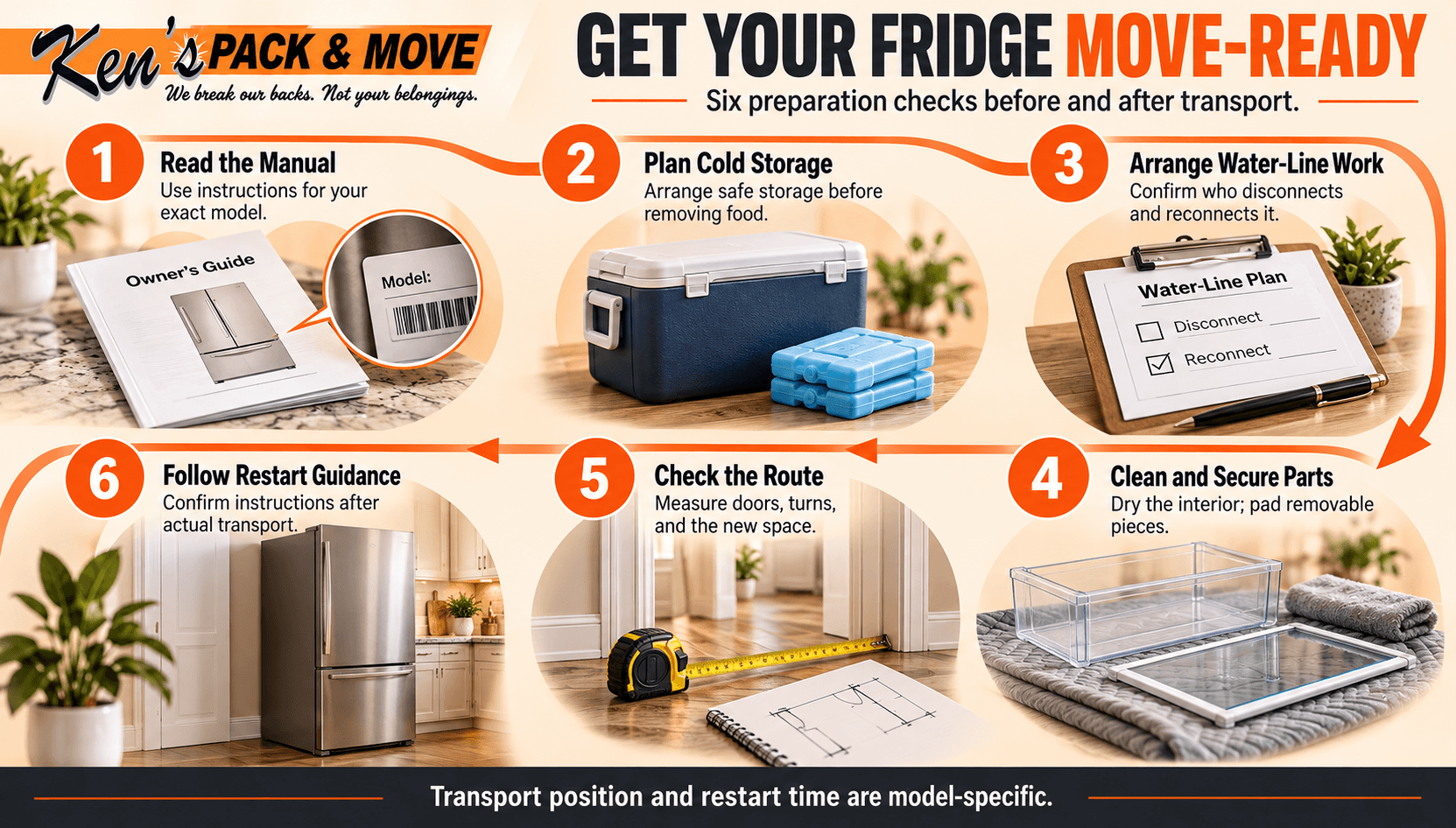
Confirm that the refrigerator is included in the move, find the model manual, plan food storage, and arrange any needed water-line disconnection. Follow the manufacturer’s shutdown and defrost instructions, dry the interior, and secure removable components appropriately. Measure the entire route and destination space. Plan upright transport unless the exact model permits another position, and follow its restart instructions after delivery.
What Should You Confirm Before Moving the Refrigerator?
Confirm that the refrigerator is yours to remove and is intended to go to the destination. In a home sale, appliance inclusion may be governed by the transaction documents. In a rental, the unit may belong to the landlord. Resolve that question with the appropriate property representative before discussing transport, especially when more than one refrigerator is present.
Next, confirm that the mover accepts the appliance and understands its type. Share whether it is freestanding, built-in, compact, French-door, side-by-side, or a separate refrigerator and freezer pair. Identify stairs, narrow turns, and special access requirements. Do not assume a standard household quote automatically includes a large built-in appliance or removal from cabinetry.
Compare moving the unit with leaving it by agreement or arranging a replacement through an appliance provider. Transport, specialized handling, disconnection, reconnection, and installation can affect the decision. A useful comparison considers the exact unit, destination fit, service requirements, and whether the household will have refrigeration during the transition. Moving an older appliance is not automatically the least expensive option.
Why Do You Need the Model Manual to Prepare a Refrigerator for Moving?
The model manual matters because refrigerators differ in permitted transport position, removable components, installation requirements, and restart guidance. Advice for one design should not be applied automatically to another. Locate the manufacturer and model number before planning the work, then use the corresponding owner’s or installation instructions.
GE Appliances’ refrigerator moving instructions illustrate these differences. Its guidance distinguishes refrigerator designs and identifies types that must remain upright during vehicle transport. It also explains post-transport considerations. These examples show why a blanket recommendation to place any refrigerator on its side is unreliable.
Share the relevant instructions with the mover and any appliance professional involved. If the manual is missing or the instructions conflict with the planned route, contact the manufacturer before moving day. Keep a copy available after delivery. A crew’s experience with household transport does not eliminate appliance-specific restrictions, and a short drive does not create an exception to the model’s requirements.
Keep These Details Together
- The refrigerator’s manufacturer and exact model number.
- The corresponding owner’s and installation instructions.
- Permitted handling and vehicle transport positions.
- Preparation requirements for water connections and removable parts.
- Restart instructions and destination installation requirements.
Who Handles Refrigerator Water-Line Disconnection and Reconnection?
Determine who will disconnect and reconnect any refrigerator water supply before the moving appointment. The moving service may cover handling and transport without covering plumbing or appliance installation. Ask the mover directly, and arrange an appropriate qualified professional when the task is outside its scope or the connection’s condition is uncertain.
Identify whether the appliance has an ice maker, water dispenser, filtration connection, or another accessory requiring preparation. Share that information during booking. If a shutoff valve is inaccessible, damaged, or leaking, resolve it before the crew arrives rather than expecting a mover to improvise. Do not disconnect an unfamiliar line or force a valve that does not operate normally.
At the destination, confirm that a suitable connection exists and that the installation professional knows the model’s requirements. Replacement parts or changes to the connection should be chosen through the appropriate professional guidance. Keep reconnection and leak checks separate from the simple fact that the appliance was placed in the kitchen. Delivery alone does not establish that the plumbing or appliance is ready for use.
How Early Should You Plan Food Removal and Defrosting?
Plan food reduction and temporary refrigeration several days before the move, then choose the shutdown time using the manufacturer’s instructions and the appliance’s condition. A heavily iced freezer or a long storage interval may need more preparation than a clean unit moving directly to an available kitchen. Do not assume all refrigerators use the same defrost time.
Use perishable food intentionally before moving and decide which remaining items can be transported safely by the household. Keep food transport separate from appliance transport. A refrigerator that is unplugged and being handled is not a reliable cooler, and movers may decline perishables. Confirm the company’s policy instead of leaving food inside and hoping the drive is short enough.
Prepare insulated storage, appropriate cold sources, and a thermometer when keeping refrigerated food during the transition. If the destination refrigerator will not be ready, choose another safe arrangement or avoid retaining perishables. Include loading delays, travel, unloading, installation, and cooling time in your plan rather than considering only the drive between homes.
What Is a Safe Food Plan for Moving Day?
A safe food plan accounts for temperature throughout packing, travel, unloading, and the refrigerator’s restart period. A cooler needs enough cold capacity for the actual interval. Keep a thermometer available and limit opening. Plan simple meals that do not depend on immediately restocking an appliance that has just been moved.
FoodSafety.gov food-safety guidance recommends keeping refrigerators at 40°F or below and promptly refrigerating perishable leftovers within two hours, or within one hour when exposed to temperatures above 90°F. Maintain appropriate temperature control for the foods you retain. If safe storage cannot be established, discard questionable perishables rather than tasting them to check.
Keep medication storage requirements separate from ordinary food planning. Ask a pharmacist or treating professional how to maintain any required conditions during the move and appliance restart. Do not assume a household cooler meets a medicine’s instructions. Carry the necessary supplies yourself and plan for delays before relying on refrigeration at the new home.
Who Should Prepare a Refrigerator for Moving?
Several people may be involved in an appliance move. Use this table to confirm responsibilities before scheduling loading. The person transporting the refrigerator is not automatically responsible for plumbing, installation, or food storage.
| Task | Confirm Responsibility With | Key Check |
|---|---|---|
| Ownership and inclusion | Homeowner, landlord, or transaction representative. | The appliance is authorized to move. |
| Model instructions | Household and manufacturer support. | Exact transport and restart guidance is available. |
| Food management | Household. | Safe separate storage or disposal is arranged. |
| Water disconnection | Agreed provider or qualified professional. | The connection is prepared before appliance handling. |
| Route and transport | Mover within the agreed scope. | Access, dimensions, handling, and position are accepted. |
| Destination installation | Agreed qualified provider. | Placement, connections, leveling, and readiness are checked. |
| Return to use | Household following manufacturer guidance. | Restart requirements and operating temperature are verified. |
On smaller screens, swipe horizontally to view all columns.
Use the table to identify gaps before moving day. One person may handle several tasks, but do not leave responsibility implied. Ask for a clear answer when a provider says it moves appliances but does not specify disconnection or installation. Record appointments and keep relevant contact details with your personal moving documents.
How Should You Empty, Clean, and Dry the Appliance?
Empty the refrigerator and freezer according to the preparation plan, including food, loose containers, and items stored in door compartments. Follow the manufacturer’s instructions for shutdown and defrosting. Protect nearby flooring against expected water using suitable methods. Do not use sharp tools, improvised heating, or aggressive chemicals to speed a process the manual does not permit.
Clean accessible interior surfaces with the products and method recommended for the appliance. Dry the interior and check for remaining water in removable trays or compartments. Tell the mover if moisture remains or if the unit has a known leak. A refrigerator can look empty while still carrying water that spills during handling.
For a storage interval, ask the manufacturer how to manage ventilation, odor prevention, and door position safely. Any open-door arrangement must prevent child or pet access and comply with storage handling requirements. Do not leave an unsecured appliance where someone could become trapped. Your preparation should make the unit ready for the agreed transport without creating a hazard while it waits.
What Should Happen to Shelves, Drawers, and Loose Parts?
Handle shelves, drawers, bins, grille pieces, and accessories using the manufacturer’s instructions and the mover’s packing plan. Some components may be removed and packed separately. Others may be secured in place through an approved method. The right choice depends on the unit and component, so avoid a universal instruction to tape everything inside.
If parts are packed separately, cushion them appropriately and label the container with the refrigerator’s identifier. Record which shelves or drawers belong to the unit, especially if two appliances are moving. Photographing their arrangement before removal can help later, but use the manual to confirm installation rather than relying only on a picture.
Keep water filters, small fittings, and hardware together when that is consistent with professional guidance. Avoid adhesives that can damage finishes, seals, or plastics. Do not tape a bag of sharp screws against an unprotected appliance surface. Tell the receiving person where the accessory container is so the refrigerator can be reassembled without opening unrelated kitchen boxes.
A short parts record can include the appliance ID, each separately packed component, its container number, and any assembly instruction reference. Keep this record with the delivery contact. If a shelf belongs in a particular position, note that detail before packing so the person receiving the appliance does not have to guess.
Which Measurements Help You Prepare a Refrigerator for Moving?
Give the mover appliance dimensions and route constraints at both addresses. Measure the unit as it will actually be handled, including projecting handles when relevant. Record doorway clearance, hall width, tight corners, steps, and the destination opening. A wide front door does not guarantee that the refrigerator can turn through the kitchen entrance.
Share photographs of the route and explain whether the unit sits within cabinetry or beneath a low obstruction. Ask who can remove doors or other appliance parts if the manufacturer permits it and the route requires it. Door removal can involve wiring or water connections, so it should not be assumed to be ordinary furniture disassembly.
At the new home, check both the route and the final space. Consider the manufacturer’s required clearances and the room needed to open the doors and use drawers. A unit can physically enter a kitchen while being unsuitable for the intended opening. Resolve fit questions before loading because discovering a problem after delivery can require additional handling, storage, or a different appliance plan.
Measure More Than the Front Door
- Appliance width, height, and depth, including relevant projections.
- Door openings and narrow points along the route.
- Hallway turns, stairs, landings, and overhead restrictions.
- The destination opening and required installation clearances.
- Space for refrigerator doors and drawers to operate normally.
Can a Refrigerator Travel on Its Side?
Some models may permit a specific alternative position, while others must remain upright during transport. Use the exact manufacturer’s guidance and the mover’s accepted plan. Do not decide based on vehicle space, a short distance, or advice for a different refrigerator. If upright transport is required and the planned vehicle cannot accommodate it, change the transport arrangement.
Avoid confusing controlled handling through a doorway with the position used for travel in the vehicle. A model may allow limited tilting during handling while requiring upright transportation. Explain manual restrictions to the crew before the appliance leaves its position. If the route cannot be completed within those restrictions, ask the manufacturer and mover about appropriate alternatives.
Refrigerators are heavy, awkward, and can create crush or tip hazards. Appropriate equipment, trained handling, and a verified route are necessary for the actual job. Do not recruit an unprepared household member to hold the lower end on stairs or compensate for an unsuitable vehicle. Arrange professional handling rather than improvising a carrying method on moving day.
What Should You Ask About Protection and Transport Scope?
Ask how the appliance’s exterior, doors, and components will be protected and what preparation remains your responsibility. Confirm whether the quote includes the specific refrigerator, its access conditions, and any disassembly accepted by the mover. If you add the appliance after the estimate, request an updated scope rather than assuming the original time allowance still fits.
Describe existing dents, broken handles, unusual noises, or known leaks. Photograph the unit’s visible condition before transport and retain the images. Honest condition information helps the crew understand handling concerns and avoids confusing an existing issue with a later observation. A condition record supports communication but does not guarantee coverage or establish responsibility by itself.
If the appliance is unusually large or built-in, ask whether a specialist service is required. Ken’s local moving services provide the household-moving starting point, but acceptance and preparation for your refrigerator should be confirmed directly. Do not treat general furniture-moving information as confirmation that every appliance installation or cabinetry-removal task is included.
When Can You Plug the Refrigerator In After Moving?
Plug the refrigerator in only when the exact model’s transport and restart instructions have been satisfied and installation is ready. There is no universal waiting period suitable for every refrigerator and transport position. Ask the manufacturer if the handling history is uncertain. Keep the appliance’s actual position during transport in the handoff information.
Before restarting, confirm that required components are correctly installed and that any professional reconnection work is complete. Follow the manual’s electrical and placement instructions. Do not run the appliance on an improvised connection or assume an outlet is suitable merely because it is nearby. If there is visible damage or another concern, get qualified guidance before using the unit.
After restart, verify operating temperature before returning perishables. The appliance may need time to reach the required temperature even after power is restored. Use a thermometer and follow manufacturer and food-safety guidance. Keep the household’s separate food plan in place until refrigeration is established, rather than treating the moment the plug enters the outlet as the end of the transition.
What if the Refrigerator Must Go Into Storage?
Storage adds preparation and retrieval questions beyond direct transport. Confirm that the storage arrangement accepts the appliance, how it should be prepared, and who will handle later delivery. Follow manufacturer guidance for cleaning, drying, ventilation, and securing the unit. Avoid storing food inside or assuming a closed refrigerator will remain odor-free over an extended interval.
Ask about access to the appliance and its separately packed parts. If accessories are buried behind other household goods, reassembly can be delayed after retrieval. Label the refrigerator and related containers consistently, and keep the manual with your personal records or accessible electronically. Document condition when the unit enters and leaves storage.
Discuss the full sequence before loading: origin preparation, storage transport, storage conditions, retrieval, final installation, and restart. Each step may have a different provider and cost. Storage availability is not implied by a moving booking. If the new kitchen is not ready, compare confirmed storage with an alternate appliance or delivery arrangement and choose a plan that respects the model’s requirements.
Your Final Check to Prepare a Refrigerator for Moving
Before the crew arrives, confirm inclusion in the booking, model instructions, food removal, moisture management, component preparation, and any water-line work. Keep the route free of loose boxes and tell the crew about remaining constraints. Have the destination’s measurements and installation contact available, especially if another person will receive the appliance.
Do not leave unresolved plumbing or fit questions for the loading team to discover. If preparation is incomplete, contact the mover and relevant professional promptly. A revised appointment may be more practical than forcing a job outside the agreed scope. Clear responsibility and verified instructions help prevent a last-minute shortcut from becoming a larger problem.
If another adult receives the appliance, send a concise handoff before delivery. Include the model manual, transport restrictions, location of separately packed parts, installation contact, and food-storage arrangement. Ask the receiving person to confirm placement and visible condition, then follow the appropriate technical guidance for connection and restart.
Ready for the Appointment?
- The appliance is authorized and accepted for the move.
- The exact model instructions are available.
- Food has a separate safe-storage or disposal plan.
- Shutdown, defrosting, cleaning, and drying are complete as required.
- Water-line responsibilities and appointments are confirmed.
- Removable components are prepared and identifiable.
- Both routes and the destination opening have been checked.
- The receiving person understands installation and restart requirements.
Discuss Your Appliance Move With Ken’s Pack & Move
For a Raleigh, Cary, or nearby Triangle move, tell Ken’s Pack & Move the refrigerator type, model, route, stairs, and destination arrangement. Ask whether handling is accepted and which preparation, disconnection, and installation tasks need another provider.
If you are deciding what must travel separately, review Ken’s restricted moving items guide before packing perishables or other special items.
Frequently Asked Questions About Preparing a Refrigerator for Moving
Do all refrigerators need to be unplugged 24 hours before moving?
No single shutdown interval applies to every model and condition. Follow the manufacturer’s defrost and preparation instructions, and allow sufficient time for cleaning and drying. An iced freezer or storage plan may change preparation needs. Confirm the schedule with the mover, but use the appliance’s instructions to decide when shutdown and any required defrosting should begin.
Will movers disconnect my refrigerator water line?
Ask directly because handling and transport may exclude plumbing or appliance installation. Identify any ice maker or dispenser connection before booking. If the mover does not accept the task, arrange an appropriate qualified professional before loading. Do not force an unfamiliar shutoff valve or assume the crew can repair a leak while performing the move.
Can I leave food inside for a short local move?
Prepare to move the refrigerator empty and arrange food storage separately. An unplugged appliance being handled is not a dependable cooler, and the mover may refuse perishables. Keep retained food under appropriate temperature control throughout preparation, travel, unloading, and restart. A short drive does not account for all the time food spends outside reliable refrigeration.
How long should I wait before plugging it in?
Use the exact model’s instructions and the appliance’s actual transport position. There is no universal restart interval for every refrigerator. If the position or instructions are uncertain, contact the manufacturer before powering it. Complete any required installation checks and verify cooling temperature before returning food, because restart and readiness for perishables are separate steps.
Should shelves and drawers travel inside the refrigerator?
Follow the manufacturer and agreed packing plan. Some components may be secured appropriately in place, while others should be removed and packed separately. Label separate parts with the appliance identifier and preserve their arrangement information. Avoid improvised tape on delicate surfaces or leaving loose glass components unsecured where they can shift during handling.
What if the refrigerator does not fit through the doorway?
Tell the mover before loading and review the full route, not just the front entrance. Ask whether manufacturer-permitted part removal or another approved route is practical within the service scope. If it is not, arrange an appropriate alternative. Do not force the unit through, remove connected appliance doors casually, or assume a second attempt will solve the fit problem.
Can I store the refrigerator until my kitchen is ready?
Confirm storage acceptance and conditions before transport, then follow the manufacturer’s cleaning, drying, ventilation, and securing instructions. Keep food out, track separately packed components, and plan later retrieval and installation. Storage and redelivery may involve additional arrangements and costs. Do not assume a moving booking automatically includes a suitable place for the appliance to wait.
Is preparing the refrigerator the same as installing it?
No. Preparation makes the appliance ready for agreed handling and transport. Installation may involve placement, clearances, leveling, electrical suitability, water connection, and checks under manufacturer instructions. Confirm who handles each task. A refrigerator delivered into the kitchen should not be treated as ready to use until the relevant installation and restart requirements have been completed.