
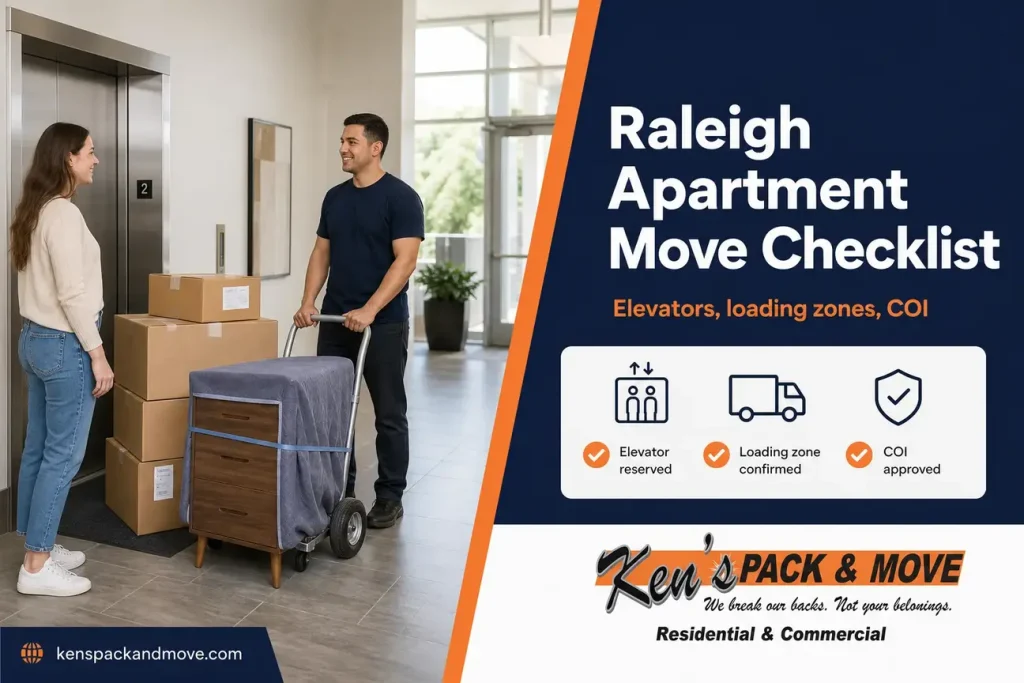
Apartment Move Checklist for Raleigh Building Rules
Quick Answer: Use this apartment move checklist to lock down building rules before move day: confirm the elevator reservation, loading zone, parking limits, move-in window, and any certificate of insurance requirement in writing. Then give those details to your mover along with both addresses, stairs, elevators, long carries, tight turns, large items, and whether you need packing or labor-only help. Raleigh apartment and condo moves go smoother when the building manager, resident, and moving crew are working from the same written instructions.
Apartment moves in Raleigh can be simple on paper and tricky in real life. A short distance from one side of the Triangle to another may still involve a freight elevator, a garage clearance limit, a loading dock, a reserved curb space, a security desk, hallway protection, and a strict move-out window. The goal is not to memorize every possible rule. The goal is to ask the right questions early, get answers in writing, and pass the details to the crew before the truck is loaded.
Ken’s Pack & Move helps with local household moves, apartment and condo moves, packing, furniture handling, and loading and unloading help in Raleigh and nearby Triangle communities. If your building has stairs, elevator access, parking limits, or a tight hallway, start by gathering the building instructions and then request a free moving quote with those access details included.
Apartment move checklist for building access
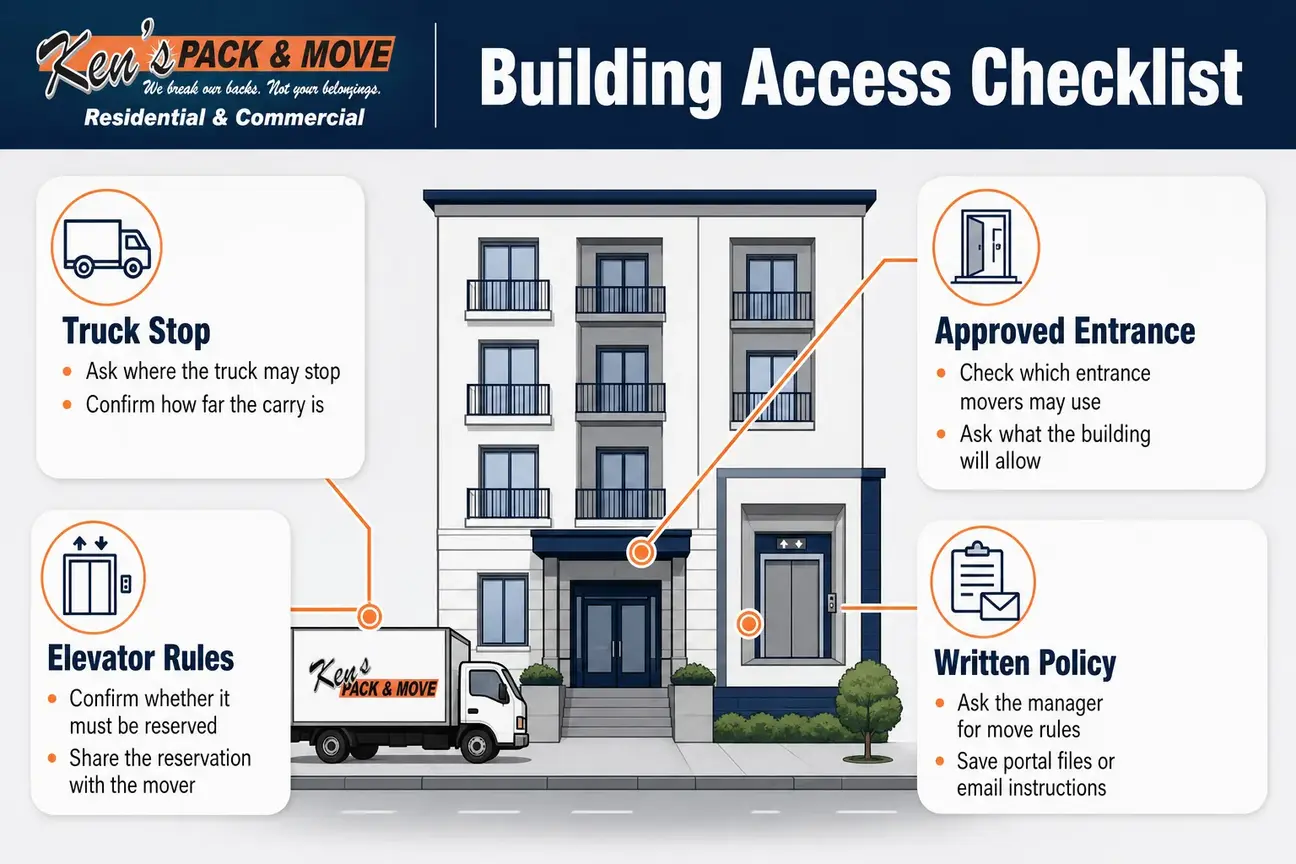
The most important part of an apartment or condo move is not the box count. It is access. A crew can plan more accurately when they know where the truck can stop, how far the carry is, which entrance is approved, whether the elevator is reserved, and what the building will or will not allow.
Ask the property manager, leasing office, HOA manager, or condo board for the move policy before you choose your time. If there is a resident portal, download the rules instead of relying on a quick hallway conversation. If the building sends instructions by email, save them and forward the relevant parts to your mover.
Use this first-pass checklist when you contact the building:
- Approved move-in or move-out days and hours
- Required elevator reservation process and deadline
- Whether the building has a freight elevator or only passenger elevators
- Where the truck or rental truck may park
- Whether there is a loading dock, garage bay, alley, or curbside loading zone
- Whether a certificate of insurance is required from the mover
- Any floor, wall, door, or elevator protection rules
- Key fob, loading dock, gate, or security desk instructions
- Rules for bulky items, furniture assembly, mattresses, appliances, or trash
- Consequences if the move runs past the approved window
Raleigh buildings are not all set up the same way. A garden-style apartment with outdoor stairs needs a different plan than a downtown building with a loading dock and controlled elevator access. A condo with an HOA may have a different approval path than a rental community with a leasing office. Treat the building’s written policy as the move-day playbook.
What to ask the building manager before you schedule movers
Before you book a crew, ask questions that reveal the real path from the truck to your front door. The route matters because stairs, long hallways, elevator waits, and parking distance can affect the time and equipment needed. The estimate should be based on the actual conditions, not just the number of bedrooms.
Start with the building entrance. Ask whether movers must use a service entrance, side door, loading dock, garage, or main lobby. Some buildings want movers away from the front entrance during busy hours. Others allow the main entrance only if mats, pads, or temporary protection are used.
Next, ask about the elevator. If the building requires an elevator reservation, confirm whether the reservation blocks off the elevator exclusively or simply gives you an approved time. Ask who pads the elevator cab, who unlocks the freight elevator, and whether a staff member must be present.
Then ask about the truck. A loading zone that works for a small delivery van may not work for a moving truck or rental truck. Ask about height limits, turn radius, garage clearance, fire lanes, towing rules, and whether the vehicle can stay in place for the whole approved window.
Finally, ask what the building needs from the moving company. If it requires a certificate of insurance, get the exact wording, insurance limits if provided, certificate holder name, additional insured wording if required, email address, and submission deadline. Do not paraphrase those requirements. Send the actual written request to the mover so it can be reviewed.
Elevator reservation details that prevent move-day slowdowns
An elevator reservation is one of the biggest schedule pieces in a high-rise or controlled-access building. Without it, the crew may arrive ready to work and still have no approved way to move furniture upstairs or downstairs. That can create extra waiting, a missed move window, or a need to reschedule building access.
When you request an elevator reservation, ask for the exact start and end time in writing. If you are moving out and moving in on the same day, you may need two separate reservations: one at the pickup building and one at the delivery building. Do not assume the destination building will be flexible because the pickup ran long.
Ask whether the elevator reservation includes padding. Some buildings install elevator pads themselves. Others require the moving crew to bring protection or ask the resident to arrange it. If the building has specific protection rules, send them with your quote request.
Also ask about elevator size and access. A freight elevator may handle tall furniture differently from a passenger elevator. If the building has no freight elevator, measure the elevator door, cab height, hallway turns, and apartment doorway for large items. A couch, dresser, or bed frame that fit in one building may need a different plan in the next one.
For Raleigh residents moving during end-of-month lease turnover, summer heat, or a weekday traffic crunch around I-40, I-440, I-540, or US-1, a realistic elevator reservation matters. Build in time for the building process, not just the drive. If your reservation is short or tightly controlled, tell the mover before the estimate is prepared.
Loading zone and parking rules to confirm in Raleigh
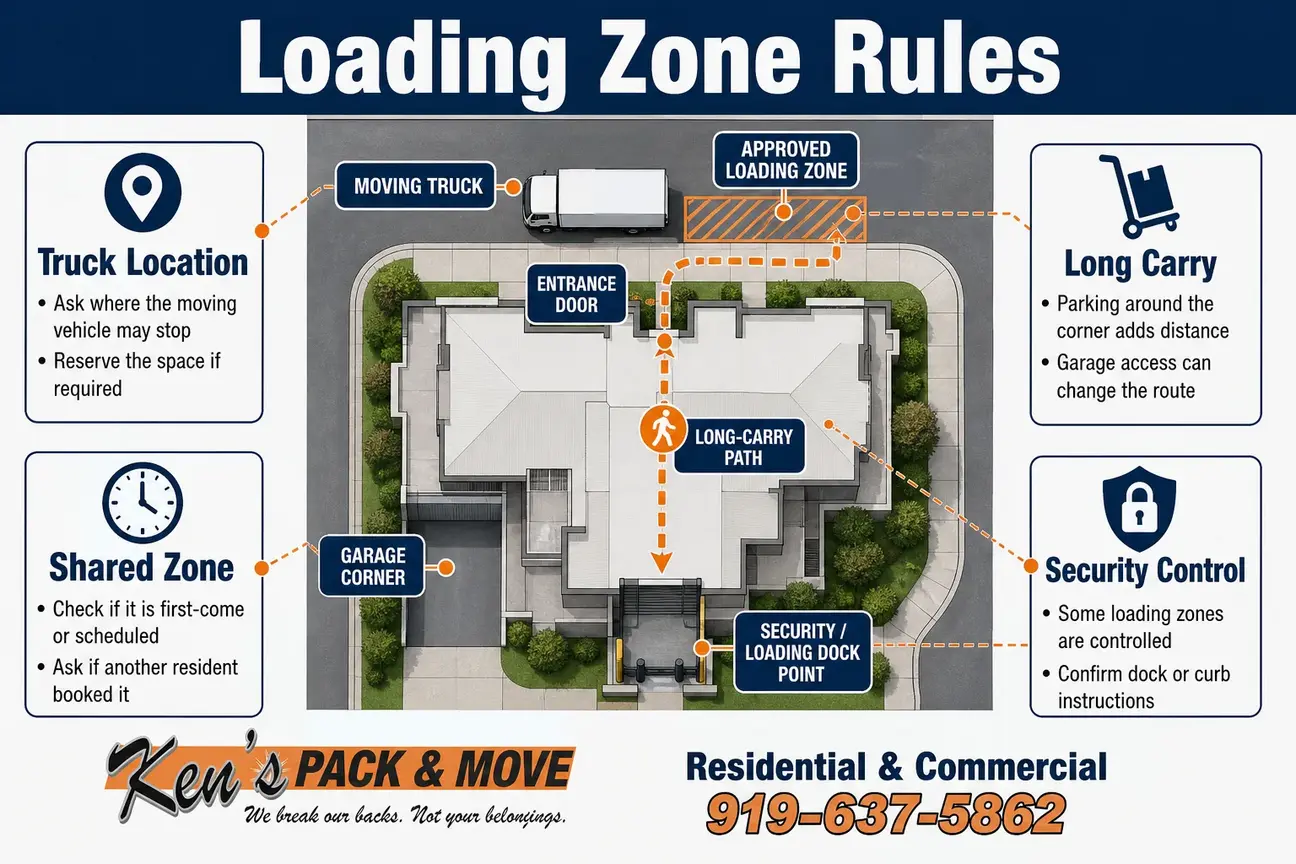
A loading zone is not just a nice convenience. It can change the entire move path. If the truck can park close to the approved entrance, the crew can focus on loading, protecting furniture, and moving carefully through tight spaces. If the only available parking is around the corner or across a garage, the long carry should be known before move day.
Ask the building manager where the moving vehicle may stop and whether that space must be reserved. If the building has a loading zone, ask whether it is first-come, scheduled, shared with deliveries, or controlled by security. If it is shared, find out whether another resident has already booked the same window.
Some Raleigh moves involve private building property only. Others may affect a public street, sidewalk, or right-of-way. If your move may block a public street or sidewalk, check the City of Raleigh’s Right-of-Way Services page and confirm current requirements with the city or building manager before move day. Do not assume a curb space can be held with cones unless the building or city has approved the arrangement.
If the move uses a parking garage, ask about clearance, ramp turns, gate access, and whether the truck can remain inside while loading or unloading. If garage clearance is limited, the crew may need to use a different entrance, which can add distance. That should be part of the plan before the crew arrives.
For a rental truck or labor-only move, the same access questions still matter. If you hired help only for loading and unloading, your crew still needs to know where the truck will sit, how far the carry is, and whether the building has time limits. If you are comparing options, Ken’s Pack & Move has a guide to labor-only movers for loading and unloading support.
Certificate of insurance requirements for apartments and condos
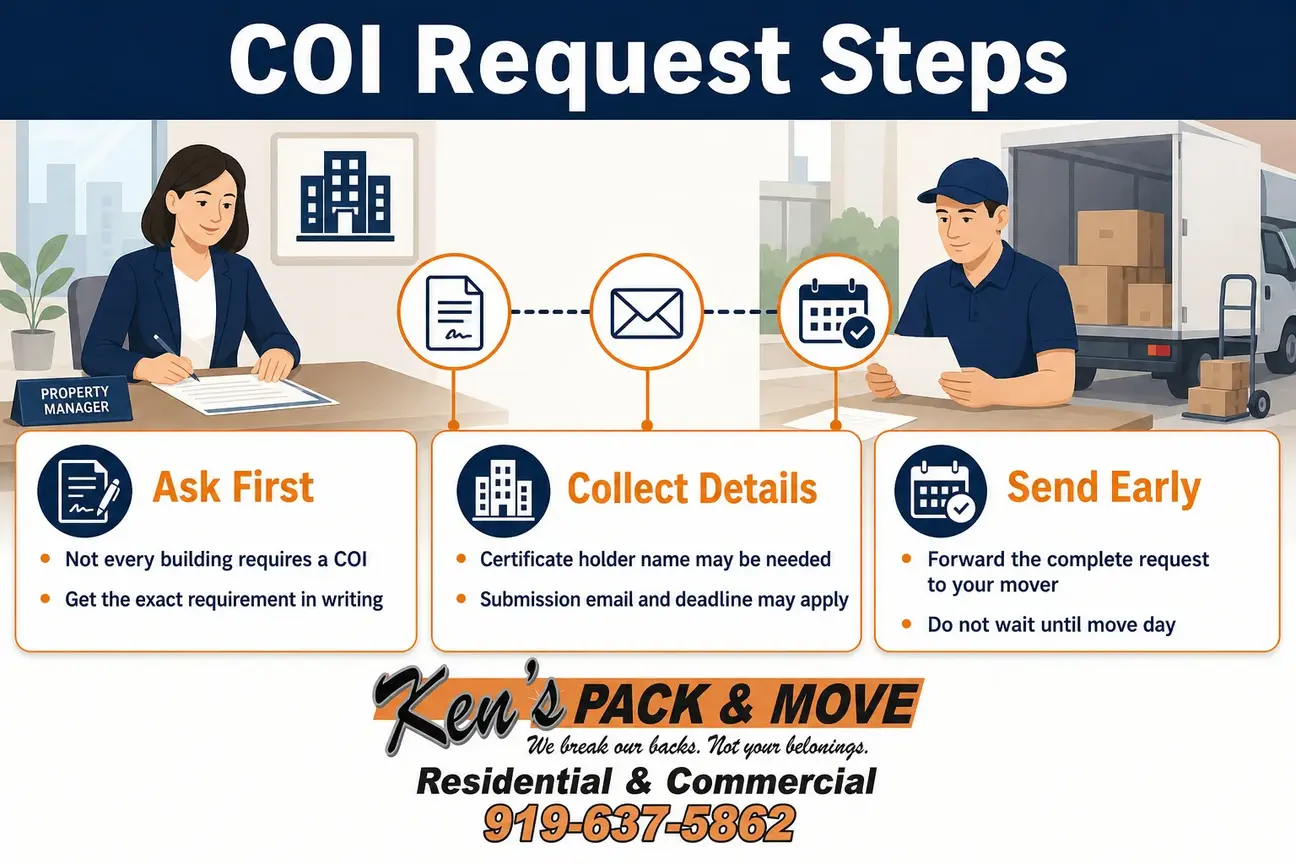
A certificate of insurance is a document a building may request from a moving company before it allows work on the property. Not every apartment or condo building asks for one, but many managed buildings and HOAs do. The key is to get the exact requirement from the building instead of guessing what the mover should send.
When a certificate of insurance is required, ask the manager for a written sample or instruction sheet. The request may include the certificate holder name, property management company, building address, email address for submission, and deadline. Some buildings also specify wording they want included. Send the complete request to your mover as soon as you have it.
Do not wait until the morning of the move to ask about the certificate of insurance. A building may refuse elevator access or loading dock access until it has approved the document. That does not mean every delay is within the mover’s control. It means the resident should treat the certificate of insurance as part of the building reservation process.
If you are moving into a condo, ask whether the HOA, management company, or concierge handles the certificate of insurance. If you are moving out of an apartment, ask whether the leasing office needs it for both move-out and move-in vendors. The answer can vary by property.
When you request your quote, include the certificate of insurance instructions along with the elevator reservation, loading zone, and parking notes. That helps the moving company understand the building’s requirements before confirming scope and schedule.
Move-in windows, keys, fobs, and building rules
Building rules often cover more than the elevator and loading zone. They may include the hours when movers can work, how long the truck can remain parked, where furniture may pass, whether doors may be propped, and what happens if the move overlaps another resident’s reservation.
Ask the manager whether the move-in window is firm. If the building allows moving only during a specific time block, share that time block with the crew. If the building has quiet hours, weekend limits, or holiday restrictions, get those in writing too. Do not rely on what a neighbor remembers from a past move.
Confirm who will have the keys, fobs, gate codes, loading dock access, and elevator controls. A common move-day slowdown is simple: the truck arrives, but the resident is still getting keys or waiting for a front desk approval. Put the access plan on your own checklist and assign one person to manage it.
For move-outs, ask about final walk-through timing, trash rooms, bulk item rules, and whether empty boxes can be placed in a designated area. Ken’s Pack & Move can discuss debris removal as an add-on tied to a move, but building rules still control where items can be staged and what the property will accept.
If your date changed, your closing shifted, or your helpers canceled, call before assuming the building can change its reservation. For moving help on a tight timeline, last-minute moving help depends on crew availability, building access, ready inventory, and a destination that is prepared to receive the items.
What to send before a quote for an apartment or condo move
A good quote starts with real details. For a Raleigh apartment move, the mover needs more than “one-bedroom apartment” or “third floor.” The crew needs the pickup and delivery addresses, requested dates, property type, stairs, elevator details, parking rules, and a clear inventory of what is moving.
The North Carolina Public Staff’s Moving 101 Consumer Guide is the source cited here for in-state written-estimate and valuation guidance. It says, “If you request it, a mover is required to give you a free written estimate on a Commission-approved form.” The same guide also says a mover is not required to provide a written estimate if the estimate is requested less than five business days prior to the move or if the total weight is less than 500 pounds.
The practical takeaway: ask early, provide complete information, and get the scope in writing. The North Carolina Utilities Commission’s Maximum Rate Tariff is part of the state framework for regulated household goods moves within North Carolina, but your building conditions still matter when a mover prepares the estimate and explains what can affect the move.
Send photos or notes for items that may be hard to move: sectionals, large dressers, bed frames, glass tops, exercise equipment, balcony furniture, storage cages, or anything that may need disassembly. If you need help with tight furniture, see the guide to moving heavy furniture for planning around doorways, stairs, and turns.
| Send this detail | Why it matters |
|---|---|
| Pickup and delivery addresses | Confirms the move route, property type, and access planning |
| Requested date and time window | Helps align crew availability with building rules |
| Elevator reservation details | Shows whether there is a freight elevator, passenger elevator, or stairs-only path |
| Loading zone and parking instructions | Helps estimate the carry distance and truck access |
| Certificate of insurance request | Allows the mover to review the building’s documentation requirement |
| Inventory and large items | Helps plan time, equipment, disassembly, and protection |
| Packing, labor-only, or debris removal needs | Clarifies the service scope before the move is confirmed |
For valuation, the Moving 101 Consumer Guide says, “Valuation establishes the total value of your shipment in case of catastrophic loss and governs the method for the mover to resolve a claim for loss of or damage to individual items.” It also says, “You must select your level of valuation before the move begins.” Confirm your estimate and valuation choice in writing before moving day.
How to protect walls, floors, doors, and elevators
Apartment and condo buildings concentrate a lot of movement into tight shared spaces. A careful plan helps reduce scuffs, scrapes, and delays, especially in narrow hallways, stairwells, elevator lobbies, and doorways. The building may also have its own requirements for floor runners, elevator pads, corner protection, or service entrances.
Start by clearing the path. Remove doormats, small tables, plants, shoe racks, wall hooks, and loose rugs from the apartment entry and hallway path. If the building allows it, prop interior doors safely, but do not block fire doors or security doors without permission. Ask the manager what is allowed.
Inside the apartment, pack loose items before the crew arrives. Small lamps, cords, chargers, décor, and open baskets can slow down the move and increase the chance that something gets bumped in a tight turn. If you need help getting ready, Ken’s Pack & Move can discuss full or partial packing services as part of the quote.
For furniture, measure the item and the path. Check the apartment doorway, hallway corners, elevator door, stairwell turn, and destination room. If an item was assembled inside the apartment, it may need to be disassembled before it can leave. Tell the mover about those pieces before move day.
Furniture pads and stretch wrap can help protect furniture surfaces during handling, but building protection is a separate topic. Ask the building what must be protected and who is responsible for installing it. If the building requires specific floor or wall protection, include that rule in the quote request.
Tight-space planning for Raleigh apartment moves
Tight-space moving is about sequencing. The order of items, the staging area, the elevator timing, and the truck position all affect how the move feels. When the crew has a clear path and the resident has handled building approvals, the work can stay more organized.
Start with the largest items. Identify the couch, bed frame, mattress, dresser, dining table, desk, and any oversized boxes. If those pieces require elevator padding, disassembly, or a specific route, plan them first. Smaller boxes can usually adapt to the path; large furniture cannot.
Next, think about staging. Some buildings do not allow items to be staged in hallways or elevator lobbies. Others allow staging only in the apartment or loading dock. Ask before placing boxes in common areas. If the building prohibits staging, the crew may need a different loading sequence.
Raleigh weather can affect apartment moving too. Summer heat, humidity, and afternoon storms can make covered access, elevator timing, and parking location more important. If your building has a covered dock, ask whether it can be reserved. If not, keep weather-sensitive items packed and ready to move quickly from apartment to truck.
If you are moving within Raleigh and want help with the full move instead of only building logistics, the Raleigh moving company page explains the local service area context. For a more detailed apartment-specific service overview, see apartment movers in Raleigh.
Short-notice apartment moves when the date changes
Apartment move dates can change fast. A lease start shifts, a closing moves, a roommate plan falls apart, or helpers cancel. When that happens, the first step is not packing faster. The first step is confirming whether the building can still approve the elevator reservation, loading zone, and move window.
Call the building first and ask what is still available. If the elevator reservation is gone, ask whether there is another time block. If the loading zone is booked, ask whether another approved truck location is available. If the certificate of insurance has not been submitted, ask whether the building will still review it before the move.
Then call the mover. Short-notice help depends on crew availability, inventory, access, and whether the destination is ready. To check availability with Ken’s Pack & Move, call 919-637-5862 and be ready with both addresses, requested date, apartment size, stairs, elevators, parking, large or fragile items, and whether you need packing, labor-only help, or debris removal.
Be direct about what is not ready yet. If the elevator reservation is pending or the certificate of insurance is still under review, say so. A clear maybe is better than a surprise at the dock. The moving company confirms the date, crew, scope, and price directly; a quote request by itself is not a confirmed reservation.
How to avoid mover and estimate problems
Building rules are only one side of the move. The other side is choosing a mover and confirming the estimate, valuation, and scope in writing. For household goods moves within North Carolina, Ken’s Pack & Move is listed in the North Carolina Utilities Commission’s certificated-carriers PDF with household-goods certificate C-2551, according to the client context for the NCUC list dated 2026-09-28.
For scam awareness, FMCSA’s red flags are useful general consumer guidance. FMCSA warns that a red flag is when “The mover or broker doesn’t perform an on-site inspection of your household items and gives an estimate over the telephone or online — sight unseen.” FMCSA also flags movers or brokers that do not provide a written estimate or say they will determine the cost after loading, and companies that demand cash or a large deposit before the move.
For an apartment move, an inspection or detailed walk-through can be in person or supported by clear photos, video, and written access details, depending on the move. The point is that the mover needs enough information to understand the inventory and the building conditions. A quote based on incomplete access details may need to change if the actual conditions are different.
Do not leave valuation until the truck is being loaded. For in-state household goods moves, review the valuation choices, ask questions, and select your level before the move begins. If you are comparing several companies, the Moving 101 Consumer Guide says, “It is a good idea to get written estimates from several moving companies and compare them to make your selection.”
Move-day building rule checklist
Use the final day-before checklist to reduce surprises. Keep the written building rules, elevator reservation, loading zone instructions, and certificate of insurance approval in one place. Share them with anyone helping you so the resident, building staff, and crew are not working from different information.
- Confirm the move date and time window with the building.
- Confirm the elevator reservation and ask who controls elevator access.
- Confirm the loading zone, dock, garage, or curb instructions.
- Confirm the certificate of insurance has been received and approved if required.
- Confirm where the crew should enter and where the truck should stop.
- Clear the apartment entry, hallways, and furniture paths.
- Pack loose items, cords, lamps, and fragile décor before the crew arrives.
- Set aside documents, medications, chargers, valuables, keys, and fobs to carry yourself.
- Label items that are not moving.
- Have building contact information ready in case access questions come up.
If you are using rental equipment or doing part of the move yourself, the checklist still applies. A labor-only crew can load and unload, but you are still responsible for having the truck, access, and building approvals ready. If you are hiring full local moving support, the same written details help the crew plan the path and timing.
A practical Raleigh apartment move starts with written rules
A strong apartment move checklist keeps the focus where it belongs: building access, elevator reservation, loading zone, certificate of insurance, move window, and protection rules. Once those details are clear, the inventory, packing plan, furniture handling, and quote can be built around the real conditions of the move.
For Raleigh renters and condo residents, the smartest move is to get building rules in writing early and share them before the quote is finalized. That gives your mover a clearer picture of the stairs, elevators, long carries, parking, and tight turns that can affect the work.
Moving rules, building policies and prices change. Confirm scope, date, price and coverage with the mover in writing before moving day.
If you are planning an apartment or condo move in Raleigh, you can request a free moving quote from Ken’s Pack & Move. Include both addresses, preferred dates, home size and type, stairs, elevators, parking limits, the loading zone, any certificate of insurance request, large or fragile items, and whether you need packing, labor-only help, or debris removal.
Frequently Asked Questions
How early should I ask my building about elevator reservations and move-in rules?
Ask as soon as you know your target move date. Elevator reservations, loading dock access, and move-in windows can fill up during busy lease turnover periods, so do not wait until the week of the move if you can avoid it. Get the rules in writing and send them to your mover before the quote is finalized.
What information should I send when requesting a quote for an apartment move?
Send both addresses, preferred dates, apartment size, stairs, elevator details, loading zone or parking instructions, long carries, large or fragile items, and whether you need packing, labor-only help, or debris removal. If the building requires a certificate of insurance, send the exact written instructions from management.
Do I need a certificate of insurance for a condo or apartment move?
Maybe. Some apartment communities, condo associations, and managed buildings require one before allowing a moving company to use the elevator, dock, or service entrance. Ask the building manager for the exact certificate of insurance instructions, including the certificate holder name, email address, wording, and deadline.
What if the building has no freight elevator or limited parking?
Tell the mover before move day. A passenger elevator, stair-only route, garage clearance limit, or distant parking area can affect the plan. Measure large furniture and ask the building which entrance and path movers are allowed to use.
What should I do if I am moving on short notice?
First, confirm whether the building can still approve the move window, elevator, loading area, and any required documents. Then call the mover with the inventory and access details. Short-notice moving help depends on crew availability, building access, and whether both addresses are ready.
How can I reduce scuffs in narrow hallways and doorways?
Clear the path, remove small loose items, measure large furniture, and ask the building about required floor, wall, elevator, or doorway protection. Tell your mover about tight turns, narrow stairwells, and items that may need disassembly.
What should I confirm before booking labor-only loading or unloading help?
Confirm who provides the truck, where it can park, whether the building requires an elevator reservation, and how long the crew will have access. Labor-only help still depends on a ready truck, a clear path, and approved building access.
What if my building requires a specific move-in window or loading dock reservation?
Share that window with the mover before confirming the move. If the pickup and delivery buildings both require reservations, coordinate both schedules and leave room for travel, elevator access, and building check-in. Keep written confirmation with you on move day.