

Ken’s Pack & Move · Moving Preparation
Moving Insurance vs. Valuation: What North Carolina Customers Should Know
Understand what you are selecting, which moving rules apply, and what to put in writing before your belongings leave home.
Understanding moving insurance vs valuation starts with a practical question: if a television, dining table, or box of household belongings is lost or damaged, what determines the settlement? A company describing itself as insured does not answer that question. You need to understand the protection selected for your shipment and the documents that explain it.
For a household moving in Raleigh, Cary, or elsewhere in the Triangle, the discussion should happen while comparing estimates. Waiting until the truck is being loaded leaves less time to examine limits, organize valuable-item records, or ask an insurer whether an existing policy applies.
This guide explains the difference between mover valuation and separate insurance, distinguishes North Carolina household moves from interstate moves, and gives you a written-question checklist. The goal is to help you compare actual terms rather than relying on labels such as “basic,” “full,” or “covered.”
Quick Answer
What Is the Difference Between Moving Insurance and Valuation?
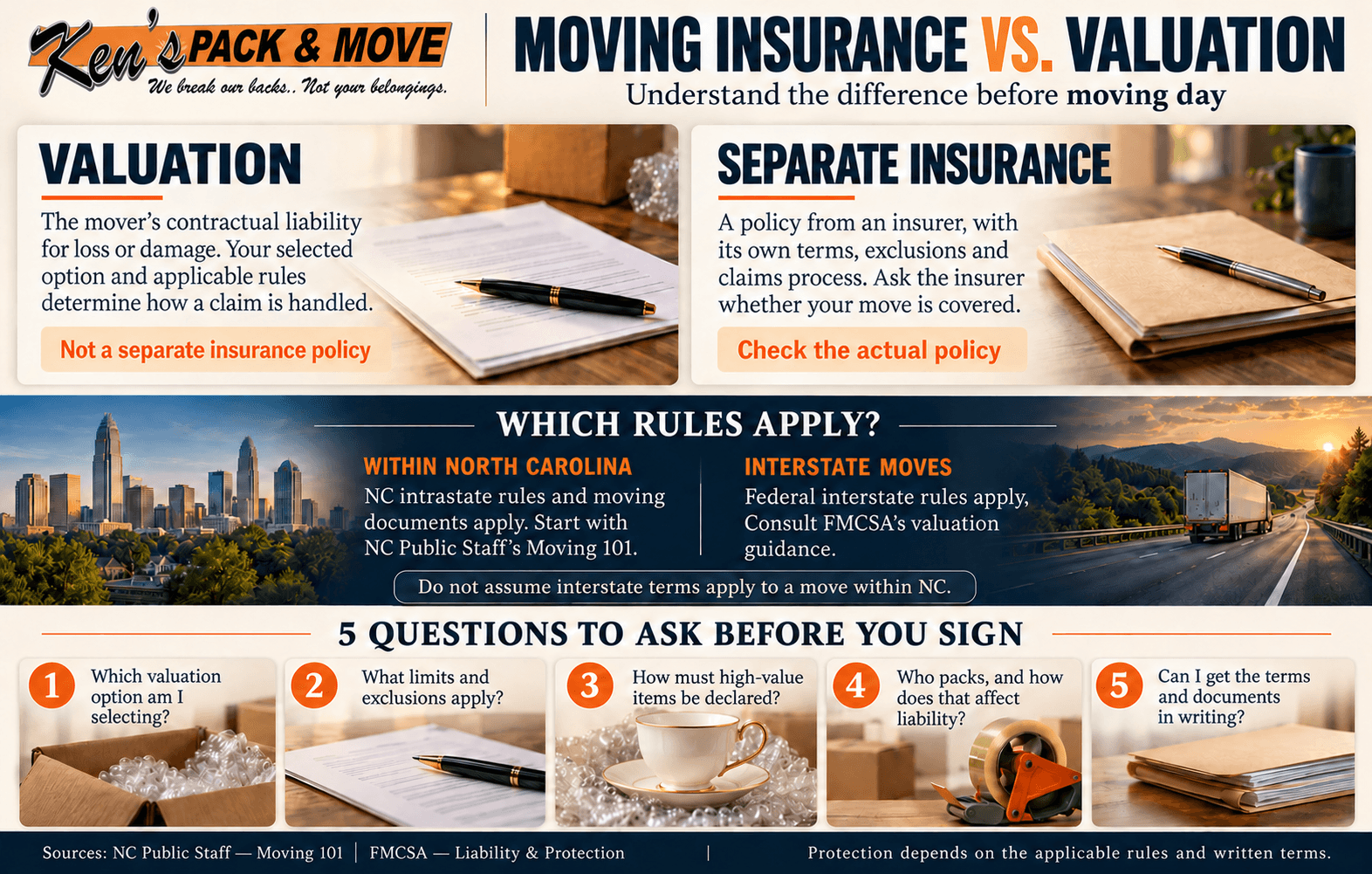
Valuation establishes the mover’s contractual level of responsibility for loss or damage to your shipment. Separate moving insurance is a policy issued by an insurer, with its own covered events, exclusions, limits, and claim requirements. Identify whether your move is governed by North Carolina intrastate rules or federal interstate rules, then confirm your valuation selection, shipment value, charges, valuable-item declarations, and any separate policy in writing before moving day.
Ask the Mover
What responsibility applies to my shipment?
Request the valuation choices, settlement provisions, applicable charges, and the form recording your selection.
Ask the Insurer
What does the actual policy cover?
Describe your move, packing arrangements, transport, and storage. Ask for written confirmation of the relevant policy terms.
What Do Valuation, Moving Insurance, and Business Insurance Mean?
These terms describe different arrangements. Valuation concerns the mover’s responsibility for your goods. A separate insurance policy concerns the insurer’s obligations under that policy. Business insurance concerns the moving company’s own insurance arrangements and should not be treated as a promise that every customer item will receive its purchase price.
FMCSA explains the difference between shipment liability and a moving company’s business insurance. The distinction matters when someone answers a question about your belongings by saying only that the company carries insurance. Follow up by asking which valuation option will appear on your shipment documents.
A useful way to organize the conversation is to separate the company, the shipment, and any policy you purchase. Ask the mover about the shipment arrangement. Ask the insurance provider about policy coverage. Keep both answers together, with the estimate, instead of assuming that one statement resolves every question.
Be equally specific when discussing damage to a building. A scratched hallway wall, an employee injury, and a broken item in your shipment raise different questions. Describe the situation you mean rather than asking whether “everything” is insured.
Moving Insurance vs Valuation: Compare the Written Terms
Compare how protection works before comparing its price. Two estimates can look similar while recording different liability selections. Use the same inventory, service scope, and questions for each provider so you can identify the reason for a difference.
| Arrangement | What to examine | Question before agreeing |
|---|---|---|
| Basic or released-value protection | The applicable weight-based liability provision and your written selection | What would the limit be for one lightweight, expensive item? |
| Full value protection | Shipment valuation, settlement provisions, charges, and declarations | How would repair, replacement, or reimbursement be determined? |
| Separate moving insurance | The insurer, policy wording, covered events, exclusions, and deductible | Does this policy cover my exact move and service arrangement? |
| Existing homeowners or renters insurance | The policy’s application during relocation and any temporary storage | Which events and stages of this move are covered? |
Keep a separate line for protection costs when reviewing your moving budget. This makes it easier to see whether a lower total reflects a different service scope, a different protection selection, or both. Ask for clarification when an estimate uses a label without explaining the underlying arrangement.
Which Rules Apply to a Move Within North Carolina?
An ordinary household move performed entirely within North Carolina is generally an intrastate move. Raleigh to Cary and Raleigh to Charlotte are examples when the transportation remains within the state and is not part of a broader interstate shipment. Mileage alone does not turn an in-state move into an interstate move.
The North Carolina Department of Justice’s moving guidance distinguishes state-regulated moves from interstate moves. For North Carolina household moving protection, start with NC Public Staff’s Moving 101 consumer guide and the applicable North Carolina Utilities Commission Maximum Rate Tariff.
Moving 101 describes basic value protection and full value protection, with the selection recorded on the bill of lading. Basic protection limits liability to 60 cents per pound of the lost or damaged article. Ask the mover to explain the full value option, applicable charge, and shipment valuation before choosing.
For an hourly move, ask how shipment weight and value are established for the protection arrangement. An hourly service estimate and a shipment valuation serve different purposes; one tells you about moving charges, while the other helps define the protection selection.
When a move includes an out-of-state warehouse, another carrier, or a connection to a longer shipment, describe the complete arrangement when asking which rules govern it. A pair of North Carolina addresses does not explain every possible transportation arrangement.
How Does Valuation Work for Interstate Moves?
For a regulated interstate household move, FMCSA identifies two valuation options: Full Value Protection and Released Value. Its Liability & Protection guidance explains these options and their differences.
Released Value carries no additional charge but provides minimal protection, limited to 60 cents per pound per article. It requires a specific written agreement. Unless you select Released Value, FMCSA explains that the shipment moves under Full Value Protection, with the applicable charge.
Do not rely on a booking conversation to identify what the final paperwork says. Locate the valuation section, check the selection, and ask about anything inconsistent with the estimate. Keep the information supplied by the company that will actually transport the goods, especially if a broker helped arrange the move.
Although some terms sound similar to those used for North Carolina moves, the governing documents are different. Ask for the interstate carrier’s written provisions rather than assuming a local-move explanation can be carried over unchanged.
Your Visual Comparison
Moving Insurance vs. Valuation: Five Questions Before You Sign
What Does 60 Cents per Pound Actually Mean?
A weight-based limit is calculated from the article’s weight, not its purchase price. It does not mean 60 percent of the item’s value. For example, multiplying a hypothetical 30-pound television by $0.60 produces an $18 weight-based limit.
| Hypothetical article | Assumed weight | Calculation | Weight-based limit |
|---|---|---|---|
| Television | 30 pounds | 30 × $0.60 | $18 |
| Desk chair | 40 pounds | 40 × $0.60 | $24 |
| Dining table | 100 pounds | 100 × $0.60 | $60 |
These are arithmetic examples using assumed weights, not Ken’s quotes, item valuations, or promised settlements. Actual liability and any payment depend on the applicable terms and claim facts.
Use an item you actually own when discussing the decision. Ask the mover to walk through the applicable limit and compare it with what replacing that item would mean for your household budget. This makes a small-looking protection selection easier to assess in practical terms.
Does Full Value Protection Guarantee a Brand-New Replacement?
Full value protection does not automatically mean a customer-selected new item or an immediate cash payment. Under the applicable provisions, resolution can involve repair, replacement with a comparable article, or payment based on repair or replacement value.
FMCSA’s guidance on a mover’s liability explains the interstate settlement alternatives. For a North Carolina intrastate move, examine the state tariff and your shipment documents.
Ask how an appropriate repair or comparable replacement would be assessed for a discontinued product, an older furniture piece, or a matched set. Provide an accurate description before the move so the discussion concerns your actual belongings.
Also ask whether the shipment’s declared value is adequate for the whole load. Looking only at one expensive item can distract from the combined cost of ordinary furniture, clothing, kitchenware, and other belongings. A minimum valuation figure should not be mistaken for a personalized inventory appraisal.
How Should You Compare Protection Costs?
Request an itemized written comparison for the same shipment. Compare the moving charge, valuation charge, declared shipment value, and any separate insurance premium. Ask about any deductible where applicable and what changes if storage is added.
Avoid budgeting from a generic online percentage. The relevant amount is the charge calculated under the rules and terms that apply to your move. Ask the provider to show the calculation and explain which shipment information it uses.
A useful comparison worksheet has a column for each option and a row for each question. Record the quoted charge, settlement approach, limit, exclusions requiring attention, declaration requirements, and claim contact. Leave an unanswered question marked for follow-up rather than filling the space with an assumption.
Revisit the comparison if the inventory changes substantially. Adding a room of furniture, using temporary storage, or changing the packing arrangement can make an earlier discussion incomplete. Send the updated details before confirming the final selection.
How Do You Declare High-Value Items?
Ask which items require written declaration and complete that process before the move. A general note such as “fragile contents” may not provide the identification or value information required by the applicable documents.
North Carolina Intrastate
Check the state provisions
The 2026 tariff addresses articles exceeding $100 per pound and articles or matched sets valued at $5,000 or more. Request the written declaration process, including the separate notice needed for qualifying articles or sets under full value protection.
Interstate
Check extraordinary-value requirements
FMCSA identifies extraordinary-value articles as items worth more than $100 per pound. Ask the carrier how these must be listed on the shipping documents.
Prepare a record that lets someone identify the article: description, manufacturer or artist when relevant, model or serial number, photographs, and available supporting value documents. Ask whether an appraisal or another form of evidence is needed for a particular item. A receipt can help identify a purchase without necessarily establishing the applicable settlement value.
Decide separately how to handle passports, medication, essential records, jewelry, and irreplaceable personal materials. Discuss suitability and any restrictions with the mover. Keep a clear list of belongings you retain personally so they are not accidentally included in the shipment.
Can Packing Choices Affect a Moving Damage Claim?
Packing responsibilities can affect both preparation and the evidence available after damage. FMCSA’s valuation and insurance guidance notes that establishing a claim can be more difficult for articles in boxes you packed yourself. That does not mean every owner-packed item is automatically excluded.
Identify who will pack each fragile category and what materials are included. For example, explain whether the television has a fitted carton, whether a mirror requires special preparation, and whether an appliance needs separate disconnection work. “Packing included” should be clarified when only selected rooms or items are involved.
Ask specific questions about pre-existing damage, internal mechanical problems, fragile contents, and furniture requiring disassembly. Describe known weaknesses or previous repairs. Ask for the applicable provision when a limitation is mentioned, especially for ready-to-assemble or engineered-wood furniture.
Keep the scope of professional packing distinct from a promise about claim payment. Paying for packing establishes a service responsibility; the protection arrangement still needs its own review. Ken’s guide to professional packing services in Raleigh can help you decide which tasks to discuss.
Does Homeowners or Renters Insurance Cover Moving Damage?
Coverage depends on your policy and the circumstances of the loss. Do not assume that protection at your residence automatically covers every event during packing, loading, transport, unloading, or storage.
The National Association of Insurance Commissioners recommends reviewing coverage before a move. Give your insurer the actual dates, origin, destination, moving arrangement, and any storage plans. Ask which policy provisions apply, including deductibles and special limits.
Be precise about the event you want explained. Asking whether theft during transport is covered is different from asking about accidental breakage while a carton is being carried. Request a response addressing your concerns instead of relying on a general statement that personal property is insured.
Also clarify settlement terminology. The North Carolina Department of Insurance explains actual cash value, replacement cost, and deductibles. Ask how those provisions apply to your belongings and whether any documentation or timing conditions must be met.
If considering a separate moving policy, identify the insurer and obtain the terms before purchasing. Ask how it coordinates with the mover’s liability and any existing insurance. Save written purchase confirmation with the policy rather than treating an additional charge on an estimate as a complete explanation of coverage.
What Changes With Storage, Rental Trucks, or Labor-Only Help?
Map the entire move and ask who is responsible at each stage. A crew loading a customer-driven rental truck, a carrier transporting a shipment, and a storage facility holding goods are different arrangements. Do not assume one document addresses all three.
| Stage or arrangement | Details to provide | Question to resolve |
|---|---|---|
| Labor-only loading | Who supplies the truck, materials, restraints, and driver | What responsibility applies to loading work and what applies during transit? |
| Temporary storage | Facility, dates, operator, and expected transfers | Which document governs the goods while stored? |
| Rental-truck move | Vehicle type, driver, route, and belongings | Which products address the vehicle, liability, and household contents? |
| Multiple providers | Every company handling or holding the shipment | When does each provider’s responsibility begin and end? |
NAIC’s moving and storage insurance guidance recommends discussing rental vehicles and stored possessions with your insurer. Give the provider the complete plan, including any overnight stop or delay between move-out and move-in.
For an apartment move, building paperwork is another separate task. Ask management what certificate of insurance information it requires, then confirm the shipment’s valuation independently. Use Ken’s Raleigh apartment move checklist to coordinate access, loading arrangements, and building documentation.
What Should You Ask Before Signing Moving Documents?
Get answers that identify the option, explain the limit, and point to the governing document. The five questions below turn a broad protection discussion into information you can keep and compare.
- Which valuation option am I selecting? Ask where the selection appears and whether the estimate and bill of lading record the same arrangement.
- What limits and conditions require my attention? Request the relevant provisions and discuss one expensive item as well as the shipment as a whole.
- How must high-value belongings be declared? Confirm the form, supporting information, deadline, and acknowledgment of receipt.
- Who packs, and what service stages are included? Identify packing, transport, unloading, storage, and any installation work separately.
- Can I receive the terms and claim instructions in writing? Save the documents and the contact information needed if questions arise after delivery.
Keep These Records Accessible
- The written estimate and agreed service changes.
- The bill of lading and valuation selection.
- Any required high-value article declarations.
- Inventory information and condition photographs.
- Any separate insurance policy and purchase confirmation.
- Delivery records, claim instructions, and correspondence.
The bill of lading is the transportation contract and receipt for the shipment. Read it before signing, request explanations for incomplete or inconsistent information, and retain your copy. A household organizing list is helpful but does not replace these official shipment documents.
Use Ken’s moving inventory list guide to connect photographs and item descriptions with recognizable box or furniture identifiers. Keep a phone-accessible copy and a backup so the records remain available while your computer and paperwork are packed.
What Should You Do If Something Is Lost or Damaged?
Document the concern, notify the mover promptly, and follow the applicable written claim procedure. Identify the article, describe what you observed, and keep the supporting shipment records together.
Photograph visible damage and relevant packaging. Record missing articles separately from damaged ones, using inventory identifiers where possible. Preserve useful materials and ask about inspection before arranging disposal or nonurgent repair.
For interstate household moves, FMCSA’s loss-and-damage guidance explains the nine-month written claim period following delivery. The North Carolina tariff also contains claim-filing provisions. Confirm the applicable deadline and its starting point; contact the insurer separately about any policy notice requirements.
A delivery notation or telephone conversation should not be treated as a substitute for the required claim submission. Ask how to submit the claim, what information is needed, and how to confirm receipt. Keep dated copies of everything sent.
For questions about a North Carolina intrastate move, NC Public Staff’s Transportation Division provides consumer assistance and investigates complaints. Its page explains that Commission remedies do not include awarding monetary damages. FMCSA likewise does not force payment of an individual interstate damage claim; its guidance describes possible dispute-resolution routes.
How Do You Choose the Right Moving Protection Arrangement?
Choose after reviewing your belongings, the applicable terms, and the loss you could reasonably absorb. Start with the actual inventory rather than deciding from the size of the home or the distance alone.
Consider a household with older but usable furniture and one expensive lightweight device. Its questions may differ from those of a household moving a matched dining set, specialized equipment, or an extensive collection. The useful comparison is between the written protection and the belongings being transported.
Ask for another explanation if you cannot describe the selection in your own words. You should be able to identify whether you selected weight-based or full value protection, whether a separate policy exists, what you declared, and whom to contact if a problem occurs.
For a Raleigh or Cary move, discuss these details while organizing access, packing, and inventory with your local moving service. A short journey still requires a clear agreement. Finish the protection discussion before moving-day activity makes it harder to review documents carefully.
Plan the Move With Clear Expectations
Discuss Your Raleigh or Cary Move With Ken’s Pack & Move
Share your addresses, inventory, packing needs, valuable-item details, and any storage plans. Ask the team to explain the applicable moving documents, valuation choices, and agreed responsibilities before you finalize the arrangement.
For insurance-policy questions, contact the insurer or agent issuing or servicing the policy.
Questions Before Moving Day
Moving Insurance vs Valuation: Frequently Asked Questions
Is moving valuation the same as moving insurance?
Moving valuation establishes the mover’s contractual level of responsibility for loss or damage to the shipment. Separate moving insurance is a policy from an insurer, governed by its own terms. Ask for the valuation selection and any insurance policy separately. A statement that a moving company is insured does not explain the settlement terms applying to your belongings.
Does a Raleigh-to-Cary move follow interstate moving rules?
A household move performed entirely within North Carolina, such as an ordinary Raleigh-to-Cary move, generally falls under North Carolina intrastate rules. Federal interstate guidance should not replace the applicable state documents. If transportation involves another state or connects to a broader interstate shipment, describe the complete arrangement and ask which rules govern the move before selecting protection.
Does 60 cents per pound mean 60 percent of an item’s value?
No. A 60-cents-per-pound liability provision uses the article’s weight, not a percentage of its retail price. For a hypothetical 30-pound article, the calculation is 30 multiplied by $0.60, producing an $18 weight-based limit. This example illustrates the formula; it does not establish an actual payment or replace the terms governing a particular claim.
Will full value protection always pay for a new replacement?
Full value protection can involve repair, comparable replacement, or payment determined under the applicable provisions. It does not automatically guarantee a new replacement chosen by the customer. Ask how the provider evaluates repair and replacement options, what shipment valuation applies, and which declarations are required. Review the written terms using an item from your actual inventory before agreeing.
How much does moving protection cost?
Request a written calculation for your shipment and selected option. Compare the valuation charge, declared value, any applicable deductible, and any separate policy premium. Ask whether adding storage or changing the inventory affects the arrangement. A generic online percentage is not a substitute for an itemized explanation based on the rules and service scope applying to your move.
How should I document artwork, antiques, or valuable collections?
Ask the mover which written declarations are required under the applicable rules. Prepare identifying descriptions, photographs, and available supporting value records, then ask whether an appraisal or additional information is needed. Confirm how matched sets and collections should be listed. Keep a copy of the completed declaration and acknowledgment rather than relying on a fragile label or a verbal conversation.
Are items I pack myself automatically excluded from claims?
Do not assume a universal exclusion. Owner-packed cartons can make establishing the cause of damage more difficult, and the applicable terms and facts matter. Ask how self-packing affects your shipment, what preparation requirements apply, and what records are useful. Identify fragile contents and agree on any professional packing work before the move rather than treating all cartons as having the same preparation.
Does homeowners or renters insurance cover belongings during a move?
Coverage depends on the policy and circumstances. Give your insurer the move dates, addresses, transport arrangement, packing responsibilities, and any storage plans. Ask about specific concerns such as accidental breakage or theft, along with limits, deductibles, and notification requirements. Request confirmation of the relevant provisions before assuming your existing policy applies to every stage of relocation.
Does a building’s certificate of insurance requirement protect my belongings?
A building’s certificate of insurance requirement should be handled separately from the valuation selected for your shipment. Ask management what documentation it requires, then ask the mover which protection terms apply to your household goods. Completing building paperwork does not answer questions about item limits, valuable-item declarations, settlement methods, or any separate insurance policy you may purchase.
What should I do first if I discover moving damage?
Photograph the concern, identify the article, preserve relevant packaging and documents, and notify the mover promptly. Request the written claim procedure and confirm the filing deadline. If a separate insurance policy may apply, notify that provider according to its requirements as well. Keep dated copies and submission confirmation; do not assume a telephone conversation completes the formal claim process.

Moving Preparation & Customer Questions
Reviewed by Ken’s Pack & Move Staff
Discuss your inventory, packing requirements, access, and shipment documents with the Ken’s Pack & Move team. Confirm the applicable valuation choices and service responsibilities before moving day.
Policy-specific coverage questions belong with the issuing insurer or agent. State and federal resources below provide the consumer guidance used for this article.